Pick the street before you pick the words. A working guide to territory by housing stock, the seasons and hours that pay, setting a demo that actually holds, and the four follow-up lists most canvassers never work.
Flat month-to-month from $30/mo · 14-day free trial · no seat minimums, no annual contract
A windows canvasser who drives a neighborhood before knocking it will out-earn a better talker who knocks whatever is closest. Slow-roll the block and look for the signals — they are visible at fifteen miles an hour.
Green lights. Narrow aluminum frames with that unmistakable thin sightline. Haze or condensation trapped between two panes that does not wipe off, which is a failed seal — that unit is functionally single-pane now. Storm windows still hanging over the originals. Sashes obviously painted shut. Sills you could press a thumb into. A house where two or three windows are new and the rest are not, meaning somebody already started and ran out of money or patience. A steel entry door with rust bleeding through the paint, or a patio slider propped with a length of dowel in the track. In warm markets, jalousie or louvered windows are a flashing sign.
Red lights. A subdivision under fifteen years old, where the builder units are still fine and the owners are still paying off the kitchen. A street where every house already has identical new white vinyl, which usually means a competitor blanketed it two years ago. Heavy renter density. Historic districts and strict architectural-review HOAs where a window change needs approval and often has to match a specific profile. And anywhere posted no soliciting, which you obey without debate.
Draw the good area as a territory, assign it, and keep it. Windows is a slow-cycle sale — you will be coming back to these same streets for a year — so a territory you own beats a territory you happened to park in.
This is the constraint that makes windows different from almost every other door trade. Solar, pest and alarms can all start a conversation with one adult. A windows demo prices a five-figure project and frequently involves a joint credit application, so a serious dealer will not send a closer to a one-owner appointment — and if they do, you will hear "I have to talk to my wife" after two hours of their evening.
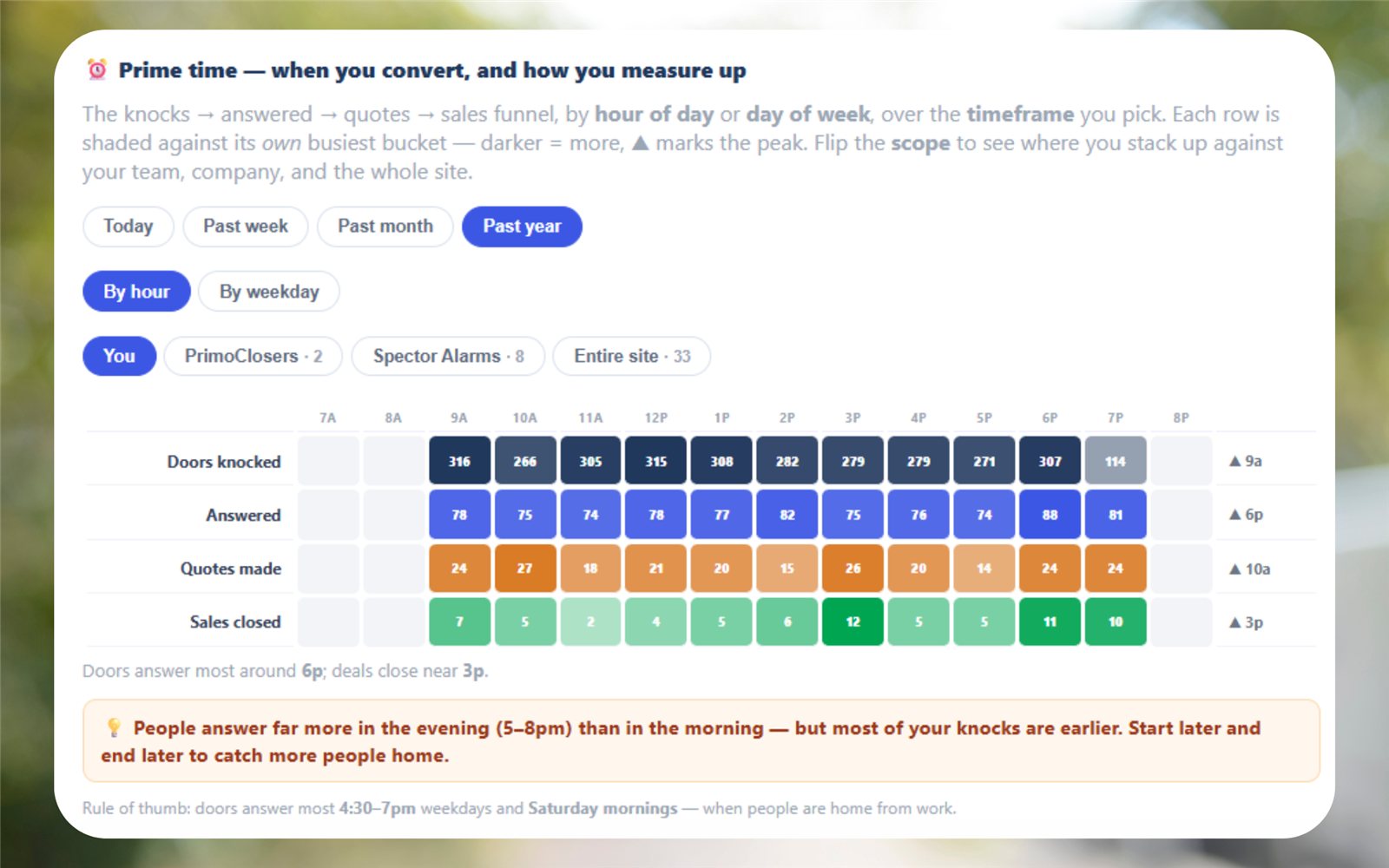
So your productive hours are narrower and later than other trades: weekday afternoons into the evening until light runs out, and Saturday from mid-morning through mid-afternoon. Midday weekdays are not wasted — retirees, shift workers and remote workers answer — but expect a higher share of one-leggers and treat those as go-backs rather than forcing a set. In November, when the clocks change, your evening window collapses by more than an hour in a single week; good crews shift to more Saturday coverage rather than pretending nothing happened.
Season is the other lever. The first honest cold night of autumn and the first heat wave of summer are the two days a year homeowners physically notice their windows, and they are worth planning around. Fall carries natural urgency because people want it finished before winter, and manufacturing lead times give you a real, non-manipulative reason to move: a custom order placed in November may not install until the new year. Winter knocking is unglamorous and works, because the draft is a daily experience. Spring is the busiest season and also the most crowded — expect to be the third quote.
Short version here; the full openers and objection branches live on the windows scripts page.
Lead with the specific thing on their house — the aluminum frames, the fogged upstairs pane. Competence in nine seconds beats charm in ninety.
Do you own? How long here? Are those the originals? Roughly how many openings? Everything after this depends on those answers.
You cannot know the number without sizes, count and install type. Say so plainly and give the honest shape of the project instead of a fake per-window figure.
Name the real length, name the both-owners requirement, and offer two times. You are selling an hour, not a window.
Set, one-legger, renter, not home, go-back in spring. The pin is what makes tomorrow's work possible; memory is not.
Set counts are the most inflated number in this trade. A set that no-shows costs a closer an entire evening and costs you the sat bonus, so the only set worth writing is one that holds. Five things make the difference, and none of them are clever.
The note you leave on the lead is the difference between a closer walking in cold and walking in prepared. Most canvassers write "nice couple, wants windows." Write this instead:
Six lines. It takes ninety seconds standing on the sidewalk and it visibly raises close rates, which on nearly every comp plan raises your own issued spiff too.
New canvassers think the job is fresh doors. Experienced ones know most of their production eventually comes from doors they already knocked. There are four lists, and in windows they are unusually valuable because the buying decision is slow and expensive.
All four of those require the same thing: every door remembering its own status and coming back around at the right time. That is the entire reason a windows canvasser needs a map with dispositions rather than a notebook.
Windows and doors is home improvement, and home improvement is regulated more tightly than most door trades. Before a crew works a new municipality, somebody needs to have checked: whether a solicitation permit is required and must be carried, whether the city keeps a no-knock registry, what the permitted hours are, whether the state or county licenses home improvement contractors, whether pre-1978 homes in your work trigger the EPA lead-safe renovation rule, and how your dealer delivers the three-business-day notice of cancellation on an in-home sale. None of this is exciting and all of it is cheaper to learn before the complaint than after.
Most canvassers track one number — sets — which is exactly the number that lies. Track the whole chain and you can see which part of your day is actually broken: a low contact rate is a timing problem, a low set rate is a script problem, and a low sat rate is a confirmation problem. They have completely different fixes.
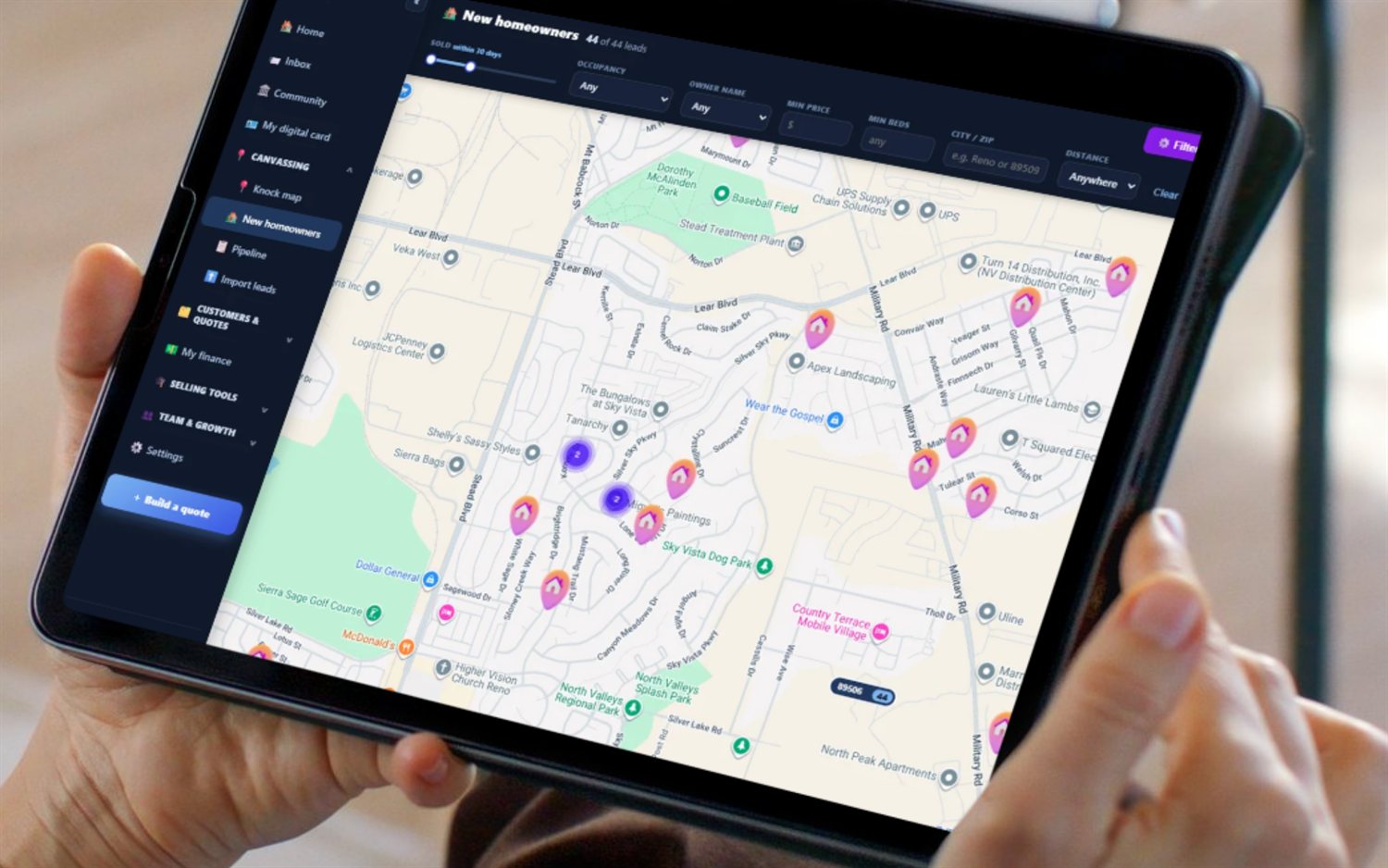
There is one lead in this trade that beats a cold street: a homeowner who closed a few months ago on an older house. They have a list on the fridge, they have already been told by an inspector what the windows are, and they have not yet been knocked by everybody. FieldStacker pulls just-sold homes onto the same map as your territory so you can run them before the rest of the market notices.
Openers, the four qualifiers, and every objection in the words homeowners use.
What a set, a sat and a sold job are each worth — and what gets clawed back.
Roofing, solar, pest, fiber and alarms share the same map and the same money tracking.
Age of housing stock beats everything else. The sweet spot is a tract built roughly between the 1960s and the late 1990s, where the original aluminum frames or the first generation of builder-grade vinyl are still in the openings — that is where you find fogged panes, failed seals, sashes painted shut and sills that have gone soft. Owner-occupied matters just as much, because renters cannot buy. Skip new subdivisions where the builder windows are still under warranty and the owners are tapped out, skip blocks where every house already has uniform new white vinyl, and be careful in historic districts and strict HOAs where exterior changes need approval.
Windows sells all twelve months, but the reasons change. The first genuine cold snap of the fall and the first heat wave of the summer are the two moments homeowners actually feel the product, and both produce a noticeable lift at the door. Autumn carries real urgency because people want it handled before winter. Winter is better than most reps expect in cold markets — people are living with the draft daily — though installs and manufacturing slow, and dealers often run promotions to keep crews busy. Spring is the busiest and the most competitive; you will be the third company that homeowner has talked to.
Later than most trades, because you need both owners at home. Weekday evenings from around 4:30 until dark and Saturday late morning through mid-afternoon produce the highest rate of two-owner conversations, which is the only kind that turns into a demo that holds. Midday weekday knocking is still worth doing for retirees and anyone working from home, but expect more one-leggers. Watch the daylight saving cliff in early November — the productive evening window shortens by more than an hour almost overnight, and crews that do not re-plan their hours lose a week to it.
It varies enough that any single figure is close to useless, but the shape is worth knowing: on a well-chosen street you might make contact at roughly a quarter to a third of doors, and canvassers commonly talk about somewhere in the range of sixty to a hundred doors per qualified, confirmed appointment. The reason the number swings so hard is qualification — a street of original aluminum windows and long-tenure owners can be several times more productive than a street picked at random. Track your own doors-to-set ratio per territory rather than trusting anyone else's.
Very likely something, and it is on you to check. Many cities and towns require a solicitation or peddler permit that you must carry and sometimes display; many maintain no-knock registries or honor posted signs, and ignoring those is how a crew gets a street shut down. Separately, home improvement contracting is licensed in a lot of states and some counties, work on homes built before 1978 falls under the EPA lead-safe renovation rule, and an in-home sale carries a three-business-day right of cancellation the customer must be given in writing. Ask your dealer to show you which of these apply to the territory you are working.
Less than people think. A cutaway corner sample of the window you sell and a small glass sample are worth carrying because they turn an abstract product into something a homeowner can hold. A door hanger or card with a QR code covers the not-homes, which will be most of your doors. Everything else is your phone: the map with your territory drawn on it, dispositions for every door, notes for the closer, and your route. Leave the tape measure alone — measuring is the closer or the technician's job, and pretending to measure at the door is how a rep quotes a number that blows up at the kitchen table.
Trace the old tract, load the doors, and knock it tomorrow evening. Start a 14-day free trial — no credit card, flat month-to-month, cancel anytime.