1099 taxes · rep money

1099 taxes for door-to-door reps, in plain English

You are not an employee — you are a business. Here is what that actually means for your taxes: self-employment tax, quarterly payments, the mileage deduction, and the write-offs most first-year reps miss. No jargon, no fear.

Flat month-to-month from $25/mo · 30-day free trial · no seat minimums, no annual contract

Not tax advice. This is a plain-English primer for 1099 reps, not personalized guidance. Tax law changes, the numbers depend on your situation, and everyone\'s return is different — talk to a CPA or tax pro before you file. FieldStacker tracks the rep-money inputs a return needs; it does not replace an accountant.

Most door-to-door reps get a 1099-NEC, not a W-2. That one form quietly changes everything about your taxes. No one is withholding money from your commission checks, no employer is covering half your Social Security, and the IRS expects you to figure out — and pay — your own tax bill four times a year. Handle it well and you keep more of what you earn. Ignore it and April becomes a five-figure gut punch with penalties on top. This guide walks the whole thing, start to finish.

W-2 vs. 1099: why the tax picture flips

A W-2 employee has taxes pulled from every paycheck and their employer pays half of Social Security and Medicare. A 1099 contractor gets the full commission with nothing withheld — which feels great until you realize none of that money was ever fully yours. You are responsible for federal income tax, any state income tax, and the entire 15.3% self-employment tax that a W-2 job would have split with you. The gross on your check is not your take-home. Treating it like it is, is the mistake.

Self-employment tax: the 15.3% surprise

Self-employment tax is Social Security (12.4%) and Medicare (2.9%) rolled together — 15.3% on your net profit. As a 1099 rep you pay both the employee and employer halves. The one bit of good news: you get to deduct half of it against your income tax, and it is calculated on your net profit, so every legitimate deduction you claim also shrinks this bill. That is why mileage and write-offs are not just income-tax savings — they cut your self-employment tax too.

Quarterly estimated taxes: pay as you go

The US tax system is pay-as-you-go. Because nobody withholds from your commissions, the IRS wants you to send estimated payments four times a year — roughly mid-April, mid-June, mid-September, and mid-January of the following year. If you expect to owe about $1,000 or more, these are effectively mandatory, and skipping them triggers an underpayment penalty even if you pay everything by the final deadline. The fix is boring and it works: set aside a percentage of every deal as you close it, then pay each quarter from money that is already sitting there.

The four dates matter more than the math. Most reps do not get in trouble for calculating wrong — a CPA fixes that at year-end. They get in trouble for spending money that was never theirs and having nothing set aside when a quarterly payment comes due.

The mileage deduction: usually your biggest one

You drive between neighborhoods all day, and the IRS standard mileage rate turns those miles into a deduction that covers gas, insurance, wear and depreciation in one per-mile figure that updates each year. For a canvasser, business miles are frequently the single largest line on the return. But the deduction lives or dies on your log: the IRS wants a contemporaneous record — date, miles, and business purpose for each trip. Reconstructing a whole year from memory in April is both miserable and shaky if you are ever asked to prove it. Automatic tracking as you drive solves this cleanly.

The write-offs reps forget

Beyond mileage, ordinary and necessary business expenses lower your taxable profit:

🚗

Vehicle

Standard mileage rate or actual costs (gas, repairs, insurance, depreciation) — pick one method per vehicle. Business miles only; your commute and personal trips do not count.

📱

Phone & data

The business-use share of your cell phone, plan and data. If you use it 70% for knocking and CRM, roughly 70% is deductible.

💻

Software

Your CRM, lead tools, and other subscriptions you use to sell — including FieldStacker itself — are deductible business expenses.

🏠

Home office

A space used regularly and exclusively for your business can qualify for a home-office deduction. Strict rules apply — ask your CPA.

🧰

Demo gear & supplies

Sample equipment, demo units, signage, business cards and other tools of the trade you buy to sell.

🍔

Business meals

Meals with a genuine business purpose are partially deductible. Keep the receipt and note who and why.

Two rules make all of this stick: keep receipts, and keep a log. A deduction is only worth what you can back up. And remember chargebacks — when a deal cancels and the company claws back your commission, that reduces the income you were taxed on, so it has to be tracked too, not just celebrated when it lands.
Your year, in four moves

You do not need to be an accountant. You need a simple system you run all year.

1

Set aside from every deal

The moment a commission lands, park a fixed percentage — many reps use 25-30% — for taxes. Treat it as money that was never yours.

2

Log every mile and expense

Track business miles as you drive and hold onto receipts. Your mileage log is likely your biggest deduction, so protect it.

3

Pay the four quarters

Send estimated payments in April, June, September and January from the money you set aside. No scramble, no penalty.

4

True it up with a CPA

At year-end, hand a pro clean numbers. They catch deductions you missed and make sure the final filing is right.

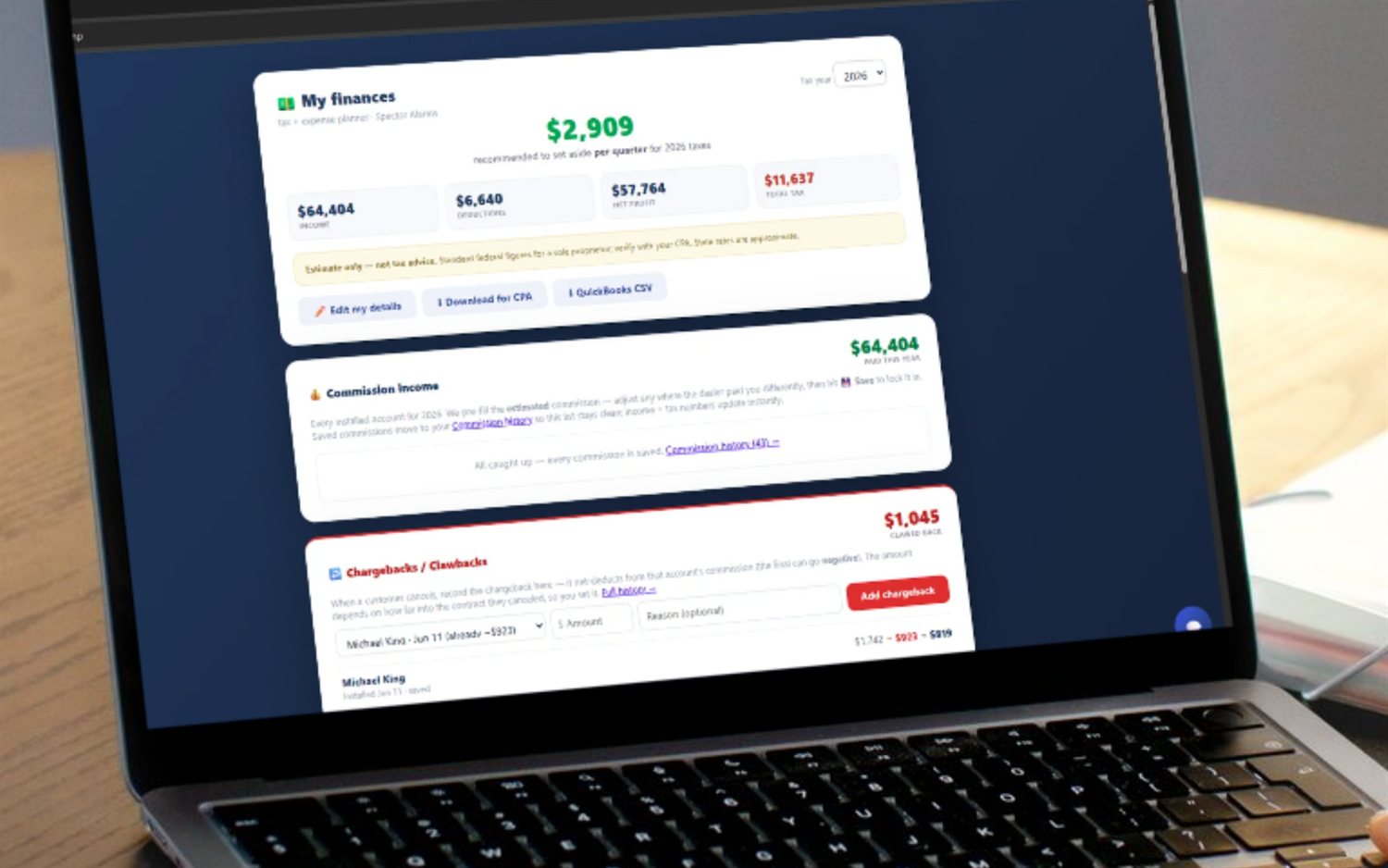
FieldStacker 1099 financials showing real per-deal commission, chargebacks and clawbacks, and a quarterly tax set-aside
Where FieldStacker fits

The shoebox that organizes itself

Most canvassing apps stop at the map and hand your money back to a spreadsheet. FieldStacker keeps the rep-money inputs your return needs in the same app you already knock with:

  • Real per-deal commission with your own rates
  • Chargebacks and clawbacks that net against your total, so your taxable income is honest
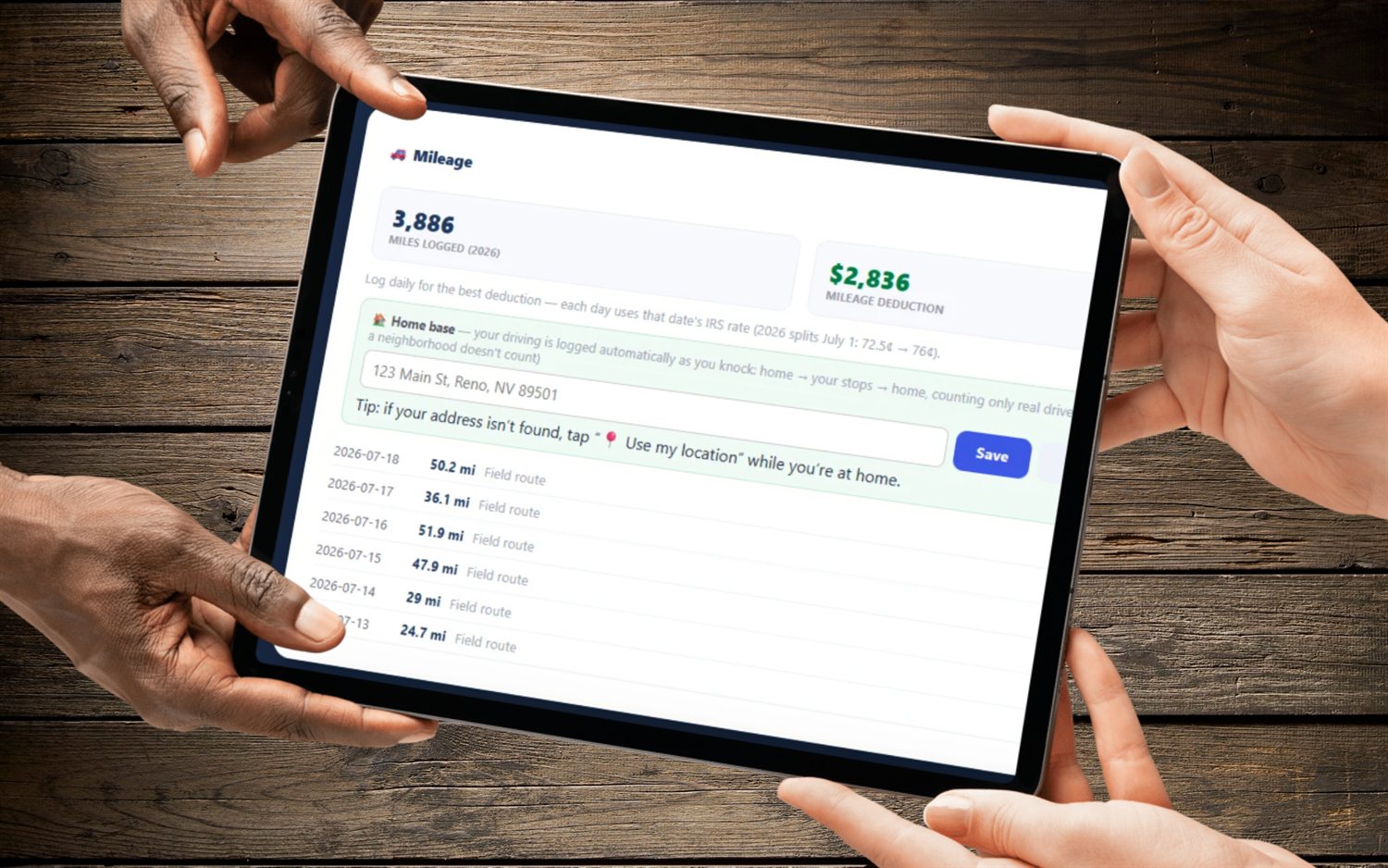
  • Auto-mileage at the IRS rate for every driving day — no manual log to rebuild in April
  • A quarterly tax set-aside that sweeps a percentage you choose off each deal
  • Clean numbers to hand your CPA or drop into tax software

See every feature →   See flat pricing →

Keep reading

More for the 1099 rep

Taxes get a lot easier when the income side is strong. If you are early in the game or trying to fill your pipeline, start here:

Selling alarms? The alarm-native edition is SecurityQS, on the same backend.

FieldStacker automatic mileage tracking logging business driving at the IRS standard rate for the tax deduction

Questions reps ask

Do door-to-door sales reps have to pay self-employment tax?

If you get a 1099-NEC instead of a W-2, yes. You are self-employed in the eyes of the IRS, which means you owe the 15.3% self-employment tax (Social Security and Medicare, both halves) on your net profit, on top of regular federal and any state income tax. A W-2 employee splits that 15.3% with an employer; a 1099 rep pays all of it. That is the single biggest tax surprise first-year reps hit, and it is exactly why setting money aside from every deal matters.

How much should a 1099 rep set aside for taxes?

A common rule of thumb is 25-30% of your net commission income, but the right number depends on your bracket, your state, and your deductions. Reps in a no-income-tax state with heavy mileage deductions sometimes land lower; high earners in a high-tax state can owe more. The safe move is to set aside on the high end as you go and true it up with a CPA at quarter-end. FieldStacker's quarterly tax set-aside sweeps a percentage you choose off each logged deal so the money is already parked when the bill comes.

What is the mileage deduction and how does it work for canvassers?

The IRS lets self-employed reps deduct business driving using the standard mileage rate — a set number of cents per mile that changes each year — which covers gas, wear, insurance and depreciation in one figure. For a D2D rep who drives between neighborhoods all day, this is usually the biggest single deduction on the return. The catch is you must have a contemporaneous log: date, miles, and business purpose for each trip. FieldStacker captures driving automatically at the current IRS rate so you are not reconstructing a year of routes from memory in April.

Do I have to pay taxes quarterly as a 1099 rep?

Usually, yes. The US tax system is pay-as-you-go, and if you expect to owe roughly $1,000 or more for the year, the IRS wants estimated payments four times a year (generally mid-April, mid-June, mid-September, and mid-January). Skip them and you can owe an underpayment penalty even if you pay in full by the deadline. Missing a quarterly payment is the most common avoidable mistake new reps make — mark the four dates and pay from money you already set aside.

What can a door-to-door sales rep write off?

Ordinary and necessary business expenses: business mileage or actual vehicle costs, the business-use share of your phone and data, your CRM and other software subscriptions, a home-office deduction if you have a dedicated space, sample equipment and demo gear, business meals (partially), and fees like this app. You cannot deduct commuting to a fixed office or personal miles. Keep receipts and a clean log — the deduction is only as good as your records if you are ever asked to back it up.

Is FieldStacker tax software?

No. FieldStacker is a canvassing CRM that happens to track the rep-money inputs a tax return needs — real per-deal commission, chargebacks, auto-mileage at the IRS rate, and a running tax set-aside. It gives you clean numbers to hand your CPA or drop into tax software; it does not file your return or replace professional advice. Think of it as the shoebox that organizes itself all year instead of the accountant who signs the form.

Stop guessing at your own money

Track commission, chargebacks, mileage and a quarterly tax set-aside from the same app you knock with. Start a 30-day free trial — no credit card.