Guide · lead sourcing

How to find new-homeowner leads — and knock them first

Recently-moved households are the warmest doors in door-to-door. Here is where new-homeowner data actually comes from, how fast you have to move, and how to get those addresses onto a map you can work before your competition even knows they exist.

Flat month-to-month from $25/mo · 30-day free trial · no seat minimums, no annual contract

The short version: A brand-new homeowner is buying every service at once with no vendor loyalty — the warmest door you can knock. The data is public (county deed transfers and recently-sold home records), the window is short (first 30–60 days), and the whole edge is timing. Get the freshest sold homes onto a map, sort by move date, and be first on the step. FieldStacker's New Homeowners map does exactly that for every industry you sell.

Ask any veteran D2D rep where the easy money is and most will say the same thing: new movers. Not because they are pushovers, but because a household that just relocated is in the rarest state a salesperson ever gets to catch — actively saying yes. They need internet, they need the place treated for bugs, they are wondering about the roof and the old panel by the garage, and nobody has locked them into a contract yet. Your job is not to create demand; it is to show up during the two-month window when the demand is already there. This guide walks through why that window is so valuable, where the lead data comes from, and how to turn a stack of addresses into a route you can knock this afternoon.

Why new homeowners are the warmest door in the business

A typical cold door is someone comfortable. They already have a security system, a pest company, an internet provider — and to sell them you first have to make them unhappy with what they have. A new mover is the opposite. Everything about their service life just reset to zero, and they are motivated to fill those blanks quickly so the house feels settled. That means:

  • No incumbent to displace. There is no "we're already with someone" because they are not with anyone yet.
  • A concentrated spending window. New homeowners make a burst of purchases in the first weeks — services, upgrades, repairs — that they will not repeat for years.
  • You set the anchor. Be the first roofer, alarm rep or fiber salesperson at the door and you frame the price and the relationship before any competitor does.
  • Genuine goodwill. People are excited about a new home and more open to a friendly neighbor-style knock than they are on a random Tuesday.

The catch is that this advantage decays fast, which is why finding movers early beats knocking more doors overall. One fresh mover is worth a block of settled houses.
Where new-homeowner leads actually come from

Every source below is real. Most of it is public — the hard part is turning it into a knockable map, not finding it.

📜

County deed transfers

When a home sells, the county recorder logs the ownership change. It is public record and the most authoritative "someone new lives here" signal there is — but pulling and mapping it by hand is slow.

🏡

Recently-sold (MLS) data

Multiple-listing "sold" feeds surface the same transfer faster, with the exact address and sale date. This is the cleanest, fastest source of fresh owner-occupant leads for canvassing.

✉️

USPS change-of-address

The national change-of-address stream catches movers who rented rather than bought. It is broader than deeds but noisier, and access usually runs through a data vendor.

💡

New utility hookups

A fresh electric, water or internet connection at an address is a strong move-in tell. Availability varies by market and is rarely a clean self-serve feed.

🚚

Signs on the street

The free version: moving trucks, a "Sold" rider on a yard sign, boxes at the curb, a dumpster in the driveway. Cheap, immediate, and completely local to whatever block you are already on.

🗺️

A recently-sold map layer

The practical answer that folds several of the above together: recently-sold homes dropped straight onto your knock map as fresh-lead pins, sortable by how recently they closed.

The honest part: data is easy, mapping is the work

Here is what nobody selling you a "lead list" mentions. The recently-sold information is public and not that hard to obtain — you could sit at the county website and copy addresses for an hour. The reason most reps never do it is that a spreadsheet of 200 addresses is useless on a doorstep. You cannot see which ones cluster on the same street, you cannot route them, you cannot tag the ones you already hit, and by next week half the list is stale and you have no idea which half. Raw data does not knock doors. A knock map does.

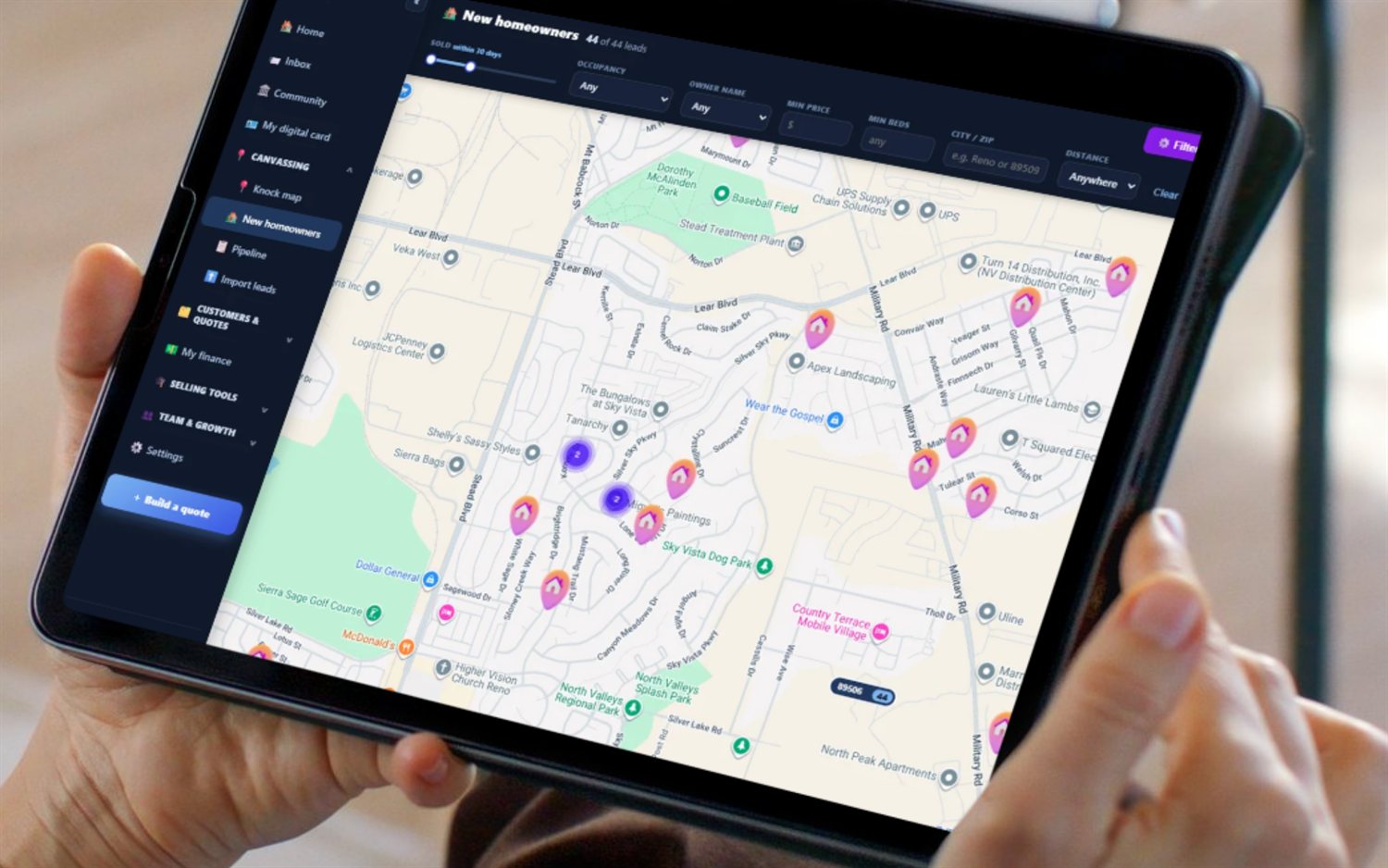
That gap is exactly the problem FieldStacker's New Homeowners map solves. It pulls recently-sold single-family homes onto your map as fresh-lead pins, so instead of a text file you get a picture of your territory with the newest movers highlighted. You sort by move date, route the freshest cluster, and start knocking — no data-entry, no list broker, no per-lead fee. And because every pin lives on the same map as your dispositions and team GPS, a mover you knock today becomes a tagged, tracked lead automatically.

The New Homeowners map

Recently-sold homes, dropped straight onto your knock map

Skip the spreadsheet. FieldStacker surfaces recently-sold homes in your area as fresh-lead pins you can filter, route and knock — the same map your dispositions, territories and team GPS already live on. One lead layer, every industry you sell.

  • Recently-sold single-family homes as fresh-lead pins
  • Sort and filter by how recently a home closed
  • Route the freshest cluster and knock it first
  • Tag each door as you go — sold, callback, not-home
  • Works for alarms, fiber, pest, solar, roofing and more from one login

See the knock map →

FieldStacker New Homeowners map showing recently-sold homes as fresh-lead pins with filters across a neighborhood

Timing: the whole advantage is being early

New-mover prospecting lives and dies on speed. The window where a household is actively choosing new vendors is widest in roughly the first month or two, then narrows as they settle and lock in providers. Every week you wait, another rep from another company gets to the door, and the goodwill of "welcome to the neighborhood" fades into "another salesperson." Build the discipline of working your freshest sold homes first, every single week, rather than grinding old lists. A home that closed eight days ago and a home that closed eight months ago are not the same lead, even on the same street.

Work the mover, don't just knock the address

Being first is worth nothing if the pitch says "hi, do you have a minute?" Use what you know. "Hey, I saw you just moved into the place on Oak — welcome. I'm working with a few of your new neighbors on getting their internet set up" is a completely different door than a cold opener, because it is true, it is relevant, and it lands during the exact week they are thinking about it. For openers you can adapt to a new-homeowner angle, see our door-knocking tips. And because movers buy several services at once, a rep running multiple industries can genuinely offer more than one thing at the same welcoming door.

From data to knocked door, in one flow

How a new-mover lead actually becomes a tracked deal.

1

Pull fresh movers

Open the New Homeowners map and let recently-sold homes drop onto your territory as pins. Sort by move date so the newest are on top.

2

Route the freshest cluster

Pick the tightest group of recent closings, plan the shortest loop, and start the block with a plan instead of a random street.

3

Knock with the mover angle

Lead with "welcome to the neighborhood," offer what a new home needs, and disposition every door with one tap as you go.

4

Track it to paid

Set go-backs on the maybes, watch commission and mileage update as deals close, and never re-knock a mover you already worked.

Where a new-mover map fits your whole lead strategy

Fresh movers are the best doors, but they are not the only doors, and a smart rep blends them with dispositioned callbacks, referrals and plain territory-clearing so there is always something to knock. The point of putting movers on the same map as everything else is that you stop switching tools: one screen shows your recently-sold pins, your tagged streets and your team's live positions, and you decide each day whether to hunt fresh movers or work a warm list. If you are still choosing an app to run all of this, our roundup of the best door-to-door sales apps compares the options, and this same New Homeowners layer is one of the reasons reps pick FieldStacker. See the full toolkit on our features page or browse the industries it covers — fiber and pest control especially thrive on fresh movers.

Selling alarms specifically? The alarm-native edition of this platform, SecurityQS, runs on the same backend with the same new-homeowner map — so a security team gets everything here plus doorstep alarm quoting.

Questions reps ask

Why do new-homeowner leads convert better than random doors?

A person who just moved is actively rebuilding their whole life of services — internet, pest control, a security system, lawn care, a roofer they can trust. They have no incumbent loyalty to fight against and a short, urgent window where they are saying yes to a dozen new vendors at once. Knock a random street and you are interrupting someone comfortable with what they already have; knock a new mover and you are answering a need they were about to Google anyway. Same effort, far warmer door.

Where does new-homeowner data actually come from?

The reliable public trail is the property record. When a home sells, the county recorder logs a deed transfer, and that recently-sold event is the single best signal that someone new is about to move in. Multiple-listing (MLS) "recently sold" feeds surface the same event faster and with the address, and USPS change-of-address and utility hookups add movers who rented rather than bought. You can pull county records by hand for free, but stitching them into a knockable map street by street is the slow part — which is exactly what FieldStacker automates.

How soon after a move should I knock?

Fast. The decision window for new services is widest in roughly the first 30 to 60 days and closes as the household settles and locks in vendors. If you show up in week two you are often the first person offering, which means you set the anchor price and the relationship. Show up in month six and someone already sold them the alarm, the pest plan and the fiber. The whole advantage of new-mover prospecting is timing, so build a habit of working the freshest sold homes at the top of your list every week.

Do I need to buy an expensive lead list to do this?

No. The core data is public property records, and FieldStacker pulls recently-sold homes straight onto your map as fresh-lead pins — no separate list broker, no per-lead upcharge, included in a flat month-to-month plan starting at $25/mo. Paid consumer-data enrichment (phone, email, demographics) exists in the market and is genuinely expensive, but you do not need it to knock. An address and a move date is enough to be first on the doorstep, which is where the money is.

Which industries benefit most from new-homeowner leads?

All of the D2D verticals, which is the point of a multi-industry app. Alarms and fiber win because a new home has no system and no provider yet. Pest control wins because a new owner wants the place treated before they unpack. Solar, roofing, lawn care and home services all catch the wave of "we just bought, let us get everything set up." Turn on the industries you sell in one FieldStacker account and work the same new-mover map for every one of them from a single login.

Put the newest movers in your area on a map

Start a 30-day free trial — no credit card — and knock your first block of fresh new-homeowner leads this afternoon. Flat month-to-month, cancel anytime.