Windows & doors · income

How much do windows and doors sales reps really make?

Honest ranges instead of a recruiter's best month. What setters, first-year closers and veterans typically earn, the four numbers that decide which one you become, and what 1099 takes back out.

Every figure below is a typical range or illustrative arithmetic — not a survey, not a promise, and not an offer.

The short version: windows income is a product of four multipliers — demos run × close rate × average ticket × effective commission rate, minus cancellations. Setters commonly land in the mid-thirties to around sixty thousand; first-year closers in the forties to seventies; established closers frequently six figures; a small top group well beyond that. The first quarter is thin for almost everyone because of the pay lag, and a 1099 gross is not a W-2 gross.

Read any income claim in this trade carefully

Windows recruiting ads are famous for large numbers, and the numbers are not usually fabricated — they are just selected. Three things quietly inflate them. Company averages are pulled hard by a small group of veterans with self-generated leads. Published figures often count only reps who lasted a year, which excludes most of the people who tried. And "written" volume is not "paid" volume, because rescissions, credit fallout and post-sale discounts come off the top after the whiteboard picture is taken.

So do not ask what your top guy made. Ask what the median rep who started twelve months ago has been paid, and ask what the company's cancellation rate is. A dealer that knows both numbers and will say them out loud is telling you something useful about how it runs.

RoleTypical rangeWhat it depends on
Canvasser / appointment setterRoughly mid-$30k to $60k full-time; strong setters higherHourly or per-door base plus set, sat and issued bonuses. The sat and issued components are where the real money is — set-only pay caps you fast.
In-home closer, year oneRoughly $40k to $70k, after cancellationsRamp time in a two-hour presentation, a lower early close rate, and the pay lag. Attrition in the first six months is high across the trade.
Established closerFrequently six figures at a healthy dealerSteady appointment supply, a close rate in the high twenties or better, and the discipline not to discount.
Top closer, premium brand or heavy self-genWell into the $200k range; genuinely rareLarge average tickets, a high self-generated mix at the better commission rate, and very little discounting.
Sales managerBase or draw plus an override on team issued volumeCrew size and retention. A bad cancellation month hits personal production and the override at once.

Typical patterns reported across the trade; varies widely by market, brand tier, lead source and comp plan. Treat as orientation, not a benchmark.

The arithmetic that actually produces the number

Ignore job titles and run the math. Four inputs and one subtraction decide what a windows closer earns, and they are the same four everywhere.

  1. Demos run per week. Often the binding constraint, because it is set by how many appointments the office issues plus how many you generate yourself. Six is a slow week, eight to ten is a working week, more than that usually means self-generating.
  2. Close rate on demos sat. A new rep may sit in the teens or low twenties. Experienced closers commonly run in the high twenties to mid thirties on qualified, both-owners-home appointments. One-leggers wreck this number, which is why the set quality matters so much.
  3. Average ticket. Whole-house projects and premium product lines are multiples of a three-window job. This is the input most reps can least control and most underestimate when comparing offers between companies.
  4. Effective commission rate. Not your headline rate — your rate after the discount slide, after the financing dealer fee, and blended across company and self-generated leads.
  5. Minus cancellations. Rescissions and credit fallout are the subtraction. A company with a high cancel rate is quietly paying you less than its comp plan says.
Illustrative scenarioDemos / wkClose rateAvg ticketEffective rateCancelsRough annual
Building622%$11,0008%15%≈ $43,000
Solid827%$13,5009%12%≈ $106,000
Top of the trade1032%$17,00010%10%≈ $225,000

Illustrative arithmetic over roughly 44 to 46 selling weeks — not survey data and not a projection of your results. The point is the shape: none of these inputs is extreme, and the top row is five times the first.

Look at what moved between rows. Nothing heroic — four more demos, ten points of close rate, a bigger average job and two points of effective rate. That is why two reps at the same company with the same product can be five times apart, and why the honest advice for a new windows rep is boring: get more qualified sits, stop discounting, and stop losing deals in the three days after the signature.

The part the offer letter skips

A 1099 gross is not a W-2 gross

If you are a 1099 contractor, the number in the recruiting ad is revenue, not income. Before you compare it to a salary, take out the pieces an employer would normally carry:

  • Self-employment tax at 15.3% on net profit — both halves of Social Security and Medicare, not just yours
  • Quarterly estimated payments, not one April bill; miss them and penalties apply even if you pay in full later
  • Health coverage, retirement and any time off, all funded by you
  • Vehicle, fuel and the wear of running demos across a metro all year
  • Phone, data, sample case, glass and corner-cut samples, and your own software
  • Chargeback exposure — a bad cancellation month can pull a paycheck negative on some plans

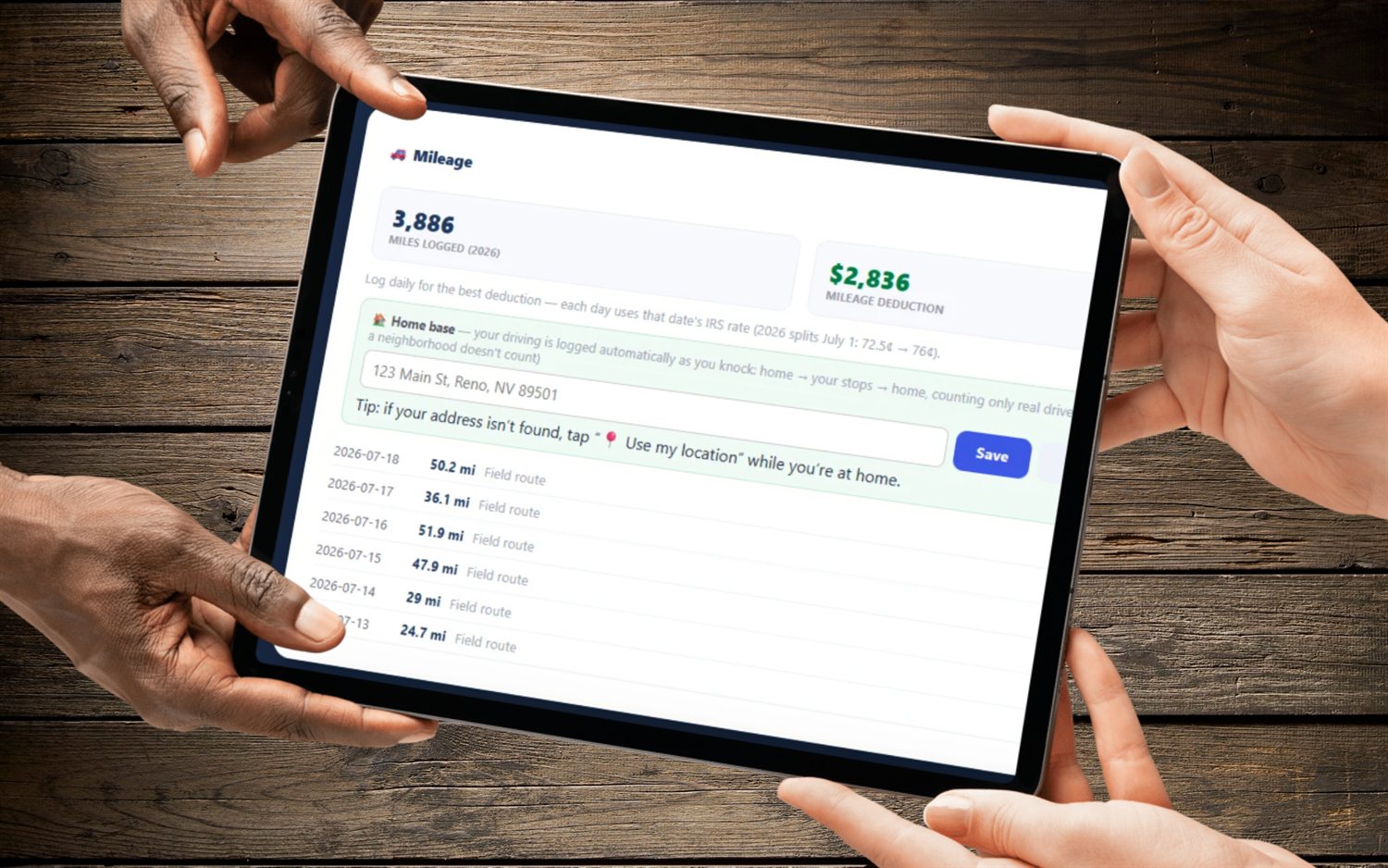
The offsetting good news is that business mileage is usually a windows rep's biggest deduction, and in this trade it is a genuinely large one. It only counts with a real log.

The 1099 tax guide →

FieldStacker automatic mileage capture at the IRS rate — a windows rep's drives between demos logged for the year

Five questions that predict your income better than the comp plan

Ask these at the interview. The answers move the multipliers above.

📅

How many appointments will I actually get?

The comp plan is irrelevant if the office issues five demos a week. Ask for the current per-rep issue rate, not the plan for next quarter.

🔁

What is your cancellation rate?

Rescission and credit fallout come straight off your paycheck. A dealer that does not track this number is telling on itself.

🎯

What is the average sold job here?

Average ticket is the multiplier you inherit from the company's product line and market, and you cannot out-work it.

🏠

What do you pay on self-generated leads?

Nearly every plan pays more for a lead you knocked. If the gap is big, canvassing is not extra work — it is a raise.

How long until my first real check?

Between rescission, credit approval, final measure and manufacturing lead time, the honest answer is often six to ten weeks. Budget for it.

🚗

Who pays for the driving?

On a 1099 plan, you do. That is fine — but it needs to be priced into the offer, and logged all year for the deduction.

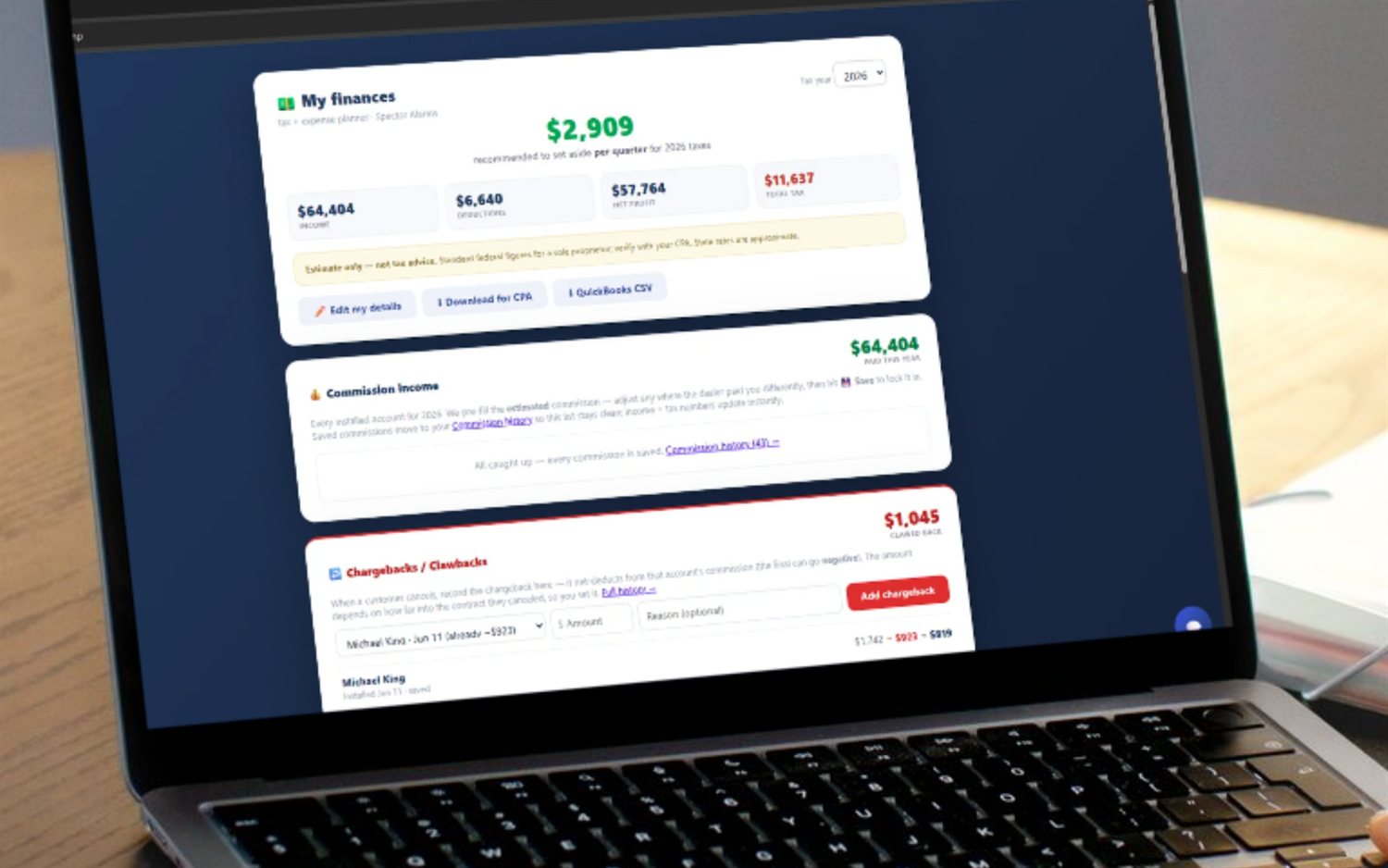
FieldStacker financials showing net windows commission after a chargeback, with mileage and a quarterly tax set-aside
Know your own number

Stop guessing what you actually earned

Most windows reps could not tell you their real close rate, their true average ticket or what a year of cancellations cost them — which means they cannot tell whether a new offer is better than the one they have. FieldStacker keeps the ledger while you work:

  • Per-deal commission on your own splits, tiers and self-gen rates
  • Chargebacks and clawbacks netted against the total, so the number is the paid one
  • Automatic mileage at the IRS rate for every day of demos
  • A quarterly 1099 tax set-aside building in the background
  • Your own stats — knocks, sets, sits and sales — instead of the office whiteboard

See the windows CRM →   Flat pricing →

Keep reading for this trade

💰

Windows sales commission

Percent of sale vs margin over base, the discount slide, and every clawback.

See pay structures →

🚪

How to sell windows door to door

Where to knock, when to knock, and how to set a sit that holds.

Read the guide →

🗣️

Windows sales scripts

Openers and the real objection branches at a windows door.

Read the scripts →

🧭

All industries

Windows, roofing, solar, pest, fiber and alarms on one login.

Explore industries → · knock map →

Windows income questions, answered straight

How much do windows and doors sales reps make?

The spread is enormous, so any single number is misleading. As a rough shape of the trade: canvassers and appointment setters commonly land somewhere in the mid-thirties to around sixty thousand a year full-time, with strong setters above that; first-year in-home closers frequently finish somewhere in the forties to seventies once cancellations are netted out; established closers at a healthy dealer often run six figures; and a small group at premium brands with self-generated leads goes well past two hundred thousand. Those are typical patterns reported across the trade and they vary hugely by market, brand, ticket size and whether the company hands you appointments. Ask any specific employer for their median, not their top performer.

Why is the income range for windows reps so wide?

Because four multipliers stack on top of each other. How many demos you get to run in a week, what percentage of them you close, the average ticket in your market and product line, and your effective commission rate after discounting. Move each one modestly and the annual number doubles. A rep running six appointments a week at an eleven-thousand-dollar average and a low-twenties close rate is in a completely different business than a rep running ten at eighteen thousand with a low discount habit — same job title, same product, three times the income.

Do first-year windows sales reps make good money?

Usually not in the first four to six months, and new reps are consistently surprised by two things. First, the ramp: it takes weeks to get comfortable in a two-hour in-home presentation, and early demos close at a lower rate. Second, the lag: on most plans part of your commission does not release until rescission expires and credit approves, and the rest waits for final measure or completion, and custom units take weeks to manufacture. That means a January sale can still be partly unpaid in March. Anyone joining this trade should plan for a genuinely thin first quarter regardless of how well they sell.

Is windows sales W-2 or 1099?

Both exist. Several large national brands and the bigger regional dealers run W-2 sales forces with benefits, a base or draw and a lower commission rate. Many independent dealers run 1099 contractors with a higher rate and no benefits. The gross numbers are not comparable: a 1099 rep pays the full 15.3 percent self-employment tax on net profit, buys their own health coverage, funds their own retirement, and absorbs mileage, phone and sample costs. A 1099 offer generally needs to be materially higher than a W-2 offer to be the same money in hand.

How many miles do windows sales reps drive?

A lot, and it is one of the most under-appreciated costs and deductions in the job. A closer covering a metro area typically runs several appointments a day scattered across it, and canvassers add drive time between territories on top. Reps in this trade commonly report annual business mileage in the tens of thousands. For a 1099 rep that mileage is usually the single largest deduction on the return, but only with a contemporaneous log — date, miles, business purpose. Reconstructing a year of routes from memory in April is both painful and weak if it is ever questioned.

What separates the top windows earners from everyone else?

Rarely raw charisma. Almost always four habits: they generate a meaningful share of their own leads, which nearly every comp plan pays a higher rate on; they hold price, because on a discount slide the giveaway comes out of their own rate; they confirm appointments so their demo count is real rather than theoretical; and they work the follow-up list nobody else touches — the quoted-and-lost from last spring and the neighbors of every install. The last one is why a windows closer benefits from a knock map, not just a calendar.
Move the multipliers, not the wishful thinking

More qualified sits, fewer cancels, a self-gen mix that pays better. Start a 14-day free trial — no credit card, flat month-to-month.