Windows & doors · pay

Windows and doors sales commission, explained honestly

Percent of the sale, or a split of the margin above base. A discount slide that punishes the rep. Set-and-sat pay for canvassers. And a rescission window that can erase a five-figure deal three days after you wrote it.

Ranges below are typical patterns reported across the trade — every comp plan is different. Ask for yours in writing.

The short version: most windows comp plans are either a percentage of the contract or a split of the margin above a base price sheet, with a slide that cuts your rate every time you discount. Self-generated leads pay more than company leads. Canvassers get paid on sets, sats and issued jobs. Nothing is really yours until the three-business-day rescission expires, credit approves, and — on many plans — the job is installed and paid.

The two plans you will actually be offered

Percentage of contract. The simplest version: you write a $16,400 job, your rate applies to the contract price, and everyone can do the math in their head. Rates for a closer running company-provided leads commonly sit in the high single digits to low teens, and dealers usually pay a meaningfully higher rate — sometimes close to double — on a lead the rep generated themselves. It is easy to understand and easy to compare between companies, which is exactly why smaller dealers use it to recruit.

Margin above base. The version most established dealers run. The company publishes a base or book price for the job — its minimum acceptable number, covering product, install, overhead and target profit — and you keep a share of everything you sell above that. The share is often quoted somewhere in the 30 to 50 percent range. On this plan two reps selling identical houses can earn wildly different money, because the plan is not paying you for the job, it is paying you for the price.

Both of these are real, both are defensible, and neither is automatically better. The percentage plan gives you a predictable floor. The margin plan gives a strong closer far more upside and gives a weak one almost nothing. What matters is knowing which one you are on before you start discounting.

StructureHow it readsWhat it rewardsWhere it bites
Percent of contractA rate applied to the signed contract price, often lower on company leads and higher on self-generated ones.Volume. Sit more, write more.The company controls the price sheet, so raising your own income means selling more jobs, not better ones.
Margin over base price sheetYou keep a share of everything above the company's minimum price for that job.Holding price and selling value instead of number.One heavy discount can take a job from a good paycheck to near zero.
Discount slide / tiered rateLayered on top of either plan: your rate steps down at each discount level.Selling at book.The "just knock off ten percent" close is coming out of your pocket, not the company's.
Per-unit spiffA flat amount per window, with larger amounts for bays and bows, patio doors and entry doors.Whole-house jobs and door add-ons.Encourages unit count over ticket size if it is the only lever.
Setter: set / sat / issuedHourly or per-door base, plus a bonus per set, a larger one per appointment actually sat, and a spiff on issued jobs.Clean, qualified, confirmed appointments.Set-only pay produces one-leggers and renters; sat-weighted pay is the fix.
Manager overrideA small percentage of the team's issued volume on top of personal production.Recruiting, training and holding the price line across a crew.Usually paid on issued or installed, so a bad cancel month hits the manager twice.
Draw against commissionA weekly advance that is recovered out of future commission.Surviving the ramp and the manufacturing lag.A recoverable draw is a debt. A slow first quarter can put you in the hole.

The discount slide is the whole game

Ask any veteran windows closer what they wish they had understood in year one and a lot of them say the same thing: the price you agree to at the kitchen table is your paycheck, not the company's. On a margin plan, every dollar you hand back is a dollar off the number your split is calculated on. On a tiered plan it is worse than linear — crossing a discount threshold can drop your rate for the entire job, so a $600 concession to close can cost you multiples of that.

This is also why "manager approval" exists on so many windows deals. When a rep phones in for a lower price, the company is often not protecting its own margin — it is deciding how much of the rep's commission to spend. Knowing exactly where your tiers sit changes how you negotiate: sometimes the right move is to add a door or a patio slider rather than cut the price, because it raises the job without touching your rate.

Company leads versus self-generated

Nearly every dealer pays more on a self-generated lead, and the gap is usually large enough to change how you spend your week. The logic is simple — a marketed lead carries real acquisition cost, and a lead you knocked, referred or picked up at a home show does not. Some plans express this as a higher percentage, some as a flat self-gen bonus per job, some as both.

The practical consequence: a closer who can canvass is worth substantially more than one who can only run whatever the office hands them, and a closer who canvasses their own past customers and neighbors of current installs is compounding. That is the real reason a windows closer wants a knock map and not just a calendar.

The clawback list, in order of how often it happens

  1. Rescission. An in-home sale carries a federal three-business-day right to cancel, and the customer must be told about it in writing. Contracts die here every week — usually on day two, usually after a family member weighs in. Full reversal.
  2. Credit fallout. The homeowner planned to finance, the application does not approve, or the loan documents never get signed. The deal was never funded, so the commission unwinds.
  3. Post-rescission cancellation. Rarer, harder to enforce, and often settled by a partial refund — and that settlement frequently comes out of the writing rep.
  4. Discounts applied after the sale. Final measure finds a condition the quote missed, or a service issue gets resolved with a price credit. On most plans that reduction flows back through your commission.
  5. Measurement or spec errors. A wrong size, a missing tempered-glass requirement near a door or tub, an egress opening that does not meet code — the re-order has a real cost, and plenty of plans put part of it on whoever wrote it.
  6. Financing dealer fees. Not a clawback exactly, but the same effect: long zero-interest plans cost the dealer a percentage of the contract, and many plans deduct that fee before applying your rate. The longer the promotional term, the bigger the bite.
  7. Unpaid balance. Collections problems on the final payment can suspend or reverse the completion half of your commission.
  8. Draw recovery. Every unearned advance comes back out of the next good month.

Ten questions to ask before you sign a windows comp plan

  • Percentage of contract, or margin over base? Show me the base price sheet.
  • Where exactly are the discount tiers, and what does each one do to my rate?
  • What is the self-generated rate versus the company-lead rate?
  • Is the financing dealer fee deducted before my commission is calculated?
  • What percentage releases after rescission, and what releases at completion?
  • How long is your average manufacturing lead time right now?
  • What is your company-wide cancellation rate, and who eats a post-rescission cancel?
  • If final measure changes the order, whose commission absorbs it?
  • Is the draw recoverable, and over what period?
  • Am I 1099 or W-2, and who pays for mileage, samples and the sample case?

A company that answers all ten without flinching is a company worth working for. Hesitation on questions five, seven and nine is the tell.

The number you take home

Track the commission that survives the rescission window

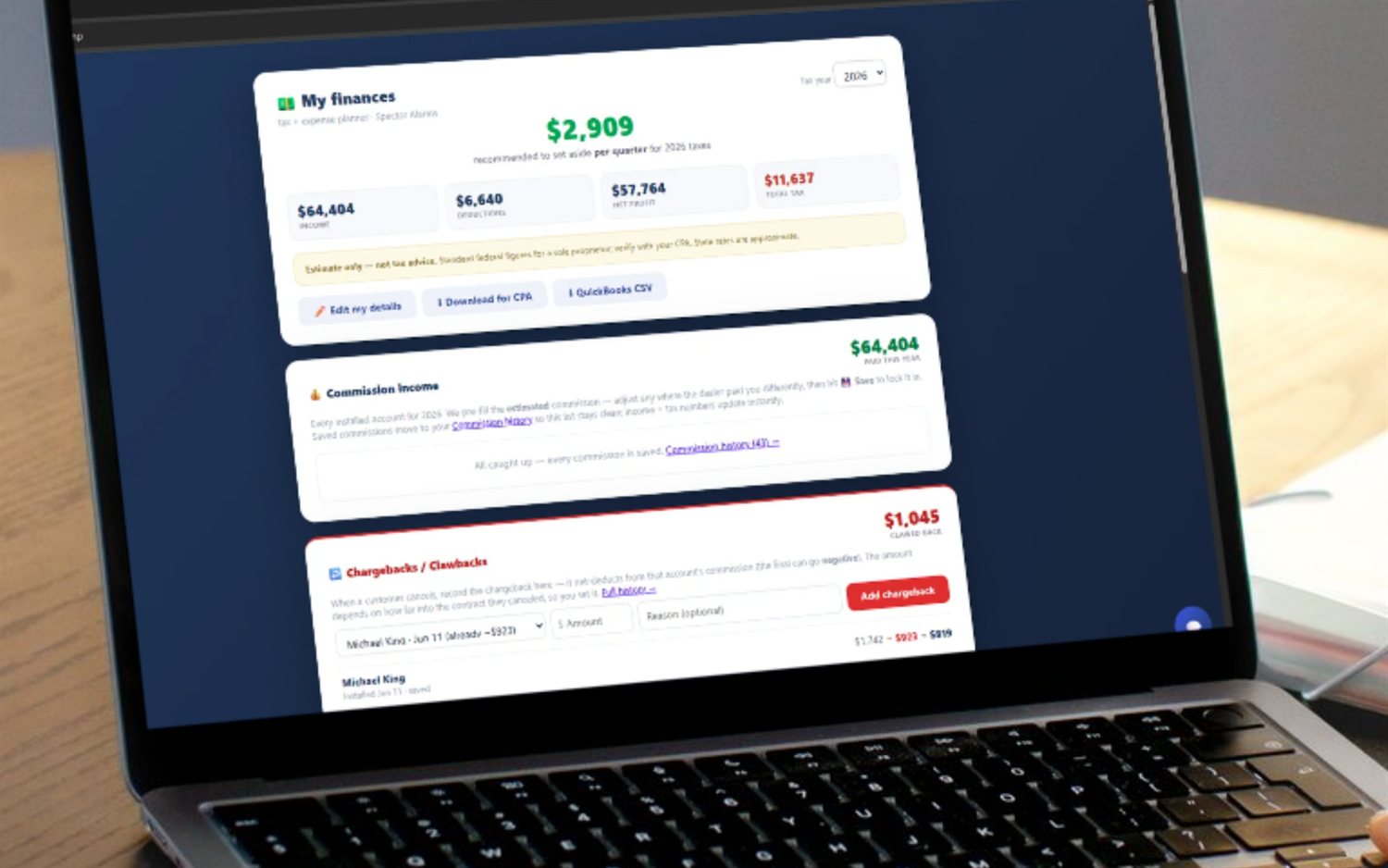
A whiteboard number is the number you wrote. Your real number is what is left after the cancel on Wednesday, the credit that did not approve, the discount you gave at final measure and the dealer fee on the 60-month plan. FieldStacker keeps the whole ledger in one app so you know what you actually earned before payroll tells you.

  • Per-deal commission on your own splits, tiers and self-gen rates
  • Chargebacks and clawbacks that net against your total — including a full reversal on a rescinded contract
  • Automatic mileage capture at the IRS rate for every day you drive demos
  • A quarterly 1099 tax set-aside that builds as the deals log
  • Team commission and payroll visibility for the sales manager running the crew
See flat pricing →   The windows CRM →

FieldStacker 1099 financials showing per-deal windows commission, a chargeback from a rescinded contract, and a quarterly tax set-aside

Where the money leaks before payroll ever sees it

Three habits that protect a windows commission more than any negotiation does.

1

Confirm the sit

The cheapest commission you will ever earn is the demo that actually happens. A confirmed appointment with both owners is worth more than two soft sets, and it costs one phone call.

2

Sell the price, not the discount

On a slide, adding a patio door raises the job without touching your rate — cutting $800 to close can cost you several times that. Know your tiers before you offer anything.

3

Work the days after the signature

Most rescissions happen on day two. A short, warm check-in call the next day — not a sales call — is the single highest-paid five minutes in this trade.

Keep reading for this trade

📊

What windows reps make

Setter, first-year and veteran ranges, and what drives the spread.

See the numbers →

🗣️

Windows door-to-door scripts

The openers and objection branches that produce sits that hold.

Read the scripts →

🚪

How to sell windows door to door

Territory, season, the set and the follow-up that pays.

Read the guide →

🧾

1099 taxes for D2D reps

Self-employment tax, quarterlies and the mileage deduction.

Read the tax guide →

Also: all industries · the knock map · flat pricing

Windows commission questions, answered straight

How does windows and doors sales commission usually work?

Two structures dominate the trade. The first is a straight percentage of the contract price, commonly somewhere in the high single digits to low teens for a rep working company-provided leads, with a higher rate when the rep generated the lead themselves. The second, and arguably more common at established dealers, is a share of the margin above a base price sheet: the company sets a minimum acceptable price for the job, and the rep keeps a meaningful slice — often quoted in the 30 to 50 percent range — of everything they sell above it. Both numbers vary heavily by market, brand and lead source, so treat them as the shape of the deal rather than a quote.

What is a sliding scale or discount slide in windows commission?

It is the mechanism that makes discounting expensive for the rep instead of the company. Your comp plan sets a full book price, and your commission rate steps down each time you discount below it — sell at book and you might be at the top tier, drop ten percent and your rate falls, drop twenty and it can fall off a cliff. On a margin-based plan the effect is even sharper, because a discount comes straight out of the margin you split. This is why experienced windows closers fight so hard over a few hundred dollars: on a slide, that money is not coming out of the job, it is coming out of them.

Is there any residual or RMR in windows sales?

No, and this is a real difference from alarms or solar. A replacement window sale is one and done — there is no monitoring contract, no power purchase agreement, no recurring revenue to build a book on. Whatever residual exists in this trade comes from referrals and from repeat phases of the same house, which is why the better dealers pay a referral spiff and why working your own past customers matters more here than in a subscription business. If someone pitches you a windows role by talking about residual income, ask exactly what recurring revenue it is paid on.

When do windows sales reps actually get paid?

Almost never on the day of the signature. The typical pattern is split: a portion releases after the three-business-day right of rescission expires and the deposit clears or the financing is approved, and the balance releases at completion — often after final measure confirms the order, sometimes not until the install is done and the final payment is collected. Pay cycles are usually weekly or semi-monthly. Because manufacturing lead times on custom units commonly run several weeks, the back half of a January sale can land in March, which is why new reps almost always underestimate how long the first real paycheck takes.

What gets clawed back from a windows commission?

More than in most trades. A cancellation inside the three-business-day rescission window reverses the whole thing. So does a post-rescission cancel before the order is placed, and financing that falls out when credit is not approved or the customer never signs the loan documents. Beyond cancellations, watch for measurement errors that force a re-ordered unit, discounts given later at final measure or to settle a service complaint, unpaid balances that go to collections, and recovery of a draw you have not earned out. Many plans also net the lender dealer fee on long zero-interest financing off the commissionable amount before your rate is applied.

How are windows canvassers and appointment setters paid?

Separately from closers, and usually on a stack rather than a single number. The common shape is an hourly base or per-door minimum, plus a bonus for each qualified appointment set, plus a second and larger bonus when that appointment is actually sat by a closer, plus a spiff or small percentage when it turns into an issued or installed job. Paying on sat rather than set is deliberate — it is what stops a canvasser from booking one-leggers and renters to hit a set count. If you are being recruited as a setter, the number that matters is the sat bonus and the issued spiff, not the set bonus.

Know your real number before payroll does

Log the deal, net the clawback, capture the miles, park the taxes. Start a 14-day free trial — no credit card, flat month-to-month.