Every rep has heard "just knock more doors." Fewer are told when to knock them. Timing is the cheapest lever you have — the same 40 doors land completely differently at 2 p.m. on a Tuesday versus 6 p.m. on a Thursday. Knock at the wrong hour and half your street is empty; knock at the right one and you are having real conversations instead of collecting not-homes. This guide breaks timing down three ways — by time of day, by day of week, and by season — then shows how to stop guessing and find the window that works for your territory.
Match the time to your goal, not a rule
Before you pick an hour, decide what this block is for. Canvassers chase three different numbers, and they don't peak at the same time:
- Raw contacts (someone answers): highest when the most people are simply home — weekday early evenings and weekend late mornings. Great for prospecting, surveys and lead capture.
- Appointments set: best when people have a minute to talk but aren't mid-dinner or mid-bedtime — often the front of the evening, around 5–6:30 p.m., and Saturday midday.
- Closed on the spot: often a hair later than your peak-contact hour, once folks have decompressed. Your best closing hour and your best contact hour can be 60–90 minutes apart.
If you only chase contacts you'll burn your best doors on quick "not interested" brush-offs. If you only chase closes you'll knock too few doors. Plan the block around the number that matters most for that shift.
Best time of day
Think of a knocking day in three windows:
- Morning (9 a.m.–12 p.m.): lower answer rates on weekdays, but the doors that do open — retirees, remote and shift workers, parents at home — give you unhurried conversations. Good for working new-mover and recently-sold leads and for weekend prime time.
- Afternoon (12–5 p.m.): the slow stretch on weekdays. Use it to clean up not-homes, drop door hangers, canvass movers, and set up the evening — don't expect your best closing rate here.
- Evening (5–8 p.m.): the money window on weekdays. People are home, fed-ish, and reachable. Start earlier in the block for appointments, hold your strongest pitch for the middle of it.
Hard stop after dark. Once porches are unlit you're hurting your answer rate and your safety — a knock at 9 p.m. in the pitch black costs you more than the door is worth.
Best day of the week
Days have a rhythm too. A reliable default order for residential:
- Tuesday–Thursday evenings: the core of the week. Routines are settled, weekends aren't distracting anyone, answer rates hold up.
- Saturday daytime (10 a.m.–2 p.m.): the single best daylight block of the week — people are home, awake and not rushing to work.
- Monday evenings: softer. People are still shaking off the weekend; fine for volume, not your make-or-break shift.
- Friday: good early, fades after dinner as people head out.
- Sunday: polarizing. Some areas are warm late morning to afternoon; others treat it as off-limits. Read the neighborhood and don't force it.
Adjust for the season
The clock lies if you ignore the calendar — daylight and weather move your windows more than anything:
- Summer: long light stretches the evening to 8:30–9 p.m. and people are outside and approachable. Your prime window is the widest it gets — protect it. (More on the grind in our summer sales guide.)
- Winter: effective knocking ends near dusk — many reps stop by 7:30 p.m. Cold, dark porches tank answer rates, so lean on weekend daytime and shorten evening expectations.
- Spring & fall: the easy seasons — mild weather, long-enough evenings, receptive doors. Bank extra volume here.
The rule isn't a fixed time — it's "work backward from sunset and weather." Adjust every few weeks as the light changes.
Find YOUR prime time from data
Generic windows get you close. Your own knock history gets you right.
Timestamp every knock
Log each door with the time and the outcome — answered, appointment, sold, not-home. A few hundred knocks is enough to see a pattern you can trust.
Split by hour and day
Compare answer rate, appointment rate and close rate across each hour and each weekday. Watch for the gap between your best contact hour and your best closing hour.
Schedule your hours where they convert
Put your prime block on the slots that actually produce, and use the slow slots for not-homes, movers and door hangers. Re-check as seasons shift.
FieldStacker charts your prime time automatically
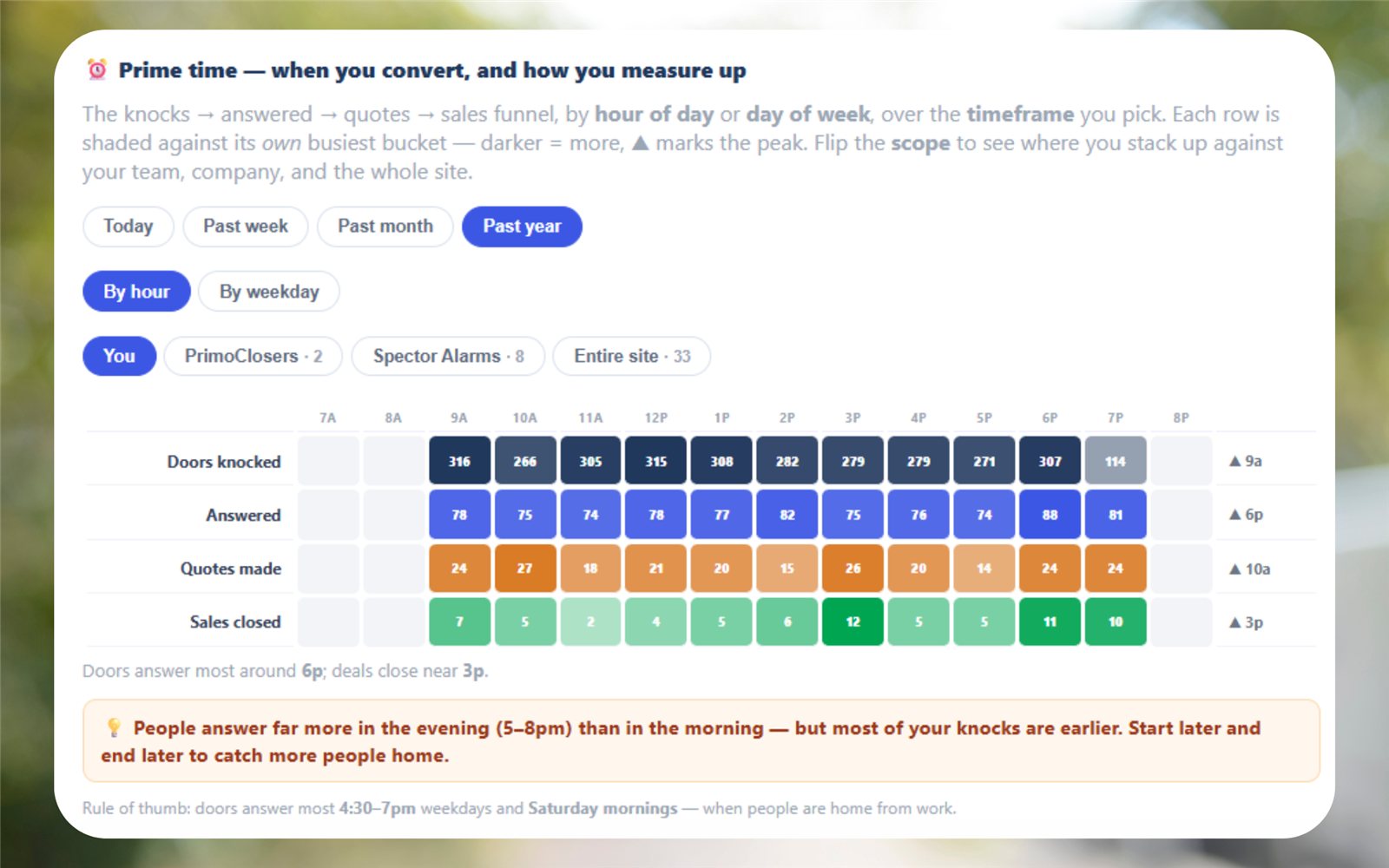
Because every knock is GPS-verified and time-stamped on the map, FieldStacker turns your own history into best-days and best-times charts — no spreadsheet, no manual tally. You see the hours and weekdays where you actually get contacts and closes, so you can aim your energy instead of guessing. Prime-time analytics come standard, right alongside the knock map and your 1099 financials.
- Best-days and best-times views from your real knocks
- Answer and conversion patterns, not just door counts
- Works the same whether you sell solar, pest, roofing, fiber or alarms
Timing tips that stack the odds
Small moves that make your prime window count for more.
Work backward from sunset
Set your evening start so your strongest pitch lands in the last hour of good light. Let the calendar move it, not habit.
Bank not-homes for later
Every daytime not-home is a warm return for your evening block. Disposition them so you circle back at the hour they're likely home.
Protect Saturday morning
It's the best daylight block of the week — don't burn it on errands. Front-load your weekend volume there.
Density beats distance
Right time, wrong route still wastes the window. Tighten your street so you knock more doors per prime hour — see more doors per day.
Respect the neighborhood
Check solicitation rules, no-soliciting signs and gated communities. Being welcome at the door beats one extra knock.
Sharpen while you wait
Slow stretches are for tightening your pitch and handling objections better next block. Pair timing with our door-knocking tips.
Questions reps ask
What is the single best time of day to knock doors?
For most residential canvassing the strongest window is weekday early evenings, roughly 5:00 to 8:00 p.m., after people are home from work but before they settle in for the night. Saturday mid-morning to early afternoon (about 10:00 a.m. to 2:00 p.m.) is the other reliable block. But "best" depends on your goal — raw contacts, appointments set, or closed deals peak at slightly different times — and it varies by neighborhood, season and product. Treat those windows as a starting point and let your own data correct them.
Is it worth knocking during the day on weekdays?
Yes, for the right doors. Mid-day weekdays skew toward retirees, remote workers, shift workers and stay-at-home parents, so your contact rate is lower but the conversations are often longer and less rushed. It is also good time to work not-homes from the evening, drop door hangers, and canvass new-mover or recently-sold leads who may be around during a move. Do not write off the day — just aim it at the households likely to answer and save the after-work rush for your prime evening block.
What day of the week is best for door-to-door sales?
Tuesday through Thursday evenings and Saturday daytime are the workhorse slots for most teams. Monday evenings can be soft because people are recovering from the weekend, and Sunday is polarizing — some areas are receptive late morning to afternoon, others consider it off-limits, so read the neighborhood and respect it. Fridays tend to fade after dinner as people go out. The honest answer is that your territory has its own rhythm; the days above are where to start testing.
Does the best time to knock change with the season?
A lot. In summer, daylight stretches your productive evening to 8:30 or 9:00 p.m. and weekends are busy but people are outdoors and approachable. In winter, effective knocking ends closer to dusk — many reps stop around 7:30 p.m. — and cold, dark porches hurt answer rates, so you lean harder on weekend daytime. Spring and fall are the easy seasons: mild weather and long-enough evenings. Adjust your schedule to daylight and weather, not just the clock.
How do I find MY prime time instead of a generic window?
Track every knock with a timestamp and an outcome, then look at answer rate, appointment rate and close rate by hour and by day of week over a few hundred doors. Your best contact hour and your best closing hour may differ — that is normal and useful. FieldStacker does this automatically: its prime-time analytics chart your best days and times from your real knock history, so you stop guessing and put your hours where they actually convert. Personal data beats any rule of thumb.
Are there hours I should never knock?
Yes. Avoid before 9:00 a.m. and after roughly 8:30 p.m. (earlier in winter), and be careful around dinner time and nap windows for young families. Never knock in the dark on an unlit porch — it reads as threatening and it is unsafe for you. Check for local solicitation ordinances, posted no-soliciting signs and gated communities, and honor them. Being welcome at the door matters more than squeezing in one more knock at a bad hour.
Put your hours where they actually convert
Start a 14-day free trial — no credit card — and let FieldStacker chart your prime time from your first week of knocks. Flat month-to-month, cancel anytime.