Rep money · water treatment

Water treatment sales commission, explained honestly

You are probably paid on the spread over a house base, not the ticket — which means your discount is your money. Here is every structure in the trade, what the finance fee does to it, everything that gets clawed back, and when it actually hits your account.

Flat month-to-month from $30/mo · 14-day free trial · no seat minimums, no annual contract

Ranges, not promises. Every figure on this page is a typical range drawn from how water treatment dealers commonly structure pay. Comp varies enormously by dealer, product line, region and whether you are 1099 or W-2. Nothing here is an offer, a guarantee or financial advice — get your own plan in writing and read it.

The structure most of the trade actually runs

Ask a roofer how they are paid and you will hear a percentage. Ask a water treatment closer and, if they know their own plan, you will hear something more like: "I am on forty points of GP over a base." That difference matters more than anything else in this article.

Here is how the gross-profit spread works. The dealer assigns every system a base price — sometimes called the house price, the cost card or the min — which covers the equipment, the install and the company's margin. You sell the system at whatever the customer agrees to above that base. Your commission is a percentage of the difference. Two reps sell the same softener on the same street in the same week; one holds price and one discounts to close, and their paychecks are not remotely similar.

That is the design, and it is deliberate. It makes you the pricing authority at the kitchen table, and it makes every dollar you concede visibly yours. It also means you cannot evaluate a job offer from the percentage alone. Forty percent of GP over a low base can pay far better than fifty percent over a base the dealer keeps raising.

The plans you will be offered

Typical shapes and typical ranges. Ranges vary widely — treat them as orientation, not quotes.

StructureHow it paysTypical rangeWhat it does to your behavior
Gross-profit spread A percentage of the sale price above a house base price Commonly 25–50% of GP; varies by dealer and product line Rewards holding price hard. A discount is a direct withdrawal from your own pay, so you learn to negotiate on terms and add-ons instead.
Flat percent of sale A straight percentage of the contract total Often in the 8–15% band Simpler and easier to forecast. Discounting hurts less per dollar, which is exactly why dealers who use it usually control pricing themselves.
Flat per unit A set dollar amount per system installed Frequently a few hundred dollars up to roughly $1,000 per system Pushes volume over ticket size. Common at higher-volume, lower-price dealers and on rental-heavy programs.
Setter / canvasser pay Per appointment set, sometimes with hourly base, plus a close bonus Roughly $25–$75 per set; close bonus often $100–$300 or 1–3 points Everything depends on the definition of a "set." Confirmed, sat, or both-parties-present are three very different paychecks.
Tiers and accelerators Your percentage steps up once you pass a monthly unit or revenue threshold Often a few points per tier, reset monthly Makes the last week of the month enormously valuable, and makes a slow first week expensive. Ask whether tiers are retroactive to unit one.
Add-on spiffs Flat dollars per attached item — under-sink RO, UV, iron filter, service plan Commonly tens to a couple hundred dollars each The cheapest income in the trade. Attaching an RO to a softener sale takes ninety seconds and pays like a small deal.
Recurring / RMR A residual or a multiple on rentals, salt delivery, or service agreements Highly dealer-specific; many pay nothing to the rep Worth asking about explicitly, along with whether it vests and whether it survives you leaving.
Draw against commission An advance you pay back out of future commission Common for closers; recoverable or non-recoverable A recoverable draw is a loan, not a salary. In a slow month it turns into a balance you owe. Know which one you signed.

The finance fee nobody mentions in the interview

Most in-home water treatment is financed. The lenders that dominate this trade — Aqua Finance is the one you will hear most, alongside GreenSky, Foundation Finance, Service Finance and Synchrony among others — charge the dealer a fee for the paper, and long zero-percent promotional terms cost the dealer more than short ones. That fee comes off the dealer's proceeds before anything else happens.

So here is the question to ask, in these words: "Is my commission calculated on the gross contract, or on net proceeds after the finance fee?" Both models exist. If it is on net, then putting a customer on a 120-month zero-interest plan instead of a shorter term can quietly cost you a meaningful slice of your own commission on the same sale — and nobody will tell you that in week one. Reps who know it learn to lead with the term that fits the customer and the plan.

What gets clawed back, and when

Water treatment has more ways for a signed deal to disappear than most door-to-door trades, because the money changes hands after several independent parties agree. Every one of these is a real clawback trigger:

  • The three-day cancellation. The FTC Cooling-Off Rule gives a homeowner three business days to cancel most sales of $25 or more made at their home, and several states have their own home-solicitation statutes with longer windows or extra notice requirements. This is the single most common way a water treatment deal dies.
  • Pre-install remorse. Past the three days but before the truck shows up, a customer changes their mind and the dealer would rather refund than fight. Your commission goes with it.
  • Funding failure. The credit application declines, the customer never completes the lender's verification call, or the contract simply never funds.
  • Install cannot happen. No drain within reach, no plumbing loop, no power at the location, a crawlspace nobody can work in, a condo or HOA that says no, or a municipality that restricts brine discharge from self-regenerating softeners.
  • The water was not what you sold to. A well test comes back with iron, manganese, tannins or a pH problem that needs pretreatment nobody quoted, and the job is re-scoped or cancelled.
  • Early cancellation of a recurring agreement. If you were paid on a rental, a salt subscription or a service plan, cancelling inside the retention window typically reverses some or all of it.

None of that is unusual or unfair on its own. What is unfair is not knowing the schedule. Ask exactly how long the chargeback window runs, whether it is full or prorated, and whether a clawback can push a pay period negative.

What to pin down with a water treatment dealer before you sign

Take these to the interview. A dealer who answers every one cleanly is one worth working for.

🧮

What is the exact formula?

Percent of GP over base, flat percent of sale, or flat per unit — and show me the arithmetic on a real recent deal, not a hypothetical.

📋

Who sets the base, and how often does it move?

On a GP plan the base is your pay. Ask to see the base price list and ask when it last changed.

🏦

Gross contract or net of finance fee?

And does the promotional term the customer picks change what I earn on the same sale?

⏱️

What is the chargeback window and schedule?

How long, full or prorated, and can a bad month go negative and carry forward?

📅

When exactly does it pay?

After install, after funding, or both — and on what cycle? Get the calendar, not the vibe.

🚪

Where do the appointments come from?

Company-issued leads, my own canvassing, or both — and does the commission rate differ between them? It very often does.

💸

Is the draw recoverable?

A recoverable draw is a loan against future commission. Know the balance rules before the first slow month.

🔁

Do residuals vest?

If there is any RMR on rentals or service plans, does it survive me leaving, and is that in writing?

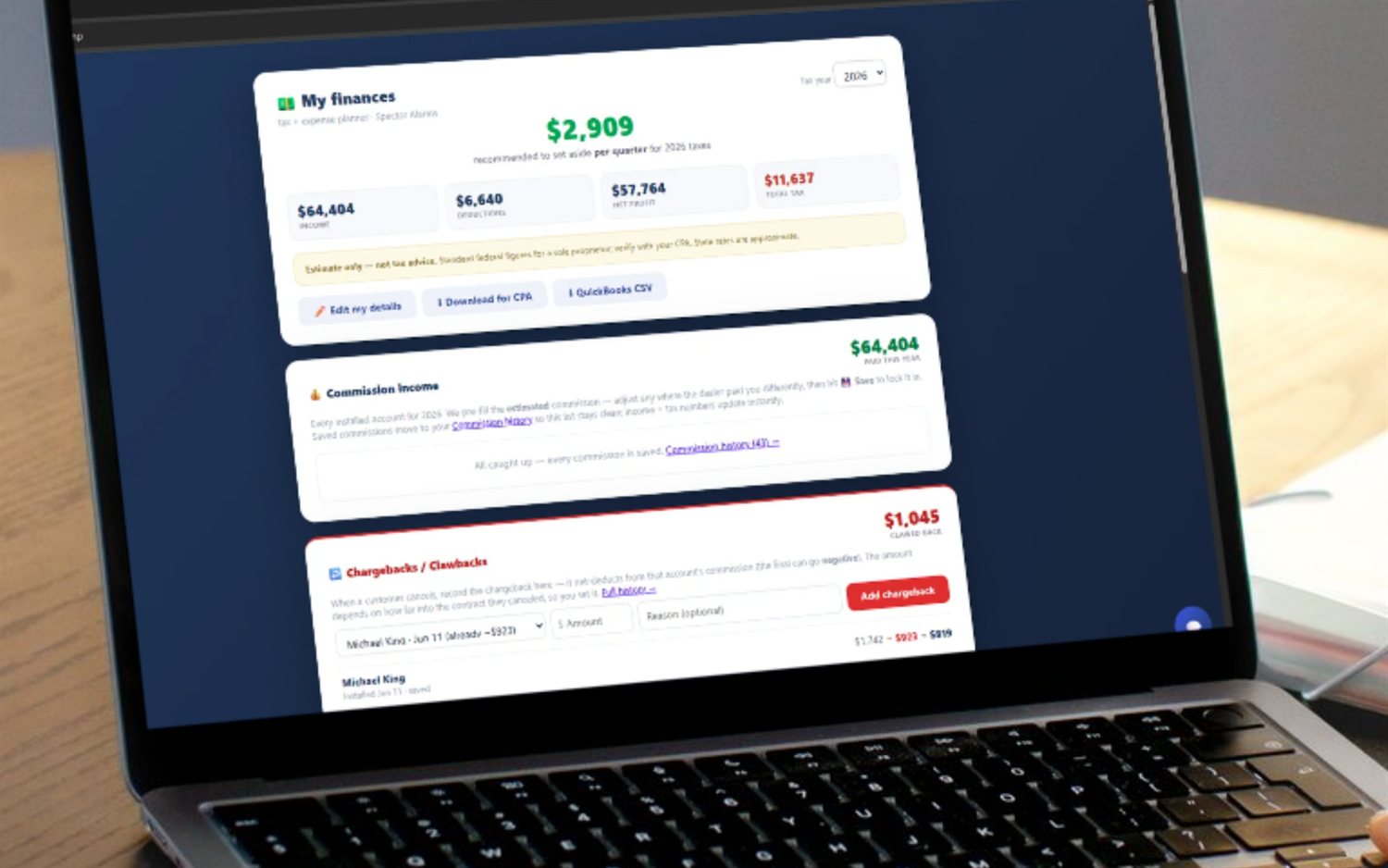
FieldStacker commission tracking showing per-deal water treatment commission with chargebacks from cancels netted against the total
Track it or guess at it

Your spread, your cancels, your real number

A gross-profit plan with a three-day cancel window and a delayed install is exactly the kind of comp that a notes app cannot survive. Most reps find out they were wrong about a month two months later. FieldStacker keeps the money in the same app you knock with:

  • Real per-deal commission on your own splits and your own spread
  • Chargebacks and clawbacks netted against your total when a cancel or decline lands
  • Auto-mileage at the IRS rate for every driving day between demos
  • A quarterly 1099 tax set-aside built from what you actually kept, not what you sold
  • Clean numbers to hand a CPA instead of a year of memory

The water treatment CRM →   Flat pricing →

Keep reading

Stop guessing what a month actually paid

Log the deal, net the cancels, watch the miles and the tax set-aside build. 14-day free trial, no credit card, flat month-to-month.