Ranges, not headlines. What a setter earns, what a first-year closer earns, what an established one earns, the arithmetic underneath all three — and what is left after self-employment tax takes its cut.
Flat month-to-month from $30/mo · 14-day free trial · no seat minimums, no annual contract
Water treatment pays better per sale than most door-to-door verticals and worse per hour than the recruiting ads suggest. A single in-home system sale is a four-figure ticket, which means a good closer's commission on one deal can exceed a whole week of pest control or fiber. But the sale takes an hour inside a house, requires two decision-makers, has to survive a three-day cancellation window, and does not pay until it funds and installs. Fewer, bigger, slower, riskier. That shape produces a genuinely wide income distribution.
Anyone who quotes you a single number for this trade is either quoting their top rep or quoting nothing. Here is the actual spread by role.
Annualized and commission-heavy. Wide bands on purpose — the honest answer has wide bands.
| Role | Typical annual range | How it is usually paid | What decides where you land |
|---|---|---|---|
| Canvasser / setter | Roughly $25k–$60k | Per set, sometimes hourly plus per set, often with a close bonus | Sets per week and the definition of a "set." Getting paid on sat appointments rather than booked ones changes the number a lot. |
| First-year in-home closer | Roughly $40k–$80k | Commission, commonly a share of gross profit over base | The ramp. Learning the test, the equipment and the finance app while your close rate is still climbing. |
| Established closer | Roughly $80k–$150k | Commission with tiers or accelerators, sometimes a draw | Steady appointment flow, a close rate that holds, and enough discipline not to discount your own spread away. |
| Top producer / selling manager | $150k–$250k+, uncommon | Commission plus overrides on a team, plus any residuals | A hard-water or well-heavy market, company-issued leads, high average ticket, and a low cancel rate. This is the tail, not the middle. |
| Sales manager / dealer principal | Highly variable | Overrides on team production, sometimes salary plus override | Team size, retention and how many of your reps survive month three. Not really a sales income any more. |
Ranges are illustrative and vary by dealer, product line, region and W-2 versus 1099 status.
You do not have to take anyone's word for these bands. Water treatment income is four numbers multiplied together, and you can run your own version in thirty seconds.
Work a middle-of-the-road example. Say you sit eight qualified in-home tests a week, close 30 percent of them, and average $900 in commission per installed system. That is 2.4 sales a week, about $2,160 a week gross. Across 46 working weeks that is roughly $99,000 — before you subtract cancels. Knock 15 percent off for three-day rescissions, funding declines and installs that could not happen, and you are near $84,000 gross commission for the year.
Now change one variable at a time and watch what happens. Drop to four sits a week with everything else identical and the same rep earns about $42,000. Hold eight sits but let your close rate fall to 20 percent and it is about $56,000. Hold eight sits at 30 percent but average $1,300 in commission because you stopped discounting and started attaching an RO, and it is about $121,000.
That is the whole story of this trade in one paragraph. The single biggest lever is how many qualified appointments you sit, and the second biggest is what you give away to close them.
Ranked roughly by how much they matter.
Everything else is a rounding error next to this. Company-issued leads, your own canvassing, or a setter team feeding you — find out which before you take the seat, and find out how many sits a week the average rep there actually gets.
One-legger appointments close far worse and cancel far more. A rep whose sets reliably have both decision-makers home outearns an identical rep whose sets do not, without changing a word of their pitch.
On the dominant comp structure you are paid on the spread over a house base, so every discount is your own money. Reps who negotiate on term, add-ons and install timing rather than price make more on the same volume.
Very hard municipal supply, iron-heavy private wells or a well-documented local contaminant issue makes the whole job easier. A soft-water metro is a harder living at the same skill level. Geography is not a small factor here.
Three-day rescissions, funding declines and installs that cannot happen all reverse commission you already counted. A rep who calls every sale within 24 hours to reassure the customer keeps meaningfully more of what they sold.
An under-sink RO, a UV lamp on a well, an iron filter or a service plan attached to a system you already sold is the cheapest income in the business — ninety extra seconds at a table you are already sitting at.
Two reps can sell the same system at the same price in the same week and be paid differently, because in this trade the payment method is part of the comp structure. Most in-home water treatment is financed, and the lender charges the dealer a fee for the paper — longer zero-percent promotional terms generally cost the dealer more than short ones. Whether any of that lands on you depends on one sentence in your plan, so ask it in these words: is my commission calculated on the gross contract, or on net proceeds after the finance fee? Both models exist. On a net plan, the term the customer picks can quietly move your own number on an otherwise identical sale.
A cash deal sidesteps that fee, though at some dealers it also sidesteps a financing spiff. And if your dealer runs rental or lease programs, salt delivery or filter-change agreements, the shape changes again: those create recurring revenue for the dealer, and some dealers share a small residual or pay a multiple of the monthly while others keep it entirely. A rental-heavy program can mean a smaller check on the day with a tail behind it — or no tail at all, if the residual never vests. Ask whether it vests and whether it survives you leaving, and get the answer in writing. The structures are broken down on the water treatment commission page.
New reps assume the gap is charisma. It usually is not. Three concrete things separate a $55,000 first year from a $120,000 third year, and all three are learnable.
Most water treatment seats at independent dealers are 1099. That means nothing is withheld, you owe the full 15.3 percent self-employment tax on your net profit on top of income tax, and the IRS wants estimated payments four times a year. A rep who mentally spends the $2,160 week is going to have a bad April.
The offsetting good news is that this trade generates real deductions. In-home demos mean three or four driving legs a day across a metro, and business mileage is usually the single largest line on a water rep's return — but only with a contemporaneous log, which almost nobody reconstructs accurately in hindsight. Phone, CRM subscriptions and test supplies are deductible too. The full picture is in the 1099 tax guide for D2D reps.
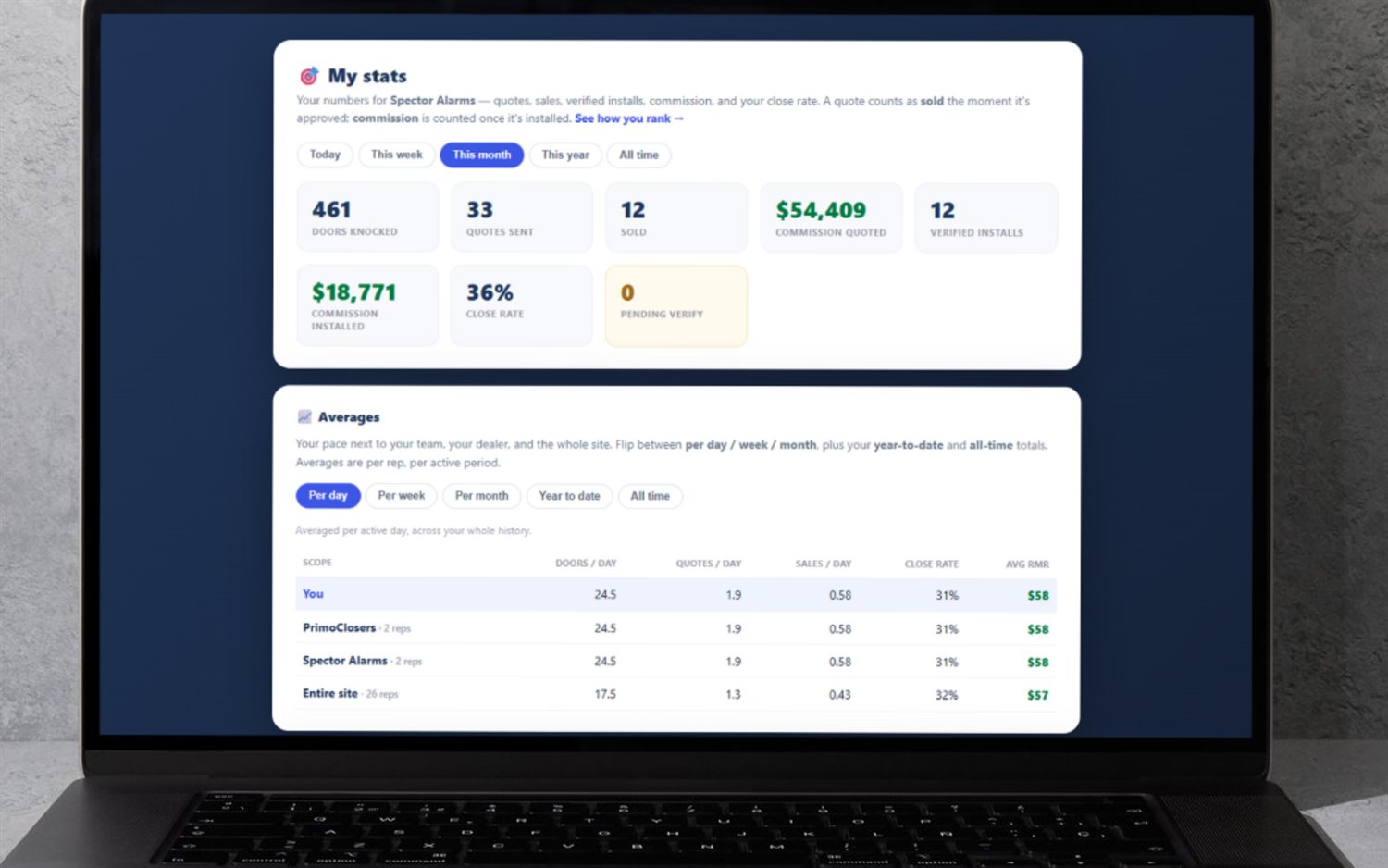
Ask a struggling rep whether the problem is appointments or closing and you will usually get a feeling rather than a figure — which is why the wrong lever gets pulled for a whole season. The six things above are all countable: tests sat, tests closed, average spread per system, how many came back inside the rescission window, miles driven between demos. FieldStacker counts them in the app you already knock with, so "was last month a lead problem or a discounting problem" has an answer by the time you have walked back to the truck.
It spreads wide. A canvasser or setter paid per appointment typically lands somewhere in the 25,000 to 60,000 dollar range annualized, with good weeks and empty ones. A first-year in-home closer commonly falls in the 40,000 to 80,000 range. An established closer with steady appointment flow more often sits between 80,000 and 150,000. Top producers and selling managers in strong hard-water or well markets can clear 150,000 to 250,000 or more, but that is the tail of the distribution and not what a recruiter should be quoting you as normal. All of these are typical ranges, not promises, and most water treatment seats are commission-only.
Appointment flow first, close rate second, and gross-profit hold third. A rep who sits ten qualified in-home tests a week has roughly triple the shots of a rep sitting three, and nothing else on the list can make up that gap. After that it is close rate, average ticket, how much you discount on a gross-profit plan, your cancel rate inside the three-day window, and whether you attach add-ons like an under-sink RO or a service plan. Two reps with identical talent and different lead flow will not have similar years.
Frequently, yes, especially at independent dealers where the rep is a 1099 contractor. Some corporate and franchise operations run W-2 seats with a modest base plus commission, and some canvasser roles are hourly plus per-set. The base, where it exists, is usually small enough that it changes your risk profile more than your income. Ask specifically whether you are W-2 or 1099, because it changes your taxes, your expenses and who pays for your mileage.
A common shape for a working closer is somewhere between four and ten installed systems a month, though that swings hard with lead flow and market. At a typical commission per system in the several-hundred to roughly 1,500 dollar range depending on ticket and structure, that arithmetic is where most of the honest income ranges come from. Watch the word installed — sold and installed are different numbers in this trade, and only one of them pays.
Most reps who make it describe a ramp of roughly three to six months. The first month is learning the test, the equipment and the finance application while your close rate is low. Months two and three are usually when the go-back pipeline from your own earlier knocks starts producing, which is why reps who did not disposition their doors ramp slower. Reps still struggling past six months are usually short on appointments rather than short on skill.
Less than the gross, and the gap surprises people. As a 1099 contractor you owe the full 15.3 percent self-employment tax on net profit plus federal and any state income tax, with nothing withheld, and you are expected to pay estimated taxes quarterly. Setting aside 25 to 30 percent of commission as it lands is a common rule of thumb, though your real number depends on your bracket, your state and your deductions. The good news is that mileage is usually the largest deduction on a water rep's return, because in-home demos mean three or four legs across a metro every day.
Track sits, closes, commission and cancels in the same app you knock with. 14-day free trial, no credit card, flat month-to-month.