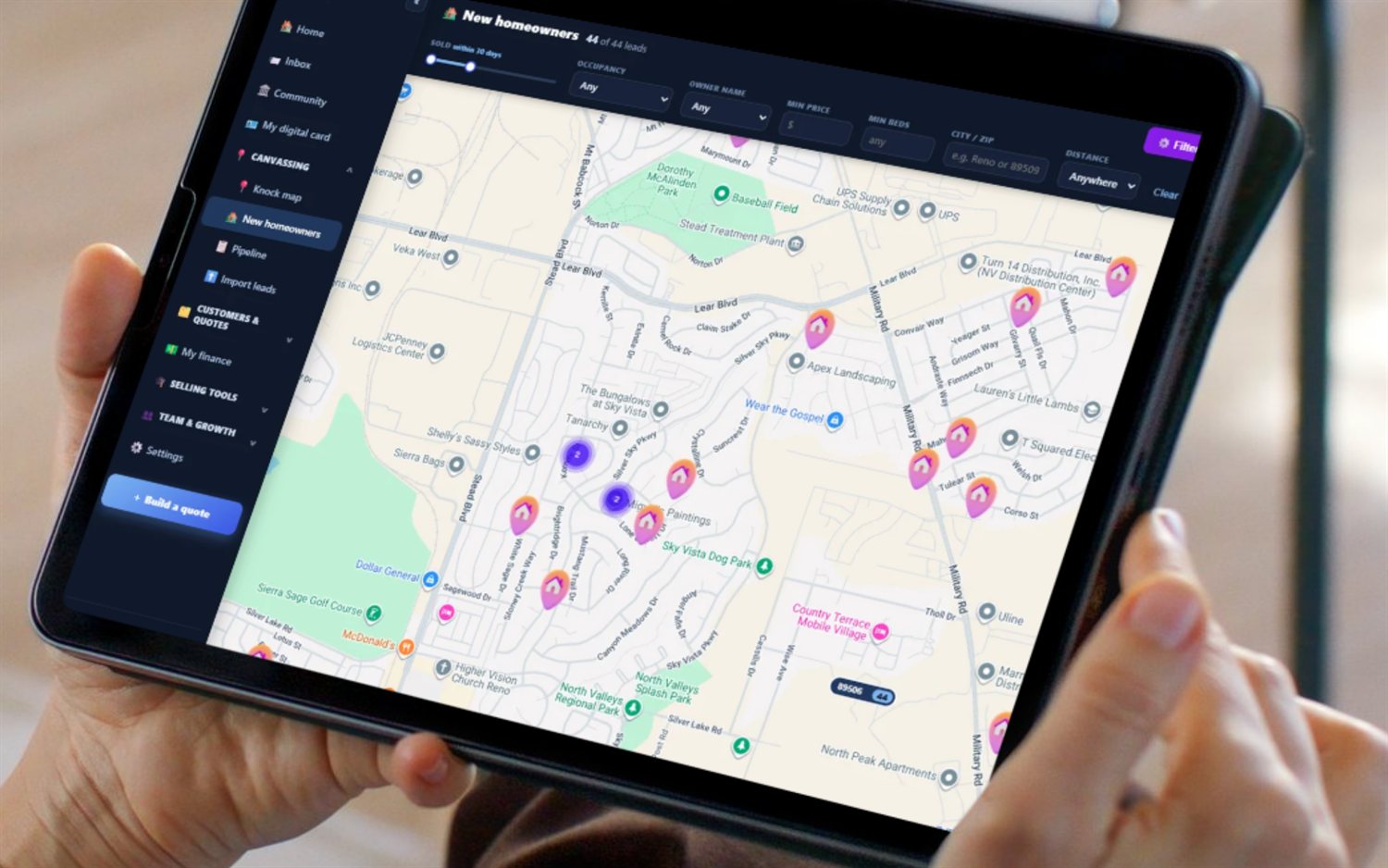
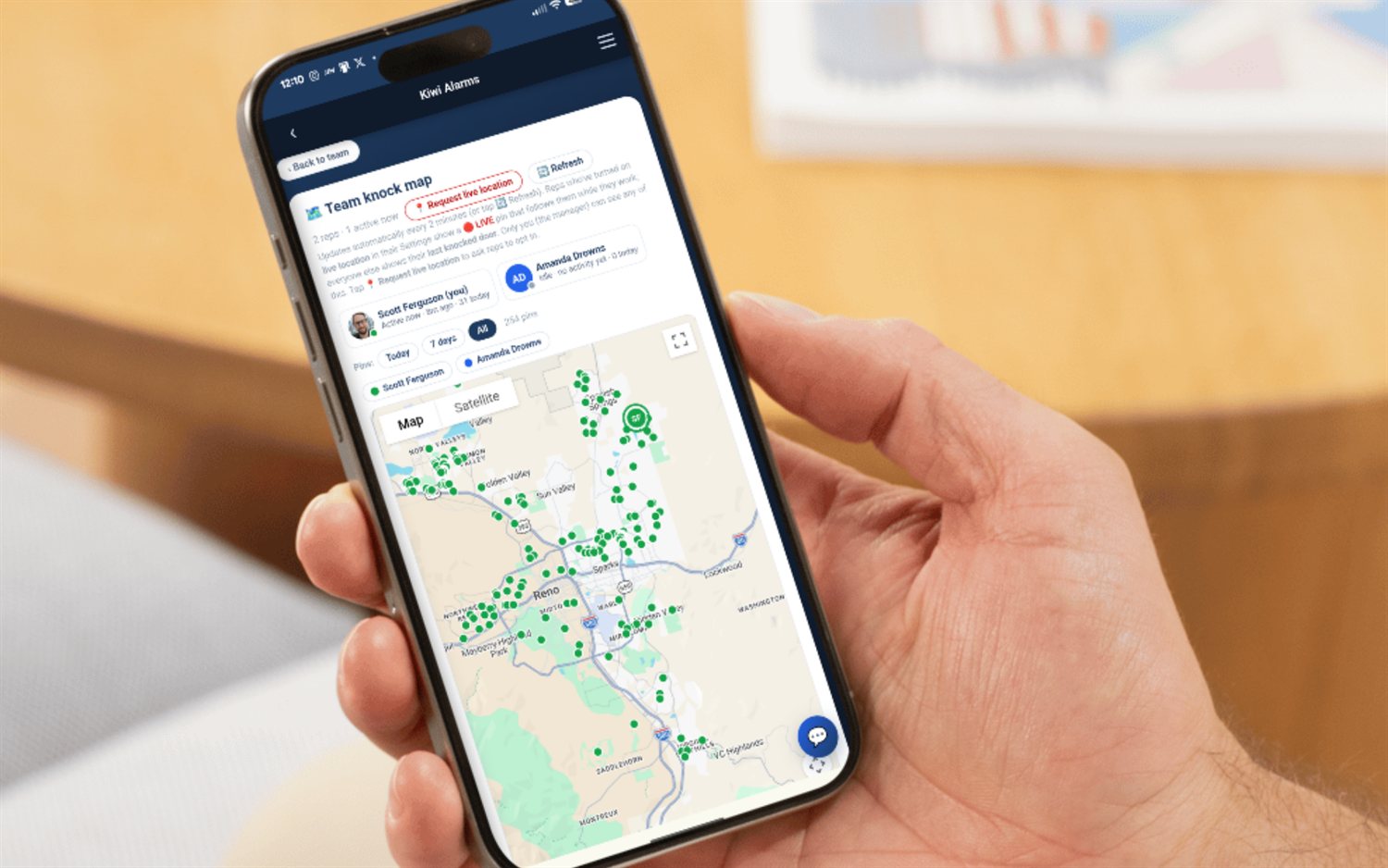
Canvass the ring around every job site, work the just-sold list, hand the setter's demo cleanly to the closer, and track what survives the three-day window. Built for retail exteriors and storm siding.
Flat month-to-month from $30/mo · 14-day free trial · no seat minimums, no annual contract
Siding is the most visible remodel a homeowner buys, and that changes how it sells. Nobody drives past a new furnace. Everybody drives past a wrapped house with a dumpster in the driveway and a crew on scaffolding — which is why the twenty doors around an active job site are the single warmest block a siding canvasser will knock all week. The other reliable vein is the just-sold list: a family that closed on a 1978 ranch four months ago is in the window where exterior projects actually happen.
The trouble is that most siding teams run that street work out of a group text and a clipboard, then hand the money side to a spreadsheet that never gets updated after a cancel. Setters get paid per demo that sits and nobody can prove which knocks were real. Closers get a name and an address with no note about what the setter actually promised at the door. And a $28,000 contract that dies on day three of the rescission window quietly stays on somebody's board as a win. FieldStacker fixes the street and the money. It leaves the elevation to the tools built for it.
Every one of these works for exterior remodeling today — no setup detour, no trade-specific configuration project.
Draw a territory around the house your crew is wrapping this week, load every door inside it, and knock the block while the scaffolding is still up. The install is the ad — this is the highest-converting siding canvass there is.
Pull recently-sold homes onto the map as fresh pins. New owners of older housing stock are the exterior-remodel buying window, and you get to them before the mailers do.
Name your own stages — no soliciting, DM gap, demo set, demo sat, sold, in rescission, credit pending, measured, install scheduled, completed — so a door that needs the spouse home reads differently from a flat no.
When setters are paid per knock or per demo that sits, verification stops being a trust exercise. See the crew on a live map, attribute every door to who worked it, and stop two canvassers double-knocking the same street.
In-app team messaging so the demo lands with the note attached: who is home Thursday, what the setter said about the chalking on the south wall, whether they already have two bids.
Real per-deal commission on your split, chargebacks and clawbacks netted against your total when a job dies in rescission or at the credit decision, auto-mileage at the IRS rate, and a quarterly tax set-aside.
Exterior takeoff and visualization are real disciplines with excellent tools, and estimating a siding job stays with them: FieldStacker's built-in doorstep quote builder is tuned for alarm equipment and plans rather than squares, corner posts and trim runs. Here is how it divides:
From an active job site to a contract that actually clears the cooling-off window.
Trace a territory around this week's install, drop in the just-sold pins for the surrounding streets, and build a route instead of wandering the subdivision.
Disposition every door as you go, and when someone is interested, set the appointment for a window when both decision-makers are home. Message the closer the context before they drive out.
The closer runs the measurement, the visualizer and the financing in the tools built for that. FieldStacker keeps the door, the note and the stage.
Follow it through rescission, credit, re-measure and install. Watch commission update, chargebacks net out, mileage log itself and the tax set-aside build.
A siding contract is a big number that can un-happen four different ways: the federal three-day cooling-off window, a declined financing application, a re-measure that eats the margin your percentage was built on, and a final-walk holdback. A canvassing app that stops at the map leaves all of that to a spreadsheet nobody updates after a bad Friday.
Most siding companies are sitting on a pile of addresses: an aged-lead export from the old CRM, a purchased list of homes built between 1975 and 1995, last spring's storm canvass, the referral list from completed jobs. Drop it in as a CSV or bring it over from another CRM and the addresses are geocoded automatically, so it lands on the map as pins you can route instead of a file nobody opens.
Almost nobody sells only siding. The same knock sells roofing after a hail event, gutters on the way out, and windows to the homeowner who says the drafts are worse than the fading. Turn on the industries you actually sell and work them from one FieldStacker account — one map, one set of stats, one bill. The alarm side is powered by FieldStacker Security, on the same backend, so nothing lives in two places.
Four companion guides, written for this trade specifically.
Real openers, the chalk-rag demo, and the exact words homeowners use when they push back — with the branch for each one.
Territory choice, the season, the pitch, the close and the follow-up that recovers the two-bid homeowner.
Per-set, percentage of contract, percentage of gross profit and the overage model — plus what gets clawed back and when it pays.
Honest ranges, what drives the spread between a $45k rep and a $180k rep, and the 1099 tax reality behind the gross number.
Yes for the canvassing and money side of exterior remodeling. The knock map with fresh-lead pins, drawn territories you can throw around an active job site, your own custom dispositions, GPS-verified team knocks, in-app messaging for the setter-to-closer handoff, the leaderboard and the 1099 financials all work for a siding crew today. What it does not do is measure the house or render colors on it: your HOVER or EagleView wall report and your visualizer stay exactly where they are. FieldStacker runs the street; your takeoff stack runs the elevation.
No. It does not count squares, corner posts, J-channel, soffit or window and door openings, and it does not drop a Dutch lap or a ColorPlus finish onto a photo of the customer's house. Those are their own disciplines and the tools that do them — HOVER, EagleView wall reports, Renoworks, CertainTeed ColorView, the James Hardie and Alside visualizers, or a ladder and a tape — are very good at it. FieldStacker earns its keep everywhere around that: getting the crew onto the right blocks, remembering every door, keeping two setters off the same street, and tracking what you actually get paid after the three-day window closes.
Both, because the street work is the same shape. Retail exteriors runs on job-site radius canvassing and new-homeowner lists, and lives or dies on setting a demo where both decision-makers are home. Storm siding runs on getting a crew into a hail or wind footprint before four competitors do. FieldStacker handles either: trace the damage zone or a ring around the house you are wrapping this week, load the doors inside it, and name your own stages — demo set, demo sat, DM gap, adjuster scheduled, sold, in rescission, install scheduled — so the pipeline reads like your business instead of a generic funnel.
Yes, and this is the part exterior reps need most. Siding money is lumpy and reversible: a signed contract can die inside the federal three-day cooling-off window, at the credit decision, at the re-measure, or at final walk. FieldStacker logs the deal on your own split, nets chargebacks and clawbacks against your total instead of quietly leaving them in a spreadsheet, captures mileage automatically at the IRS rate for every driving day, and builds a quarterly tax set-aside. It does not run credit or process financing applications — that stays with your lender portal.
Those are capable canvassing platforms, but they are seat-based, priced for teams, usually sold on an annual commitment, and they hand the rep's own money — commission, cancels, mileage, quarterly taxes — back to a spreadsheet. FieldStacker is flat month-to-month from $30/mo with a 14-day free trial, no credit card, no seat minimums and no annual contract, and it folds the rep financials into the same app the setter is already knocking with. Built for the 1099 exterior rep first, then scaled to the crew. Check their sites for current pricing before you compare.
That is the point of the stack. Most exteriors companies sell siding, roofing, windows and gutters off the same door, and a storm knock is often all four at once. Turn on the industries you actually sell and work them from one login — one map, one set of stats, one bill. The alarm side is powered by FieldStacker Security, our alarm edition, on the same backend, so nothing lives in two apps.
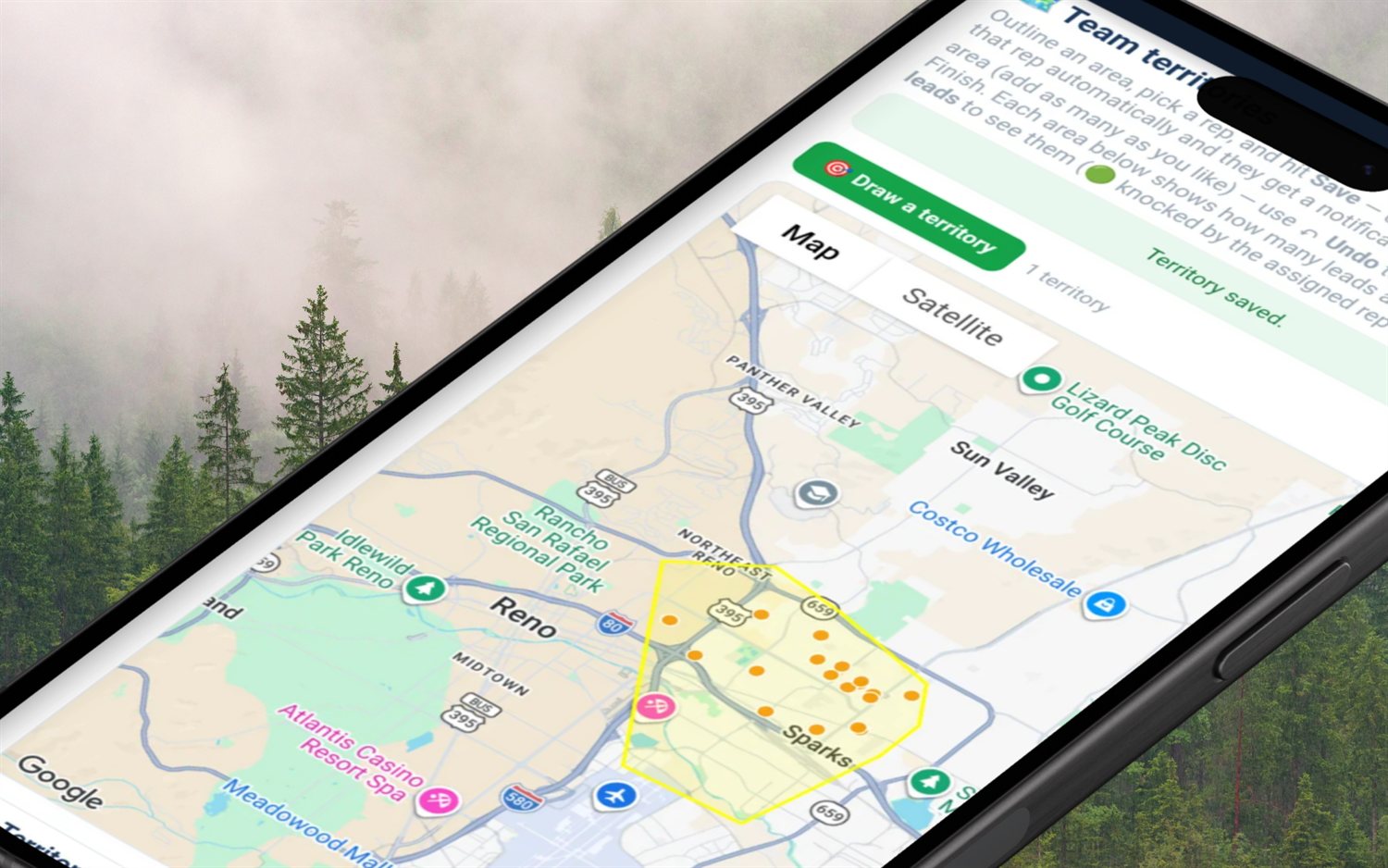
Draw an area on the map and one pull reveals up to 500 homeowners at once — the owner’s name, mailing address, whether they live there or it’s likely a rental, and their estimated age. Every plan with the owner reveal includes 50 pulls a month — that’s up to 25,000 homeowners of rich data every month. Run out and $10 adds another 50 (about 20¢ a pull).
Start a 14-day free trial — no credit card — and canvass the ring around your current install before the scaffolding comes down. Flat month-to-month, cancel anytime.