Field guide · siding

How to sell siding door to door

Which streets to work and which to skip, why the block around your own scaffolding is the best territory you will ever have, what the season really does to this trade, and the thirty-second walk around a house that turns a doorstep into an appointment.

Flat month-to-month from $30/mo · 14-day free trial · no seat minimums, no annual contract

The advantage this trade has: the problem is visible. You can put physical evidence into a homeowner’s hand inside the first ninety seconds, which no interior trade can do. Everything below is about converting that advantage into a walk around the house, and the walk into an appointment with both adults present.

Siding is an appointment-setting business

New exterior reps lose their first month trying to close on porches. It does not work, and it is not a confidence problem. The ticket is large, the decision is nearly always shared between two adults, and the product carries half a dozen material, profile and colour choices that need a table and a laptop to present properly. Nobody can responsibly commit to a twenty-five thousand dollar exterior while standing in a doorway holding a dog by the collar.

What they can agree to is thirty seconds around the side of their own house, and then a time when both of them are home. So the number that runs your income is not doors knocked. It is appointments that actually happen with both decision-makers in the room. Everything upstream serves that, and everything downstream depends on it.

Territory: build year, storm track, and your own dumpster

Exterior territory is not chosen by income bracket. It is chosen by age and by weather.

🏘️

Single-era subdivisions

A neighbourhood built out over two or three years ages as one cohort. If the first house needs siding, so do the other thirty. Roughly twenty-five to forty years old with original panels still on is the sweet spot.

🏗️

The active job-site ring

Your crew’s own install is the best advertising your company will buy this year, and it expires when the dumpster leaves. Knock the surrounding blocks every day the trucks are parked there.

The completed-job ring

Return a week after a finish, while the homeowner is still showing it off and the neighbours are still comparing. A reference standing in a driveway forty feet away outperforms anything printed.

🌩️

The storm footprint

Hail and wind take siding on whichever elevation faced the storm, and the track ignores neighbourhood boundaries entirely. Work it fast, then work it again at sixty days when the out-of-town crews have moved on and stalled claims are still sitting.

🔑

Recently sold homes

New owners of older houses are squarely in the exterior-project window: they have just formed an opinion about how the place looks from the kerb, and they are still making decisions about it.

🚫

Streets to leave alone

Brand-new builds, blocks that have already been re-sided, and rental-heavy pockets where most doors cannot say yes. Rigid HOA colour rules are not a dealbreaker but they add a step — find out early rather than at the close.

Reading a wall from the sidewalk

Spend ten seconds looking before you knock. You want to walk up carrying one specific, true observation rather than a generic pitch, and the house will tell you if you know where to look.

  • Chalky, washed-out panels on the south and west walls — the finish has oxidised and the colour layer is largely gone.
  • Mismatched replacement panels where somebody patched with a discontinued colour. That household has already tried the cheap fix and watched it fail.
  • Warping and buckling, particularly near a grill or facing a neighbour’s reflective low-E window, which can genuinely deform vinyl.
  • Cracking at corners and nail hems — brittle aged panels that keep splitting every time somebody touches them.
  • Dark streaks, sag or soft spots along the fascia and soffit, plus daylight or holes where birds and insects have got in.
  • Dented aluminium on older houses, and hail bruising on the storm elevation of newer ones.

One caution that protects your reputation: report what you can see, not what you imagine. Telling a household there is rotted sheathing behind a wall nobody has opened is a guess dressed as expertise, and it is exactly the behaviour that gets doors closed on the next five reps down the street. “I can see the fascia is soft here, and I would want to check what is behind this corner” is both more honest and more convincing.

Stop guessing the squares before you promise a number

Siding is priced by the square — a hundred square feet of wall — and the most expensive habit in this trade is estimating that count from a driveway. A two-storey with three gables and a walkout basement wall you cannot see from the street routinely measures a third larger than it looks, and on a gross-profit or overage plan that difference comes out of your own commission weeks later.

Which is why the measurement conversation belongs in your field routine rather than back at the office. Aerial and photo-derived wall reports — EagleView and HOVER are the two names in general use — return square footage elevation by elevation, with opening, corner and trim counts, before anything is priced. If your company pulls one on every house, your appointment gets easier: you arrive with a real number instead of a hopeful one.

It also hands you a genuinely strong line at the door, and it happens to be true: “I’m not going to guess at your house. We measure the walls properly before anybody quotes anything, because the guy who guesses low is the guy who comes back halfway through and asks for more money.” Every household on that street has heard a story exactly like that one. Being the rep who says it first is worth more than any discount you could offer.

The exterior year, month by month

What actually changes across the seasons, and what to say when it does.

WhenWhat is really going onHow to work it
Late winter → early springHouseholds come out of hibernation, look properly at the house for the first time in months, and start thinking about the outside. Production calendars are not full yet.The easiest honest urgency in the trade: get measured now and be first on the spring schedule rather than tenth. Work last autumn’s "maybe in the spring" pile before you knock anything cold.
Spring → early summerPeak demand, peak competition, and in many markets the start of hail season. Every exterior company in town is out working.Differentiate on the walk-around rather than on volume. If a storm lands, get into the footprint quickly and be straight about what you find, including finding nothing.
High summerLong evenings, people outdoors, crews visible on scaffolding all over town. The best hours of the year for catching both adults at home.Live on the job-site ring, and push your knocking later. A seven o’clock July door finds households that a two o’clock door never will.
Late summer → fallThe genuine "before winter" window. Households feel the season closing and installs still run smoothly.Real, unmanufactured urgency: production calendars do fill and cold-weather installation genuinely gets harder. Say it plainly and never invent a deadline on top of it.
Deep winter (cold climates)Installs slow because vinyl turns brittle and moves with temperature. Most reps stop knocking entirely. Households are indoors and answering.Sell into the spring backlog. Fewer competitors at the door, darkness at four means evenings start early, and you reach March with a full calendar rather than an empty one.

The walk-around, in four beats

Doorstep to calendared appointment. This is the actual craft of the job.

1

Qualify in two questions

Do they own it, and how long have they been there? You now know whether this door can say yes and roughly how invested they are. Do not spend nine minutes on a tenant.

2

Earn the walk

"I'm not going to sell you siding on your porch — give me thirty seconds around back and I'll either show you something worth knowing or tell you your house is fine." Small ask, honest out.

3

Show, do not tell

Rag on the wall for chalk. Press the fascia. Point at the cracked corner. Say what is fine as well as what is not — credibility is built on what you decline to flag.

4

Book both people

Two options, not an open calendar. Say honestly how long it takes and why you need both of them there. Then write down what you just learned before you reach the next driveway.

Colour, profile and the selection conversation

Reps treat the selection as paperwork after the sale. It is not. It is where a fair number of exterior jobs cancel, and it is also where the ticket grows honestly.

  • Show real samples in real daylight. A colour chip on a kitchen table under a yellow bulb bears no resemblance to a full wall in afternoon sun. Take them outside and hold them against the existing house. Households who choose indoors are the ones who change their mind after material is released.
  • Profile is a visible upgrade, so let them see it. Dutch lap carries a shadow line a flat panel does not; board-and-batten or a shake accent on the gables changes the whole front elevation. These are differences somebody can see from the kerb, which makes them sellable with no pressure at all.
  • Be straight about factory finish versus site paint. Factory-applied finishes such as ColorPlus are coated under controlled conditions with the finish itself warranted; primed board painted on site is not the same product. That is a real, explainable reason for a price difference, and explaining it beats defending it.
  • Deal with the HOA before the contract, not after. Colour approval is a genuine step in plenty of subdivisions, and discovering it late converts a signed job into a delayed one and occasionally a cancelled one. Ask on the first visit whether there is an architectural committee.
  • Price the trim while the samples are out. Soffit, fascia, corner boards and wrapped window openings are the natural moment for that conversation, because the household is already picturing a finished house rather than a bill.

Storm work adds steps a retail rep never runs

If hail lands in your market the job changes shape, and reps who treat it as ordinary selling with a different payer make expensive mistakes.

  • The carrier sets the price, not you. On an approved claim the scope and price come from the carrier’s estimate, typically written in Xactimate. There is no number to hold and no overage to earn, so your value is entirely in accuracy — every damaged elevation, the tear-off, disposal, trim, wraps and code-required items being in the scope before anybody starts.
  • Be present when the adjuster is. Elevations get missed far more often than roofs do. Meeting the adjuster on site is the difference between a scope you can build and a supplement fight three weeks later.
  • Never touch the deductible. Offering to cover, waive, absorb or discount it is illegal in many states and treated as insurance fraud. Walk away from any company that suggests otherwise — no job is worth a licence or a prosecution.
  • Do not over-claim damage. The reps still working a market five years after an event are the ones who told households their house was fine. Say so when it is.
  • Explain the money honestly. On a replacement-cost policy the carrier commonly pays the depreciated value first and releases the remainder after the work is completed and documented. Households who understand that up front do not panic when the first check does not cover the job.

At the table, and the day after

Most of the closing happens at a kitchen table, over a real measurement and a real visualisation — work that lives in your takeoff and visualiser tools rather than in a canvassing app. But three habits there decide whether a signed contract survives to become a paid one.

  • Let them choose the material, not whether to buy. Present good, better and best honestly with the real difference between them, and let the household land somewhere. Reps who present one option get one answer.
  • Say the price once, clearly, then be quiet. Present cash and financing side by side without steering. Talking through the silence after a number is the most common self-inflicted wound in this trade.
  • Announce the three-day right to cancel yourself. Federal cooling-off rules give a homeowner three business days to cancel most sales made at their home, and you are required to disclose it. Reps who bury it collect cancellations; reps who offer it as reassurance close calmer deals that stick.

Then make the reconfirm call within a day or two. Not a sales call — a thank-you, a recap of what happens next, and a genuine invitation to ask questions. Second thoughts on a purchase this size almost always grow in silence, and ten minutes on the phone is the cheapest cancellation insurance available. Everything you promised at the table should already be written onto the contract, because a verbal extra is the least expensive thing to give away and the most expensive to eat later.

Where the other half of the year comes from

A household spending this much will usually collect two or three bids over several weeks, and a great many of the people who say "not right now" are telling the truth rather than brushing you off. The rep who wins that job six weeks later is almost never the best presenter. It is whoever was still politely present when the other two companies went quiet.

  • The next day: a thank-you, plus one useful thing they can check for themselves.
  • Once the cancellation window closes: confirm what happens next, or simply ask where they landed.
  • Around a week, and again at three: short, low-pressure, no fresh pitch attached.
  • The season they named: the February call to everybody who said spring, and a go-back whenever your crew is working their block again.
  • After every install: knock the ring around the finished house while it still looks new and the neighbours are still asking about it.

All of it collapses without a record. If you cannot tell in February which doors said spring, which needed the spouse at home and which are sitting on somebody else’s bid, you are cold-knocking the warmest leads you own.
Permits, signs and the deductible rule

Exterior sales has a reputation problem in some towns and it was earned by a small number of crews. Do not join them, and protect your own company’s ability to knock this market next year.

  • Get the solicitor’s permit. Many municipalities require a licence and set knocking hours. A single complaint can close an entire city to your company.
  • Honour the signs. A no-soliciting sign is a hard stop. Disposition it and never knock it again.
  • Wear identification and look like a company. Badge, branded shirt, marked vehicle. Do not block driveways and do not open gates without asking first.
  • Do not climb anything without permission. Ladders and roofs on a stranger’s property before anything is signed is a liability problem waiting to happen.
  • Never offer to cover, waive or absorb an insurance deductible. On storm work this is illegal in many states and treated as insurance fraud. Do not do it, and leave any company that asks you to.
  • Disclose the cancellation right. Required, and it is also good selling.
Where FieldStacker fits

The map that remembers a spring callback

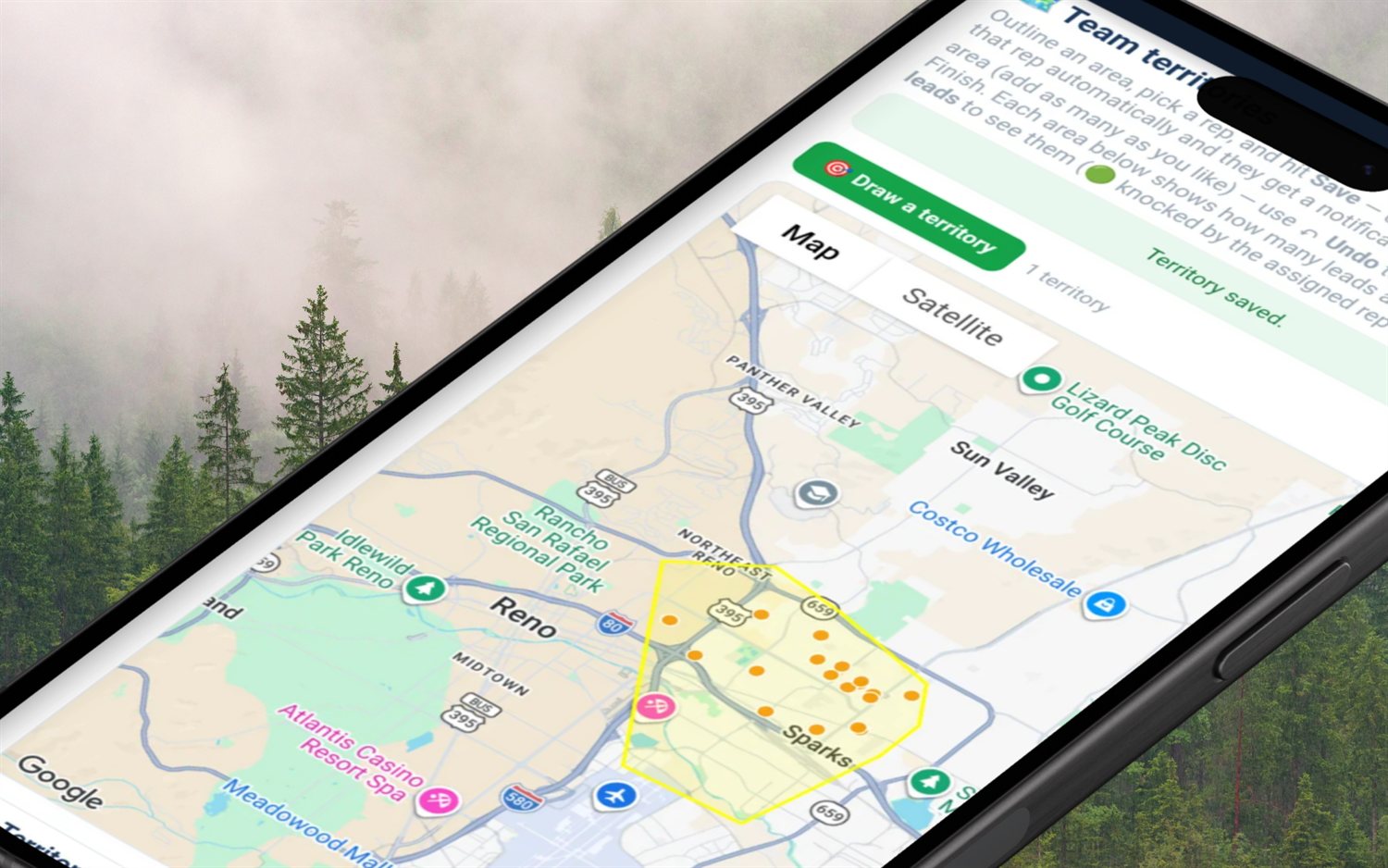
Every tactic above depends on remembering things across months. FieldStacker is the layer that does that. Your wall measurements, colour renderings and insurance scopes stay in the takeoff, visualiser and estimating stack you already run; FieldStacker runs the street around them.

  • Draw a territory around this week’s job site and load the doors inside it
  • Just-sold homeowner pins for the older housing stock you actually want
  • Dispositions you define yourself — spouse gap, spring callback, competitor bid, storm claim pending
  • Callbacks that come due, so February’s calls make themselves
  • GPS-verified team knocks so setters are paid for real work and nobody double-knocks a street
  • Route building, offline mode, and a free QR business card for the leave-behind

See the knock map →   Siding CRM →

FieldStacker territory drawn around an active siding job site with the surrounding doors loaded for canvassing

The rest of the siding series

🗣️

Siding sales scripts

The exact words: five openers and a branch for every objection you will hear this week.

💰

Siding sales commission

Per-set, percent of contract, gross profit and overage — plus the re-measure clause.

📊

What siding reps make

Honest ranges, the per-square arithmetic and the material ladder behind the ticket.

🧭

All industries

Roofing, solar, pest, fiber and alarms on the same account and the same map.

Questions siding canvassers ask

What neighborhoods are best for selling siding door to door?

Streets where the houses all aged together. A subdivision built out across two or three years and now roughly twenty-five to forty years old, still wearing its original panels and largely owner-occupied, is the classic pocket — because when the first wall on a street starts chalking, the other thirty are on the same clock. After that comes the storm footprint, which follows a hail or wind track rather than a plat map and can cut diagonally through several neighbourhoods at once. But the two best territories in this trade never appear on a purchased list: the houses surrounding the job your crew is wrapping this week, and the ring around the one you finished last month. Pass on new builds, pass on streets already re-sided, and be careful in rental-heavy pockets where most doors cannot authorise a project.

What time of day should I knock for siding?

Evenings and Saturday daytime, because an exterior project usually needs two signatures and you are trying to find a house with both adults in it. Weekday daytime still earns its keep, though: it is when you find long-tenure retirees who own outright, have equity, are genuinely home and are frequently the best exterior customers on a street. What to avoid is booking an appointment at an hour when only one of them will be there — that demo usually dies, and on a per-set plan it may pay you nothing at all. Check local knocking hours and solicitor permit rules before your first door.

Is winter a bad time to sell siding?

A bad time to install in a cold climate and an underrated time to sell. Vinyl gets brittle and moves considerably with temperature, so northern crews slow in deep winter — which is precisely why selling then works. Competition at the door thins out, households are indoors and answer more often, darkness arrives early so evenings start at four, and you are filling a spring calendar that would otherwise be sold in a panic in April. The pitch writes itself and it is completely honest: get measured now, get a firm number, and be first on the schedule rather than tenth.

How do I know if a house needs siding just from the street?

Read the wrong side of the house. Households judge the front elevation from the driveway; failures show up on the sun-facing and storm-facing walls, along the soffit and fascia line, and on the wall behind the fence nobody visits. From the sidewalk you can already spot chalky faded panels, mismatched replacement pieces where a discontinued colour was patched in, warped panels near a grill or a neighbour reflective window, dented aluminium, and dark streaks or sag at the fascia. None of that is a diagnosis. It is a reason to ask for thirty seconds around the back, which is the only thing your knock is trying to earn in the first place.

Should I quote a siding price at the door?

Give a range and say why it is a range. Refusing to answer at all makes you sound like somebody hiding a number, and naming a firm price on a house nobody has measured means you either raise it later or absorb the difference yourself. Siding is priced by the square, and until the walls are actually measured you do not know how many there are — nor how much soffit, fascia and wrap sits behind the panels, which is often where the real spread lives. So: a genuine range, the honest reason for it, and then a small request to walk the house. You are trading a number for permission to look, which is a fair exchange and reads as one.

How many follow-ups does a siding sale usually take?

More than most reps run. Households typically collect two or three bids across several weeks for a project this size, and a large share of the people who said "maybe in the spring" genuinely meant it. A workable rhythm is a thank-you the next day, a check-in once the three-day window has closed, another at about a week, one at three weeks, then a seasonal callback on whatever month they actually named. The highest-return ten minutes anywhere in exterior sales is the reconfirm call a day or two after a contract is signed — it is what stops second thoughts from turning into a cancellation you never saw coming.

Draw a ring around this week’s scaffolding

Load the doors inside it, disposition every knock, and let the spring go-backs come due on their own. Start a 14-day free trial — no credit card.