HVAC · commission

HVAC sales commission, explained without the sales pitch

Revenue plans, gross-profit plans, flat per-system pay, canvasser set fees, membership spiffs — and the clawbacks nobody mentions in the interview. What to ask before you sign the plan.

Flat month-to-month from $30/mo · 14-day free trial · no seat minimums, no annual contract

Ranges, not promises. Every figure on this page is a range that reps and managers commonly report, not a quote. HVAC comp varies enormously by market, company size, equipment mix and whether you are handed leads or generate your own. The only number that matters to you is the one in your own written plan — and this page is mostly about how to read that document properly.

HVAC pay confuses new reps because two different jobs get called "HVAC sales," and they are compensated on completely different logic. Get those straight first, because almost every argument about commission in this trade comes from mixing them up.

Two jobs, two comp plans

Some companies combine them into one role. Most do not, and when they do the pay math changes completely.

🚪

The canvasser / setter

Works the street, books tune-ups and sets in-home comfort assessments. Typically paid an hourly base plus a set fee for each appointment that actually sits — commonly in the range of roughly $15 to $50 per sat appointment — plus a bonus when a door they generated turns into an installed system. That bonus is where the real money is, and it lands weeks after the knock. Often 1099, often seasonal.

🧰

The comfort advisor / closer

Runs the in-home appointment, does or orders the load calculation, presents good-better-best, handles financing and closes the system. Paid on the job itself — a percentage of revenue or gross profit, or a flat amount per installed system — plus spiffs. Frequently a W-2 employee with a small base or a draw, which is a real difference from solar and roofing.

If you are being recruited for "HVAC sales," ask which of these you are actually being hired for and how the two roles split credit on a door you generated yourself. Companies that do not have a clear written answer to that question tend to resolve it in their own favor later.

The four base structures

Almost every HVAC comp plan is one of these, or a blend of two.

StructureHow it is calculatedWhat it rewards — and where it bites
Percentage of revenue A flat percentage of what the customer signs for. Commonly cited in the range of about 6–12%, varying widely by company. Simple and predictable — you can do the math in the driveway. But it pays you the same on a job the install crew loses money on, so companies on this model usually control your pricing tightly and police discounts through approval rather than through your rate.
Percentage of gross profit A percentage of revenue minus equipment, materials, labor and sometimes financing fees. Commonly cited around 20–40% of GP. Pays you for selling well rather than selling big, and top closers usually earn more on it. The catch: your check is not final until job costing closes, a difficult install can quietly shrink it, and you are now exposed to costs you did not control.
Flat per system A fixed dollar amount per installed system, often tiered by efficiency level or by good/better/best. Commonly cited from the low hundreds to under $1,000 per system. Easy to forecast and easy to trust, which is why high-volume replacement shops like it. It also makes you indifferent between a $9,000 job and a $19,000 one, so expect efficiency or tier multipliers layered on to fix that.
Sliding scale by margin Your rate moves with how close you sold to book price. Sell at book, earn the top tier; discount, and both the job and your rate shrink. The strongest anti-discounting design in the trade, and the one that punishes a rep hardest for buying a deal. Read the tier breakpoints carefully — a small concession can cross a line and cost far more than the discount itself.

Ranges above reflect what is commonly reported across the trade and vary substantially by market and company. Always verify against your own written plan.

The layers that sit on top

Base commission is usually only part of the check. These are the lines reps forget to negotiate.

🔁

Maintenance memberships

HVAC’s closest thing to recurring revenue — seasonal checks, priority service, a repair discount, commonly sold around a couple hundred dollars a year or a modest monthly fee. The rep spiff is usually a one-time payment in the tens of dollars, not a residual. Some shops add a small renewal bonus. Ask which.

💨

Indoor air quality & accessories

Media filters, purifiers, UV, humidifiers, smart thermostats, surge protectors. Margin is usually higher than on the equipment, so the spiff percentage often is too. This is the fastest way for an average closer to become an above-average earner without selling more systems.

🏦

Financing

Cuts both ways. Some companies bonus financed deals because financing raises close rates and average ticket. Others reduce commission on them because the dealer fee comes straight out of gross profit. Both are legitimate — just know which one you are on before you build your pitch around a payment.

🎯

Self-generated bonus

A higher rate or a flat adder for a job you sourced yourself instead of taking from the dispatch board. This is the single most valuable clause a canvassing rep can negotiate, because it is the only one that rewards the work you do on the street.

📈

Volume or margin tiers

Monthly or quarterly accelerators — hit a revenue or average-margin threshold and every job above it pays at a higher rate. Confirm whether the accelerator is retroactive to the first dollar or only applies going forward. That distinction is worth thousands.

Review and close-rate bonuses

Increasingly common: a bonus tied to five-star reviews naming you, or to holding a close rate above a set number. Fine incentives, but read how the denominator is defined — a rep who gets fed bad leads can fail a close-rate gate through no fault of their own.

What gets clawed back

This is the part of the plan that is written in the smallest font and costs the most money. In HVAC, a commission is rarely final on the day it is credited.

  • Three-day cancellations. Sales made at a customer’s home are generally covered by a federal cooling-off rule allowing three business days to cancel, and many states layer on their own protections. If your deal cancels in that window, the commission reverses. Confirm the current federal rule and your state’s law with your company — this is the one clawback that is not negotiable because it is not your company’s choice.
  • Financing that never funds. The customer signs, then does not qualify, does not complete the paperwork, or the lender declines. Ask specifically whether you are credited at signature or at funding.
  • Cost overruns on a gross-profit plan. The install hits unexpected ductwork, an electrical upgrade or a two-day job that took four. The GP shrinks, and so does your commission — sometimes after you have already been paid.
  • Uncollected balances. The job is done and the customer has not paid the remainder. Many plans hold or reverse commission until collection clears.
  • Callbacks and warranty rework. Some shops charge a portion of rework back to the selling rep, especially where the rep specified the equipment. Others never do. Ask directly.
  • Post-sale concessions. The customer complains, the company discounts to keep them happy, and the concession comes out of the job’s margin — and therefore, on some plans, out of you.
  • Permit or inspection failures. Rare for the rep to eat, but it happens on plans that charge the job for redoing work.

None of these are unreasonable on their own. The problem is that reps almost never track them, so the difference between what they think they earned this quarter and what actually landed goes unexplained until it is too large to reconstruct.

When it actually pays

The gap between the signature and the deposit is longer in HVAC than most reps expect.

1

Sold

Contract signed at the kitchen table. On most plans nothing is earned yet. The three-day cancellation window is running.

2

Installed

Equipment in, system running, invoice issued. This is where most plans credit the commission — and in peak season the install date can be weeks after the sale.

3

Costed & collected

Job costing closes and the final balance clears. Gross-profit plans finalize here, which is also where a good-looking commission can quietly shrink.

4

Paid

Lands on the next one or two pay cycles. Canvasser set fees usually run far ahead of this — often the next payroll after the appointment sits.

Nine questions to ask before you sign the plan

Ask these in writing. A company that answers all nine clearly is usually a company worth working for, regardless of the numbers.

  1. Is my commission on revenue or gross profit — and if GP, what costs are loaded into it?
  2. Am I credited at signature, at install, or at collection?
  3. What exactly reverses a commission, and is a reversal capped?
  4. Do financed deals pay more, the same, or less than cash deals?
  5. Do I get a higher rate on a job I generated myself versus one from the dispatch board?
  6. How many company leads am I promised per week, and what happens in the shoulder season when there are fewer?
  7. Are accelerators retroactive to the first dollar or forward-only?
  8. What is the spiff on memberships and IAQ, and does it renew?
  9. Am I W-2 or 1099 — and if 1099, is anything reimbursed, or is my truck and phone entirely on me?

That last one changes your real take-home more than a point or two of commission does. If you are 1099, read the 1099 tax primer before you celebrate a big month, and see what HVAC reps actually take home.

Track it or guess at it

Your comp plan is layered. Your tracking should be too.

Most canvassing apps stop at the map and hand your money back to a spreadsheet that never gets updated after week three. FieldStacker keeps the money in the same app as the door it came from:

  • Per-deal commission on your own splits, plus flat spiffs for memberships and add-ons
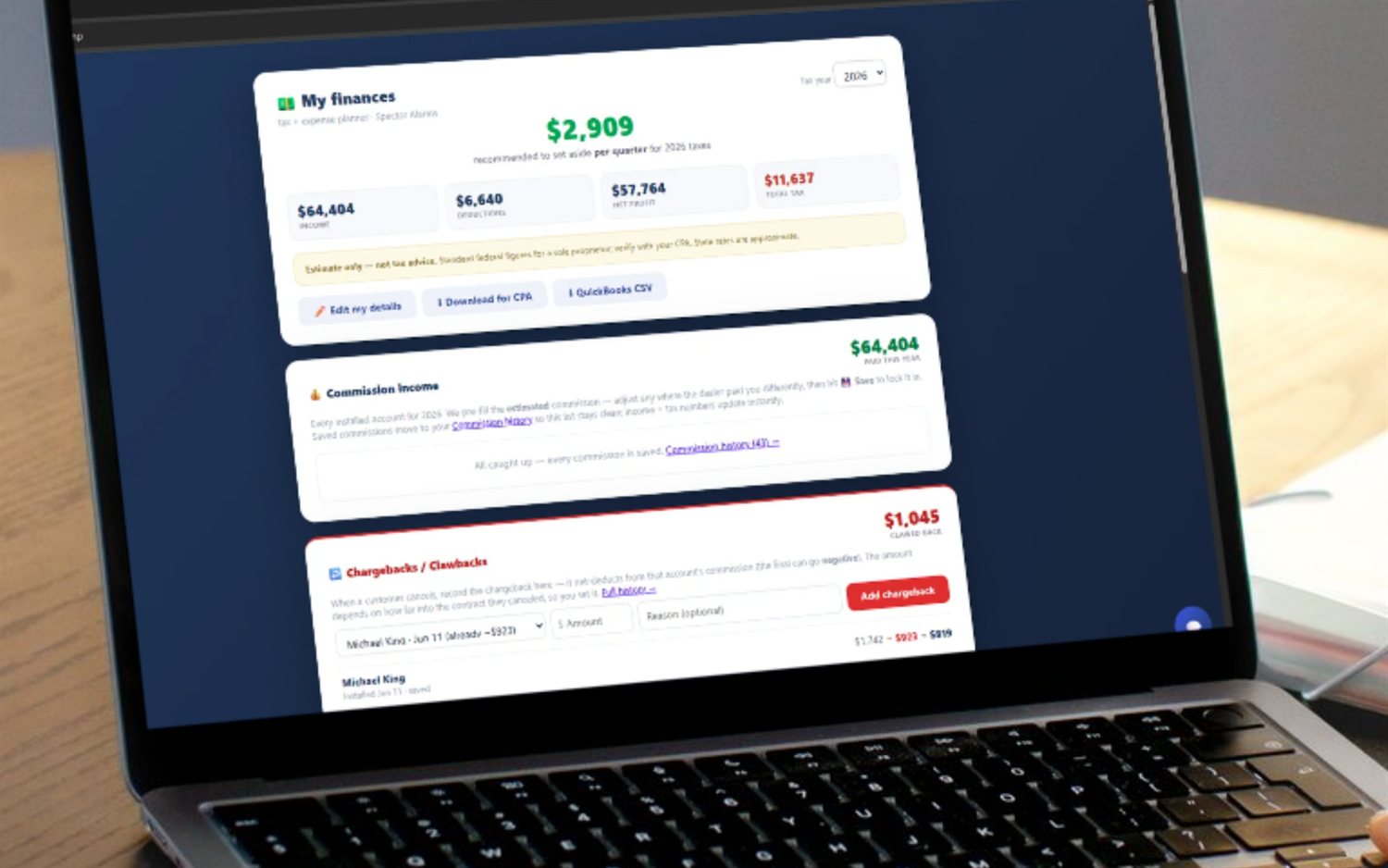
  • Chargebacks and clawbacks netted against your total, so a three-day cancel does not sit in your head as income
  • Set fees and install bonuses tracked against the door that produced them — even when they land weeks apart
  • Automatic mileage at the IRS rate for every day you cross the metro
  • A quarterly 1099 tax set-aside that builds while the season is good

The HVAC CRM →   See flat pricing →

FieldStacker financials showing per-deal HVAC commission and spiffs with chargebacks netted out and a quarterly tax set-aside

HVAC commission questions, answered straight

How is HVAC sales commission usually calculated?

One of four ways, and you need to know which one you are on before you take the job. A percentage of the job's revenue is the simplest. A percentage of the job's gross profit is increasingly common and pays you on margin instead of sticker price. A flat dollar amount per system installed is used at high-volume replacement shops because it is easy to forecast. And a sliding scale ties your rate to how close you sold to book price, so discounting costs you twice. On top of whichever base you are on sit spiffs — memberships, indoor-air-quality add-ons, thermostats, surge protectors — that are usually separate line items.

What is a typical HVAC commission percentage?

It varies enough that any single number is misleading, but the ranges reps and managers commonly describe are roughly 6% to 12% of the job's revenue on revenue-based plans, or roughly 20% to 40% of gross profit on margin-based plans. Flat per-system plans commonly land somewhere in the low hundreds to under a thousand dollars per installed system, often tiered by efficiency or by good-better-best level. Canvassers and setters are paid differently — usually an hourly base plus a set fee per appointment that actually sits, plus a bonus if that door turns into an installed system. Treat all of these as typical, not universal, and verify against the actual written plan.

What is the difference between revenue-based and gross-profit-based commission?

Revenue-based pays you a percentage of what the customer signs for, so a $14,000 job at 8% is $1,120 whether the install went smoothly or went sideways. Gross-profit-based pays you a percentage of what is left after equipment, materials, labor and sometimes financing fees, so the same job can pay very differently depending on how it actually got built. Margin plans usually pay more on a clean, well-sold job and less on a discounted or difficult one, and they cannot be finalized until job costing closes — which is why margin-plan reps often wait longer to get paid and occasionally see an adjustment after the fact.

Do HVAC reps get residual income like alarm RMR?

Not really, and it is worth being honest about that because it is the biggest structural difference between HVAC and alarm sales. Maintenance memberships are the closest thing this trade has to recurring revenue — the customer pays monthly or annually for seasonal checks, priority service and a repair discount — but the rep is almost always paid a one-time spiff for selling one, commonly somewhere in the tens of dollars, not an ongoing residual. Some companies pay a small renewal bonus. If you want true recurring monthly revenue on your own book, that lives in alarm and monitoring sales, not HVAC.

What gets clawed back from an HVAC sales commission?

More things than new reps expect. Cancellations are the big one: sales made at a customer's home are generally subject to a federal cooling-off rule giving three business days to cancel, and many states add their own protections — confirm the current rule and your state law with your company. Beyond that: financing that never funds or a customer who does not qualify, uncollected final balances, jobs that blow their install budget on a gross-profit plan, callbacks and warranty rework at shops that charge them back, price concessions given later to resolve a complaint, and permit or inspection failures that require redoing work. A good comp plan states each of these in writing.

When does HVAC commission actually get paid?

Rarely at the signature. The most common pattern is payment after the system is installed and invoiced, on the next one or two pay cycles, which for a job sold in the peak of summer can still mean weeks. Some companies split it — part at sale, part at install — and gross-profit plans generally wait for job costing to close, which can run several weeks past the install date. Canvasser set fees usually pay much faster, often on the next payroll after the appointment sits. The gap between selling and getting paid is why tracking each deal to its own payout matters more in this trade than in fast-cycle verticals.
The rest of the HVAC set

📊

Income

What the plan turns into in a real year. How much HVAC reps make →

🗣️

Scripts

Openers and objection branches. HVAC door-to-door scripts →

🧭

Field guide

Territory, season and follow-up. How to sell HVAC door to door →

Knock map →   All industries →

Know what you actually earned this quarter

Track every set fee, spiff, system commission and clawback against the door it came from. 14-day free trial, no credit card, flat month-to-month.