Field guide · tree service

How to sell tree service door to door

Choosing streets by canopy instead of income, knocking the block your crew is on, the walk-the-tree pitch, permits and city trees, and the follow-up that closes the other half.

Flat month-to-month from $30/mo · 14-day free trial · no seat minimums, no annual contract

The short version: tree service canvassing is won before you knock. Pick streets by canopy age, work the block your crew is already on, knock earlier in the day than the solar guys, lead with what you can see from the curb, walk the drop zone before you price anything, and follow up like the second visit is where the money is — because it is.

Why this trade does not knock like the others

Every general door-to-door playbook is built on the same assumption: the homeowner does not know they have a problem, so your job is to create awareness and then urgency. Tree work breaks that assumption in the best possible way. The problem is fifty feet tall, it is directly over their bedroom, and they have been looking at it for two years. You are not creating demand — you are converting a postponed intention into a booked date.

That flips three things. Your credibility matters more than your persuasion, because the homeowner is judging whether you know what you are looking at. Price comes up in the first ten seconds instead of the last ten minutes. And the risk of overselling is enormous: tell someone a healthy tree is about to fall and the first arborist who tells them otherwise takes the whole street. The reps who dominate a neighborhood for a decade are the ones who occasionally say "honestly, that one is fine."

Step one: pick streets by canopy, not by income

This is the highest-leverage decision you make all week and most reps never think about it. Drive or map the neighborhood before you commit a day to it, and look for these:

  • Build era of roughly twenty-five to sixty years ago. Trees planted at build-out are now large, over structures, and due. This one factor beats every demographic filter.
  • Species that are actively in trouble in your region. Ash in emerald ash borer country is the clearest example in the Midwest and Northeast — whole streets of standing dead. Elsewhere it might be oak wilt, hemlock woolly adelgid, bark beetle, or storm-damaged pine.
  • Canopy over roofs and service drops. Limbs on shingles, branches into the drop line, and trees leaning toward the house are the jobs that sell themselves.
  • Access you can actually work. Look at gates, side yards and driveways from the street. A rear-yard-only lot with a narrow gate is a much more expensive job — know that before you price it, not after the crew arrives.
  • Storm track. Where the wind or ice band actually crossed, not the whole county.
  • Hillside and wildland-interface lots in fire country, where clearance around structures is a live concern for the homeowner.
  • Density. A block you can walk beats a rural road where every door costs twenty minutes of windshield time.

And know what to skip: brand-new subdivisions full of staked saplings, blocks that are mostly rentals where the decision maker is an absentee landlord, and communities where the HOA owns and maintains the common trees. Those are polite conversations that never become jobs.

Step two: the season calendar

Tree demand is seasonal in a way that is completely predictable — which means it is plannable. Regional and species guidance varies, so check your state extension service before you build a pitch around a pruning window.

SeasonWhat is visible and sellableThe knock
Late winter into early springStructure is visible with no leaves; ground often firm; storm damage from winter still standingDormant-season rates, structural pruning, and cleaning up what the winter broke before it leafs out
Late springLeaf-out exposes what is dead — the tree that never came back is now provably goneThe easiest evidence knock of the year: point at the bare crown on a street that has fully leafed out
SummerDrought stress, deadwood, hangers, pest and disease pressure, full canopy weight over the roofWeight reduction over structures, deadwooding, and treatment programs where they apply
Storm windowsWhatever just came down. Wind, ice, derecho or hurricane band, depending on your regionTriage first, sell second. Be honest about what you can reach and when
FallLeaf drop reveals hangers, deadwood and cracked unions that were hidden all summerPre-winter risk reduction and booking the dormant schedule before the first ice event

One regional caution worth knowing because it makes you sound like a professional: in parts of the country affected by oak wilt, extension services commonly advise against pruning oaks during the high-risk months of the year. Know whether that applies where you sell, and say so at the door when it does. A rep who declines to prune an oak in June for a real reason earns more trust than one who books it.

The strategic use of all this is not the pitch — it is load balancing your own income. Everybody sells in storm season. The reps with a flat, boring income curve are the ones who deliberately fill the slow stretch by booking dormant work in the fall. See what tree reps actually make for why that matters more than another point of commission.

Step three: knock the block your crew is on

If you take one tactic from this page, take this one.

1

Territory it that morning

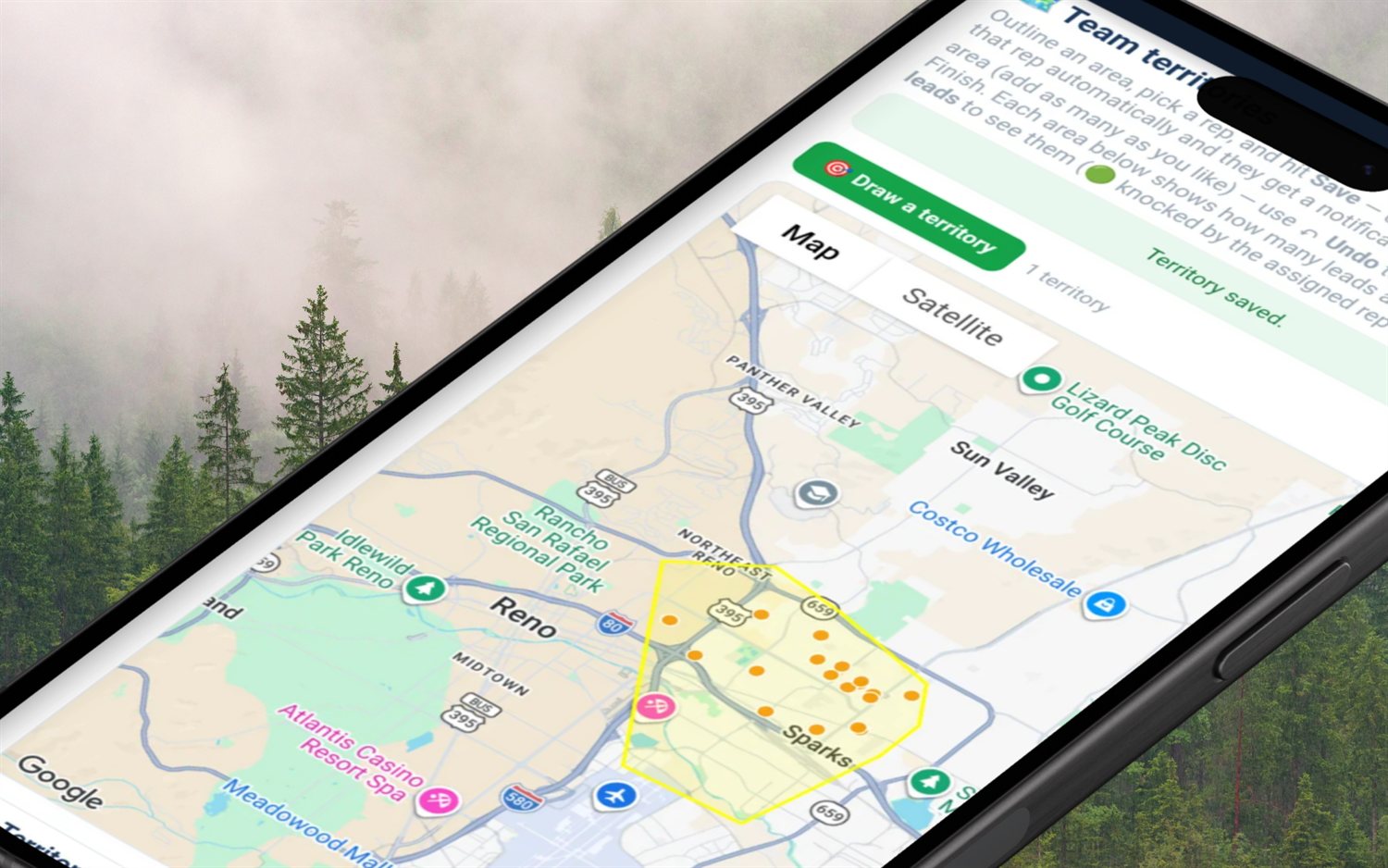
The moment a multi-day job starts, draw a territory around the street and load every door in sight of the truck. This is a same-day window, not a someday plan.

2

Knock while the bucket is up

Your crew in harnesses is better proof than any brochure. Lead with the truck: everything is already set up, so anything on their lot costs less to produce than a return trip. That saving is real.

3

Walk anything they point at

Same-day estimates while you are already there. Half of what sells on these blocks is work nobody was actively shopping for.

4

Disposition every door

Not-home, walked it, estimate left, waiting on spouse. That record is what lets you work the street again in six months instead of starting cold.

Why it works, honestly: mobilization is a genuine cost. Getting a bucket truck, a chipper, a dump body and a three-person crew to a street is expensive whether they cut one tree or four. That is why the on-site rate is not a fake discount — and why homeowners who have been quoted before recognise it as a real one.

Step four: the doorstep, then the drop zone

The doorstep is not where you sell tree work. Under the tree is. Your entire objective in the first thirty seconds is to get them off the porch and standing at the root flare with you, which is why every good tree opener names a specific, true, visible thing about their tree before it names your company. The full openers and every objection branch live on the tree service scripts page; here is the shape:

  • Observation — the bare crown, the hanger, the split union, the limb on the shingles.
  • Placement — why you are on this street today: the job at 412, the storm, the ash on the block.
  • Invitation — "walk out here with me for two minutes," said while you are already turning toward the yard.
  • Next step — a walked tree, a written scope, and a date. Never end on "here is my card."

Then walk the whole job with them. Where the brush comes out, what gets driven on, whether a fence panel comes off, whether the stump is included and to what depth, whether the wood is left in rounds or hauled. This is not customer service theatre — it is how you bid accurately and how you avoid the verbal promises that quietly come back out of your commission later. Read the drop zone, the access and the rigging before you say a number, every single time.

Step five: know the legal edges before you sell

Tree work has boundaries that other trades do not, and the rep who knows them looks like the only professional on the street.

  • Whose tree is it. Street and right-of-way trees frequently belong to the city. Telling a homeowner they do not owe for a tree is the fastest trust you will ever buy.
  • Permits. Many municipalities require one for protected, heritage or above-a-certain-size trees, sometimes with an arborist report. Selling work that gets stopped is worse than not selling it.
  • Property lines. Rules vary by state; homeowners often may trim to the line and not beyond. Do not play lawyer — do go knock the neighbor.
  • Utility corridors. Line clearance crews clear the conductor corridor and stop; everything outside it is the homeowner's. Explain the boundary rather than badmouthing the utility.
  • Insurance. Carry it, prove it, and lead with it. General liability and workers compensation, with a certificate emailed from the office naming the customer before the crew arrives.
  • Their insurance. Never promise a homeowner their policy will pay. Coverage for removal commonly depends on whether the tree struck a covered structure and varies by policy — send them to their carrier.
  • Your qualification. If the honest answer is a certified arborist assessment, say so and book one. Overclaiming loses neighborhoods.

Step six: close on a date

A tree close is a calendar slot, not an abstract yes. The homeowner has usually already accepted that the work needs doing — what they are stalling on is committing a Thursday and a deposit. So close on the date: the on-site close while the truck is on the block, the two-option close that offers a reduction instead of a removal, the photo close that texts them the defect so the picture argues for you at dinner, and the honest weather close when there is genuinely a line coming through Sunday. Then get the scope in writing before you leave.

Step seven: the follow-up is half the job

Tree sales has a long, quiet middle that no other trade has quite the same way. The estimate sits on the counter. The spouse has to weigh in. The permit takes three weeks. The HOA meets on the second Tuesday. Nobody says no — they just go quiet, and a rep with no system loses the sale to whoever knocks next. A cadence that works:

  • Same day: text a photo of the actual defect with the written scope. That photo does the selling you cannot do from the porch.
  • Within a week: a short check-in that gives them a reason to reply — the schedule, the weather, an answer to something they asked.
  • Next time you are on that street: knock it. You are not a stranger now, which is the entire advantage of a go-back.
  • Seasonally: the dormant-rate call in late fall, or the honest "there is wind coming this weekend" call about the hanger you flagged.

The discipline is not the hard part. Knowing which of two hundred doors is due today is the hard part, and that is a systems problem — every knock needs a disposition and a callback date attached to it the moment you walk away.
Where FieldStacker fits

The street, the doors, and the go-backs

Everything above depends on remembering things: which streets are worth walking, which door was walked last April, which estimate is waiting on a permit, and which callback is due today. FieldStacker holds all of it in one app on your phone; the bidding itself stays in SingleOps, ArborGold, ArboStar, Jobber or whatever your shop estimates in.

  • Draw a territory around the working block the morning the job starts
  • Custom dispositions that match a tree bid, not a subscription sale
  • Callbacks that come due on the date they matter, so go-backs stay warm
  • GPS-verified team knocks so two reps never re-pitch the same house
  • Just-sold lead pins you can filter down to older housing stock
  • Commission, clawbacks, automatic mileage and a 1099 set-aside
  • Works offline, because the good streets are not always the ones with signal

See the tree service CRM →   The knock map →

FieldStacker territory drawn around the block a tree crew is working, with every door inside it loaded for canvassing

The rest of the series

🗣️

Scripts and objections

Six openers word for word, plus every objection tree reps actually hear. Read the scripts →

📊

Commission structures

Revenue versus gross profit, tiers, setter fees and what gets clawed back. Read it →

💰

What tree reps make

Honest ranges and the six things that decide where you land. See the numbers →

🧰

The tools

The CRM, the map and flat pricing. Tree service CRM → · Pricing → · All industries →

Field questions, answered straight

How do you pick a good neighborhood for tree service canvassing?

Read the canopy, not the ZIP code. The best tree territory in almost any city is a neighborhood built roughly twenty-five to sixty years ago: the trees planted at build-out are now over the roof, near the service drop, and old enough that somebody has been putting the work off for years. Brand-new construction is the worst street you can walk, because the trees are staked whips and there is nothing to sell for a decade. After that, look for the specific tells — ash on the parkway in emerald ash borer country, storm-track streets, hillside lots in fire country, and driveways with enough access for a chipper. Density matters too: a compact block you can walk beats a rural road where every stop costs twenty minutes of driving.

What is the best time of day to knock for tree service?

Earlier than most door-to-door trades, which is a genuine advantage. Solar, alarm and pest reps live in the five-to-eight evening window because they are hunting working couples. Tree work skews toward long-tenure owners in established neighborhoods, a lot of them retired or working from home, and they answer the door mid-morning through early afternoon. That is also the only window in which the crew-on-the-block knock works, because it depends on the bucket truck being visible in a yard behind you. Work your own numbers rather than a rule of thumb — but do not assume the evening window that works for solar is where your doors are.

What is the single most effective tree service canvassing tactic?

Knocking the block your crew is already working. The truck, the chipper and the crew in harnesses are the most credible sales asset your company owns, and they cost you nothing to bring. Mobilization is a real expense, so a job done while everything is already set up genuinely costs less to produce than a return trip — which means the on-site rate you offer is honest rather than a pressure tactic. Territory the street the morning the job starts, work every door within sight of the truck, and disposition each one. This knock closes at a rate cold canvassing does not approach.

Do I need a permit to remove a tree, and whose tree is it?

It depends on the city and it matters enough to learn before you sell. Street and right-of-way trees frequently belong to the municipality rather than the homeowner, and many cities require a permit to remove protected, heritage or above-a-certain-diameter trees even on private property, sometimes with an arborist report attached. Some HOAs add their own approval on top. Getting this wrong is worse than losing the job: you sell work that gets stopped, the customer is angry, and your commission reverses. Learn your local rules, tell the homeowner the truth even when the truth is that the tree is not theirs to pay for, and disposition those doors as waiting-on-permit so you actually go back.

What should I never say at a tree service door?

Three things. Never quote a price from the sidewalk before you have walked the drop zone and the access, because that guess becomes the number you get held to and the overrun comes out of your commission. Never tell a homeowner their insurance will cover it — policies commonly pay to remove a tree that strikes a covered structure and commonly do not when one falls in the yard, it varies by policy, and it is not yours to promise; tell them to call their carrier. And never diagnose beyond what you are qualified to say. If the answer is a certified arborist assessment, say so and book one. Overclaiming is the fastest way to lose a neighborhood.

How many times should I follow up on a tree estimate?

More than you are currently doing. A large share of tree work closes on the second or third contact, because the real blockers are a spouse, a permit, an HOA meeting and a budget month rather than a genuine no. A cadence that works: a same-day text with a photo of the actual defect, a check-in within about a week, a knock when you are next on that street, and a seasonal go-back — the dormant-rate call in late fall or the "there is weather coming Sunday" call. The hard part is not the discipline, it is knowing which of two hundred doors is due today, which is why every knock needs a disposition and a callback date attached to it.

Walk your next street with a plan

Territory the block, disposition every door, and let the go-backs come due on their own. 14-day free trial, no credit card, flat month-to-month.