Tree service · rep earnings

How much do tree service sales reps really make?

Ranges instead of screenshots. What a canvasser, a first-year estimator and an established sales arborist actually take home — and the six things that decide where you land in that spread.

Flat month-to-month from $30/mo · 14-day free trial · no seat minimums, no annual contract

Read this first. Every figure on this page is a typical range, not a promise, an average or a guarantee. Tree sales income swings hard on region, canopy, company size, storm luck, your comp basis and how much of the year the weather eats. We would rather give you honest ranges you can sanity-check than a hero number from somebody's best month.

The short answer, by role

"Tree service sales rep" covers three quite different jobs that get paid three quite different ways. Sort out which one you are being offered before you compare any numbers.

🚪

Canvasser / setter

Commonly low $30Ks to around $50K. You knock, you qualify, you book the estimate — someone else closes and prices it. Usually hourly plus a fee per qualified estimate, sometimes plus a small slice of what sells. Highly dependent on hours worked and season, and the definition of "qualified" is the whole ballgame.

🌱

First-year sales arborist

Commonly $40K to the mid $60Ks. You walk the tree, write the scope and close it. Base-plus-commission plans cluster toward the lower half with more stability; straight commission stretches the range in both directions. Year one is mostly spent learning to bid accurately, which is also what stops your commission leaking.

🌳

Established rep, mature market

Commonly $70K into six figures. Three-plus years, a repeat customer book, referrals coming in, and a shop whose crews can actually produce what you sell. This is where consistency beats heroics — the reps here are not knocking harder, they are bidding better and losing far less to clawbacks.

🏔️

The tail

Well past six figures happens — it is not typical. Storm markets, high-ticket crane work, big plant health care books, or a rep who effectively runs a division. Real, but it is the end of the distribution, and a company quoting you the tail as the expectation is selling you something.

The math behind the ranges

You do not have to take anyone's word for it. Tree sales income is one multiplication with three inputs you can estimate honestly for your own market: annual sold revenue × your commission rate, minus clawbacks. Annual sold revenue is itself just estimates per week × close rate × average ticket × working weeks.

The table below is illustrative arithmetic to show the shape of the curve. It is not a claim about what any particular company pays, and it deliberately ignores clawbacks, which will take a real bite out of every cell.

Sold and produced revenue per yearAt 5%At 8%At 10%
$500,000$25,000$40,000$50,000
$750,000$37,500$60,000$75,000
$1,000,000$50,000$80,000$100,000
$1,500,000$75,000$120,000$150,000

Two things fall straight out of that table. First, the rate matters far less than the volume — moving from 5% to 8% is worth a lot, but doubling your sold revenue is worth more, and volume is the input you actually control. Second, the row you land on is not really about how hard you knock. It is about ticket size and whether the crews can produce it. A rep in a mature-canopy market with big removals and four crews running will out-earn a harder-working rep in a market of small ornamentals with one truck, at the same percentage, every year.

If you are on a gross-profit plan the arithmetic works the same way but the pool is smaller and the rate is higher — see how tree service commission is structured before you compare two offers by percentage.

Six things that decide where you land

Two reps at the same company on the same plan routinely finish the year forty thousand apart. This is why.

🌲

Your market's canopy

The single biggest factor and the one you cannot change without moving. Older Midwest, Northeast and Pacific Northwest neighborhoods with sixty-year-old hardwoods over houses generate large removals. Newer desert and Sun Belt subdivisions generate small ornamental trims. Same effort, very different average ticket.

🏗️

Crew capacity

The ceiling nobody mentions in the interview. You cannot earn commission on work that never gets produced, and once the backlog passes a few weeks customers start cancelling for whoever can come Tuesday. Ask how many crews run and what the current backlog is — it belongs in your income estimate.

🌩️

Storm exposure

An ice storm or a derecho can double a market's volume for a quarter. It is real money and it is genuinely unpredictable, so never build your budget on it. The reps who profit most from storms are the ones already dispositioned into those neighborhoods before the wind, not the trucks that drive in after.

🎯

Bid accuracy

Underbidding does not just cost the company. On most plans the overrun is recalculated against you, so a rep who guesses low on access and rigging quietly gives back thousands a year. Accuracy is a bigger raise than negotiation.

🌿

Plant health care attach

PHC programs renew every season, so a rep who attaches treatment plans to removals and prunes builds a book that shows up again next year without knocking. If your company pays anything on renewals, this is the closest thing the trade has to residual income.

🔁

Follow-up discipline

A large share of tree work closes on the second or third contact — after the spouse, after the permit, after the HOA meeting. Reps who only work new doors leave sold work sitting on kitchen counters. This is the cheapest income increase available and it is purely a systems problem.

Year one versus year four

What actually changes when the money goes up

Reps assume experienced arborists earn more because they close better. Mostly they do not — the close rate difference between a good first-year rep and a veteran is smaller than you would think, because the tree sells itself. What changes is everything around the close:

  • They bid accurately, so they stop funding their own overruns
  • They scope in writing, so verbal promises stop eating margin
  • They have a repeat and referral book, so a chunk of the year arrives without knocking
  • They know which streets in their city are worth walking and which are staked saplings
  • They chase go-backs relentlessly instead of chasing new doors
  • They have relationships with property managers, HOAs and realtors that feed multi-tree jobs
Read the field guide →

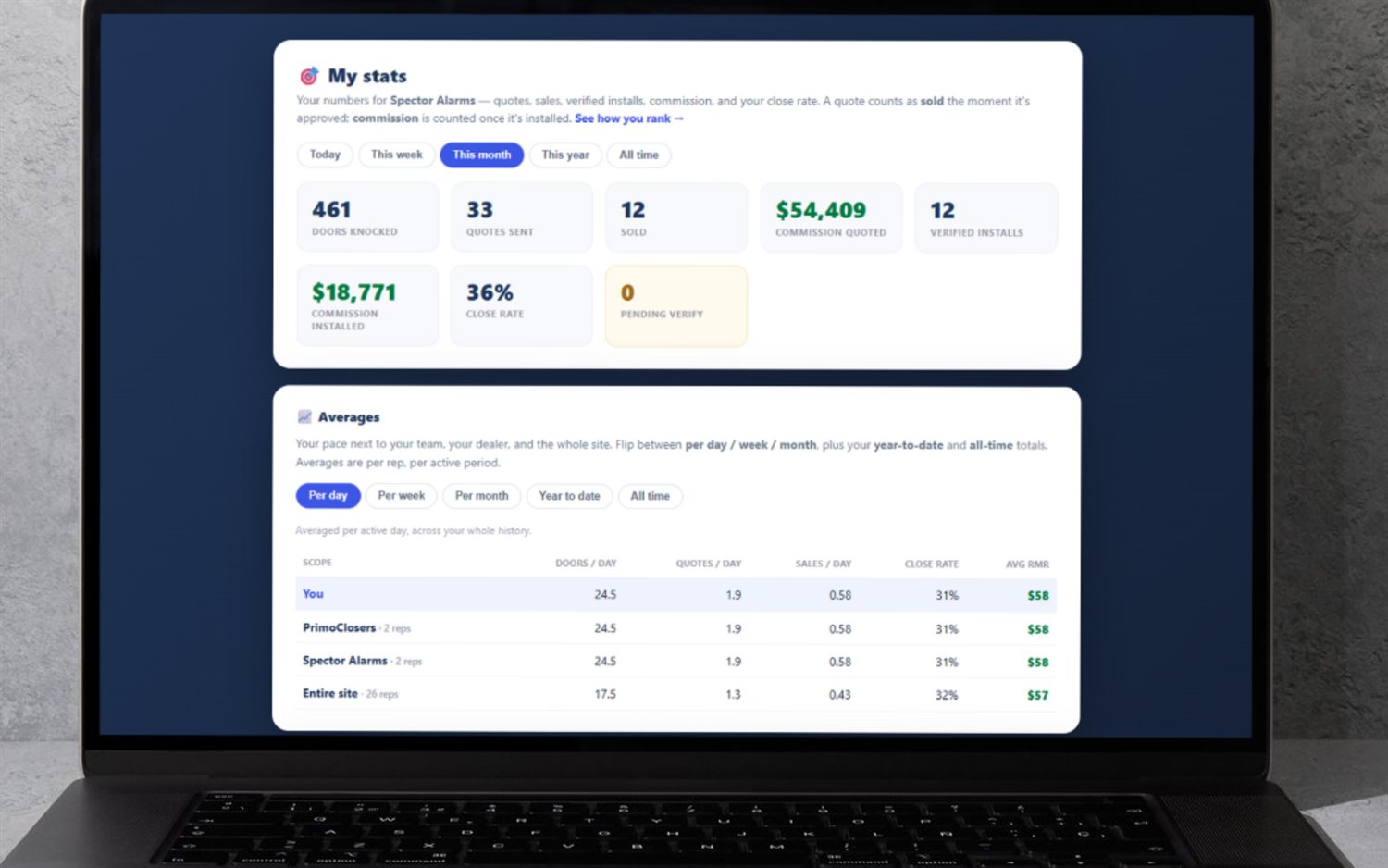
FieldStacker rep stats dashboard tracking knocks, contacts, estimates and closes over time for a tree service rep

The seasonality nobody puts in the job ad

Annual figures hide the shape of the year, and the shape is what makes or breaks a new rep. Most markets run hot from spring storms through the fall, then hit a quieter dormant stretch. Frozen or saturated ground shuts crews down. A week of rain is a week of cancelled production, which means a week of commission that slides into the next cycle. If you are on straight commission with no base, January and February can be genuinely thin, and reps who spent a good October like it was a normal month feel it hard.

The counter-move is the same one every seasoned rep makes: sell into the slow season on purpose. Dormant pruning is legitimately better work for many deciduous species, the ground is firm so you are not rutting lawns, and the crews are hungry so scheduling is fast. A rep who books January in November has flattened their own income curve without earning a single extra point of commission.

If you are 1099, the number on the offer is not the number

Tree service leans more W-2 than solar or alarms — plenty of sales arborists are employees with a truck and withholding. But if you are contracted as 1099, understand what changes before you compare offers. Nothing is withheld from your commissions. You owe self-employment tax on top of income tax, at a rate a W-2 job would have split with you. The IRS expects estimated payments four times a year, and skipping them can trigger a penalty even if you settle up in April.

The offsetting good news is that your deductions are real and, for an estimator, substantial. Driving between estimates all day makes business mileage frequently the largest single line on the return — but only if you have a contemporaneous log, not a reconstruction. Add your phone, your software and your gear. Then set money aside from every commission as it lands, because a percentage of it was never yours. Full walkthrough: 1099 taxes for door-to-door reps. None of this is tax advice — talk to a CPA.

FieldStacker financials showing per-job commission, clawbacks netted against the total, automatic mileage and a quarterly tax set-aside
Know your real number

Most reps cannot tell you what they actually earned

Ask a tree rep in October what they have made this year and you usually get a guess. Gross commission is not take-home: clawbacks come off it, mileage goes back on as a deduction, and if you are 1099 a chunk of what is left belongs to the IRS. FieldStacker keeps all of that honest in the same app you canvass with:

  • Per-job commission on your own rate and basis
  • Clawbacks netted against the running total, not hidden
  • Automatic mileage at the IRS rate for a day of six estimates
  • A quarterly 1099 tax set-aside so a good quarter is not a spring problem
  • Every dollar traced back to the door that produced it

See the tree service CRM →   Flat pricing →

The rest of the series

📊

Commission structures

Revenue versus gross profit, tiers, setter fees, clawbacks and payout timing. Read it →

🗣️

Scripts and objections

Curb-evidence openers and the real sentences homeowners say. Read the scripts →

🧭

Sell tree service door to door

Territory, season, the walk, the close, the follow-up. Field guide →

🗺️

The knock map

Territories, dispositions, GPS knocks and go-backs. See the map → · All industries →

Earnings questions, answered straight

How much do tree service sales reps make?

Broad, honest ranges: a canvasser who books estimates but does not close often lands somewhere in the low thirties to around fifty thousand a year on an hourly-plus-per-estimate arrangement. A first-year sales arborist or estimator commonly lands in the forties to mid sixties. An established rep in a market with real canopy, a repeat book and a company whose crews can keep up commonly runs from the seventies into six figures. Top producers in storm-heavy or high-ticket crane markets go well past that, but that is the tail of the distribution and usually involves a big plant health care book or an unusually good storm year. All of it varies by region, company, basis and how much of your year the weather takes away.

Do tree service reps make more than roofing or solar reps?

Usually less at the very top and more at the bottom. Solar and storm roofing have famously long tails — the outliers earn enormous numbers and the median rep washes out in a year. Tree service is steadier: the average ticket is smaller than a re-roof or a solar system, the sales cycle is short, the objection is easier because the homeowner can see the problem, and the demand does not depend on a tax credit or an insurance approval. What caps tree earnings is not demand, it is production. You can only earn on what your crews can actually cut, and that ceiling is very real.

What is the biggest thing that limits a tree sales rep's income?

Crew capacity, and almost nobody warns you about it. In most trades the constraint is finding buyers. In tree care a good rep can regularly sell more work than the company can produce, and once the backlog stretches past a few weeks the damage compounds: customers cancel and take a competitor who can come Tuesday, your commission slides into a later month, and you spend your days apologising instead of estimating. Before you take a job, ask what the current backlog is and how many crews are running. A modest percentage at a shop with four productive crews beats a great percentage at a shop with one truck and a broken chipper.

Is tree service sales 1099 or W-2?

It leans more W-2 than solar or alarms, which is a genuine difference in this trade. Sales arborists and estimators are frequently employees with a base, a company truck or a vehicle allowance, and payroll withholding. Pure canvassers and independent closers are more often 1099. If you are 1099, the picture changes: nothing is withheld, you owe self-employment tax on top of income tax, you pay estimated tax four times a year, and your mileage becomes one of the largest deductions on your return — which only works if you logged it as you drove. Read our plain-English 1099 primer before your first quarter comes due.

How many estimates a week does a tree sales rep run?

It varies with drive time and market density, but a full-time estimator in a compact suburban territory frequently runs something in the range of eight to fifteen estimates a week, while a rural territory with an hour between stops runs far fewer for the same effort. Close rate is typically better than most door-to-door trades — the homeowner can see the problem — but it drops fast when you are the third bid. That is why territory density and being first to the door matter more to your income than another two points of commission.

What should a first-year tree sales rep focus on to earn more?

Three things, in order. Bid accurately, because on most plans the overrun on a job you underbid comes back out of your own commission. Chase your go-backs, because a large share of tree work closes on the second or third contact and reps who only knock new doors leave half their sold work on the counter. And canvass the block your crew is already working, because the mobilization is already paid for, the truck is visible proof, and those knocks close at a rate cold canvassing never touches. None of those require a better percentage. They just require a system that remembers every door.

Move up a row on that table

More doors, better go-backs and a commission number you can actually trust. Start a 14-day free trial — no credit card, flat month-to-month.