Rep money · satellite and cable TV

Satellite and cable TV sales commission, explained honestly

Per unit, paid after the install, and reversible for months. Here is how the rate cards actually work — units, ladders, bundle spiffs, residual, reserves — and exactly what gets taken back.

Flat month-to-month from $30/mo · 14-day free trial · no seat minimums, no annual contract

The short version: TV pay is per unit, back-loaded and reversible. You are usually not paid for a sale — you are paid for a completed install that survives a chargeback window of commonly 90 to 180 days. Every figure on this page is a range reps describe, not a rate you are owed. Your agreement is the only authority.

The unit is the whole vocabulary

Telecom does not count deals, it counts units. You will hear RGU (revenue-generating unit) or PSU (primary service unit) depending on whose building you are in, and it means the same thing: each service on the account counts on its own. Video is a unit. Internet is a unit. Voice is a unit. A mobile line, on the carriers that now bundle one, is a unit — sometimes with its own rate and its own rules.

That is why two reps with identical “12 sales this week” can have completely different checks. One sold twelve video-only accounts. The other sold twelve households at two or three units each and picked up the bundle bump on top. In a category where video subscriptions have been shrinking for years, the attach — internet, and increasingly mobile — is where the money moved. Any rep still counting households instead of units is measuring the wrong thing.

The five structures you will actually be offered

1️⃣

Flat per unit

One rate per activation, same rate at unit one and unit forty. Simple, easy to verify, common at smaller retailers and for subcontracted reps. Reps describe figures roughly in the $40–$150 range per unit depending on product and market — treat that as the shape of the market, not your number.

📶

Tiered / volume ladder

The rate climbs as you hit monthly thresholds. The detail that decides whether it is generous or decorative: does hitting the tier lift every unit that month retroactively, or only the ones after the threshold? Ask that question out loud before you sign.

🏦

Base plus commission

Common where a cable operator staffs its door channel through a vendor firm: hourly or salary, plus per-unit on top, usually as a W-2 employee. Lower ceiling, real floor, and the employer covers half your Social Security and Medicare.

🎁

Spiffs and bundle bumps

Layered on top and constantly changing: a bonus for a triple play, a mobile-line spiff, an autopay or paperless enrollment kicker, a weekend blitz bonus, a push on one specific promo. Read the fine print — spiffs frequently carry their own qualification and their own clawback.

♻️

Residual / RMR

The retailer often earns a monthly residual from the provider on accounts it places, which is why owning a dealership is a different business from working at one. Rep-level residual exists but is uncommon; if it is promised, get it in the agreement with the rate and the term.

⚠️

Draw against commission

An advance you repay out of future commission. It smooths a slow week and it quietly builds a hole you have to sell your way out of. Ask whether the draw is recoverable and what happens to the balance if you leave — that answer matters more than the amount.

You are not paid for the sale. You are paid for the install.

This is the structural fact that surprises reps arriving from other trades. In roofing or solar there is a contract with a value attached. In TV, the customer’s yes on the porch is the beginning of the pay event, and several things still have to happen:

  1. Qualification — the address is serviceable and the customer clears credit. A failed credit check can change the upfront cost or kill the order outright.
  2. Verification — on most telecom orders the customer confirms the terms on a recorded third-party call. Anything you oversold in the driveway dies here.
  3. Install completed — the technician actually gets in the house and the service goes live. A no-show, a refused install, an obstructed line of sight discovered on the site survey, an HOA that will not permit a dish: no install, and typically no commission.
  4. Survival — the account stays active and paying through the chargeback window.

Steps three and four are where most lost income hides. A rep with a great close rate and a terrible install-completion rate can out-sell everyone on the board and out-earn nobody. If your dealer publishes install-completion or 30-day-retention stats, that number tells you more about your income than your knock count does.

Chargebacks: what triggers them, and when

Every one of these is defined in your agreement. Windows in this trade commonly land somewhere in the 90-to-180-day range, and a bundled mobile line sometimes carries a longer one than the video sale that brought it in. Read the actual document.

TriggerWhat it usually meansTypically
Cancel inside the windowCustomer disconnects before the retention period endsFull reversal of the unit
First bill never paidAccount disconnects for non-payment earlyFull reversal, sometimes flagged for review
Install never completedNo-show, refused install, no line of sight, HOA or landlord blocks the mountNothing was ever earned
Cooling-off cancellationBuyer exercises the right to cancel a sale made at their homeFull reversal
DowngradeCustomer drops below the package that qualified the ratePartial reversal to the lower tier
Unreturned equipmentReceivers, gateways or modems never come backVaries by dealer; can be charged to the rep
Misrepresentation flagTerms, price or affiliation described inaccurately at the doorReversal plus a compliance problem
Spiff qualification failureAutopay dropped, mobile line ported out, promo condition unmetThe spiff reverses even if the base unit survives

Two chargeback details worth more attention than they get. First, reserves: some dealers hold back a percentage of each payout until the window closes, which is defensible but means your real earning rate is lower than your rate card until the release lands. Second, trailing liability: at some dealers, chargebacks on your accounts can be collected after you stop working there. Ask that question before your first day, not after your last.

When the money actually shows up

Payouts commonly run weekly or semi-monthly, a pay period or two behind the install date. That lag means your first month in this job usually pays very little regardless of how well you sell, and your last month pays out after you are gone. Reps who do not plan for both ends of that lag quit in week five with money in the pipeline they never collected. Combine the lag with a reserve and a 90-plus-day window and the honest description is this: your income in month one reflects nothing, and your income in month six reflects month four.

W-2 vendor or 1099 retailer? The structure changes the whole deal

Cable operators frequently reach the door through vendor firms that hire reps as W-2 employees with a base plus per-unit commission. Satellite retailers more often engage reps as 1099 contractors on a higher per-unit rate with no floor. Neither is automatically better, but they are genuinely different jobs:

  • W-2 base plus commission: a floor under bad weeks, the employer pays half of Social Security and Medicare, taxes are withheld, and mileage is usually not deductible to you. Lower ceiling.
  • 1099 straight commission: higher per-unit, no floor, you owe the full 15.3% self-employment tax on net profit, you pay quarterly estimates yourself, and your business mileage becomes a real deduction. Higher ceiling, higher variance.
  • Either way: the chargeback window applies. Being a W-2 employee does not mean commission cannot be reversed.

If you are 1099, read the 1099 tax guide for D2D reps before your first quarterly deadline, not after.
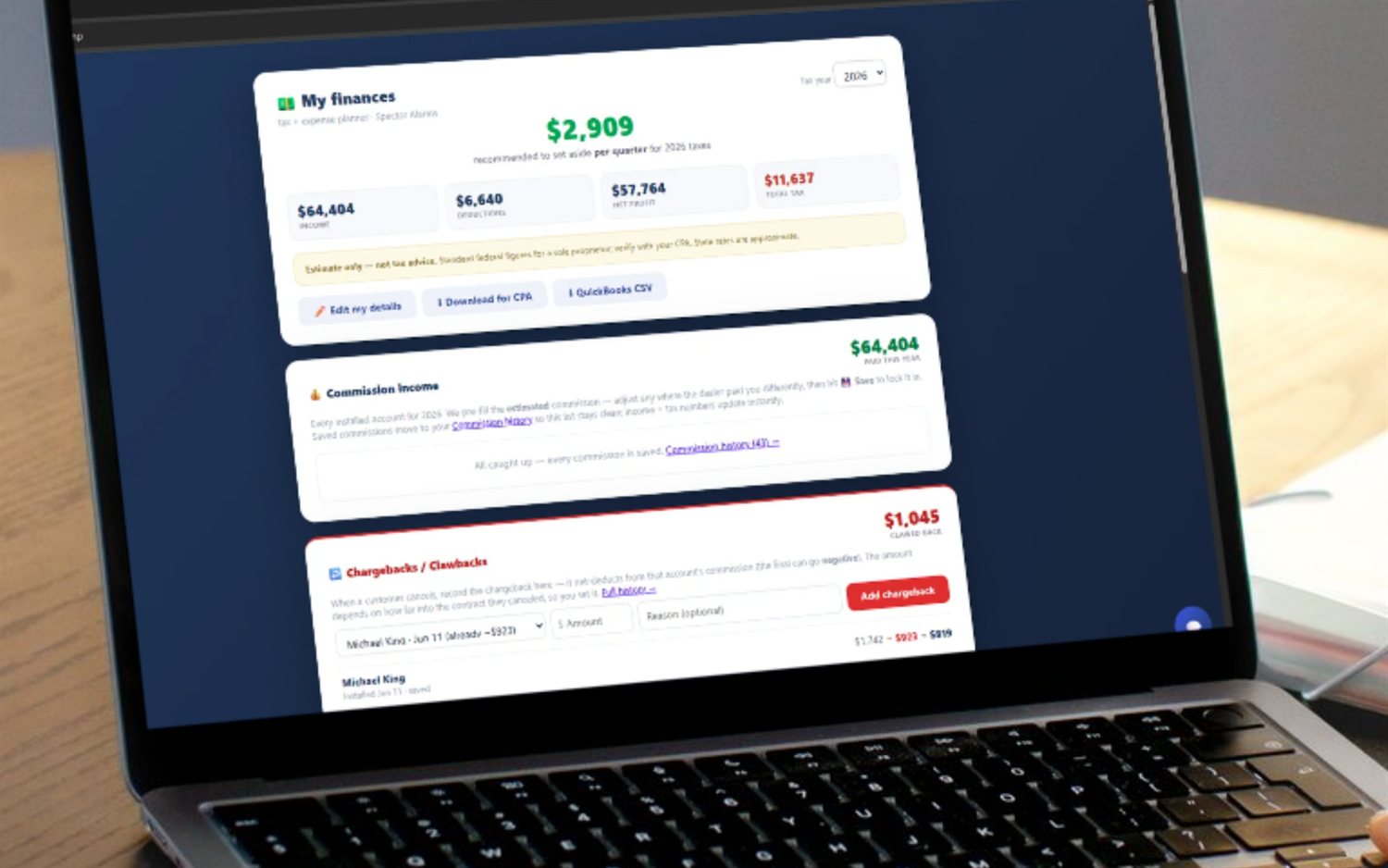
Why reps track this themselves

A dealer statement tells you the total. It rarely tells you which deal died

Nobody is trying to hide anything — but a semi-monthly statement with a net deduction line does not tell you that the Peterson install on Vine canceled in month three, or that four of your six mobile spiffs from March reversed. Reps who keep their own ledger spot patterns the statement buries: a bad install crew, a promo that always cancels, a street that never pays a second bill.

  • Log each sale with its own per-unit rate and any bundle or mobile spiff
  • Record the chargeback against the original deal so it nets, instead of appearing as an unexplained deduction
  • Auto-mileage at the IRS rate for the driving this trade demands
  • A quarterly 1099 tax set-aside that builds as you go
  • Your real net per month, after reversals — the only number that pays rent

See the TV sales CRM →

FieldStacker financials showing per-deal commission with chargebacks netted against the running total and a quarterly tax set-aside

Six questions before you sign anything

Print these. A good dealer answers all six without flinching.

1

The rate, per product

Not “up to” — the actual per-unit figure for video, internet, voice and mobile, in writing.

2

The pay trigger

Order submitted, install completed, or first bill paid? These are three very different jobs.

3

The window

How many days, measured from what date, and does any product carry a longer one?

4

The reserve

Is a percentage held back, how much, and what exactly releases it?

5

Trailing liability

If you leave, can chargebacks on your accounts still be collected from you?

6

W-2 or 1099

It determines your tax bill, your mileage deduction and whether you have any floor at all.

Keep reading

The rest of the satellite and cable TV playbook.

📊

What reps actually earn

Ranges, first year versus experienced, and what drives the spread. Income ranges →

🗣️

Scripts and objections

The openers and branches that produce the units on your rate card. TV sales scripts →

🚪

The field guide

Territory, season, the day, the close, the follow-up. How to sell TV door to door →

🗺️

The knock map

Where the units come from in the first place. Knock map →

🛰️

The CRM for this trade

Knocks, dispositions, chargebacks and mileage in one app. Satellite and cable TV CRM →

🧩

Other industries

Sell more than TV? Same login, one bill. All industries →

Commission questions TV reps ask

How does satellite and cable TV sales commission work?

Almost always per unit, paid after the install completes, and reversible for months afterward. The industry counts revenue-generating units — video, internet, phone and increasingly a mobile line each count separately — so a single household can pay as one unit or as four. Reps report typical per-unit figures anywhere from roughly $40 to $150 depending on the dealer, the product and the market, often with a volume ladder on top and spiffs layered over that. Those are ranges reps describe, not a promise: the only number that matters is the rate card in your own agreement.

When does a TV sales rep actually get paid?

Not when the customer says yes. The normal sequence is order submitted, verification completed, install completed, then commission earned — and a sale that never gets installed usually pays nothing at all, no matter how good the appointment was. Payouts commonly run weekly or semi-monthly and a pay period or two behind the install date, and some dealers hold back a reserve percentage until the chargeback window closes. Ask exactly which event triggers pay before you sign, because "paid on the sale" and "paid on the install" are wildly different jobs.

What gets clawed back in cable and satellite TV sales?

More than new reps expect. The common triggers are a customer canceling inside the dealer's chargeback window, a first bill that never gets paid, a disconnect for non-payment, an install that never happens or gets refused at the door, equipment that never comes back, a downgrade below the package that qualified the sale, and anything flagged as misrepresentation. Windows are commonly somewhere in the 90-to-180-day range and bundled mobile lines sometimes carry a longer one than the video sale they rode in on. Every one of those is defined in your agreement, not by custom.

Is there residual income or RMR in satellite TV sales?

At the dealer level, often yes; at the rep level, usually no. Authorized retailers frequently earn an ongoing monthly residual from the provider for accounts they placed, which is what makes owning a dealership a different business from working for one. Some retailers pass a small piece of that through to reps, and a few build it into a tenure or team-lead structure, but a plain field rep on a per-unit rate card typically gets a one-time payment per activation and nothing recurring. If a recruiter implies otherwise, ask to see it written into the agreement.

Should I take W-2 with a base or straight 1099 commission?

It depends on your cash reserve and your close rate, and both structures are common in this trade. Cable multiple-system operators often staff door channels through vendor firms that pay hourly or salary plus per-unit commission, which smooths the bad weeks and covers half your Social Security and Medicare. Satellite retailers more often run straight 1099, where the per-unit rate is higher but you carry the full 15.3% self-employment tax, your own mileage, your own gaps and no floor under a slow month. A strong closer usually earns more on 1099; a new rep usually survives longer on a base.

What should I ask a dealer before signing a commission agreement?

Get six things in writing: the exact per-unit rate for every product you can sell, which event triggers payment, the length and terms of the chargeback window, whether any reserve or holdback applies and when it releases, whether unpaid chargebacks can follow you after you leave, and whether you are being paid as a W-2 employee or a 1099 contractor. A dealer that answers all six plainly is usually a fine place to work. A recruiter who talks only about the top rep's check and gets vague about the window is telling you something too.

Know what you are owed, and what came back

Per-unit commission, bundle spiffs, chargebacks that net against your total, mileage and a quarterly tax set-aside — in the same app as your knock map. 14-day free trial, no credit card.