You are selling a subscription, not a job — so the pay plan looks nothing like roofing or solar. Here is how the four common structures work, what the retention window takes back, and why the money lands weeks after the handshake.
Flat month-to-month from $30/mo · 14-day free trial · no seat minimums, no annual contract
A roofer sells a job. A pool rep sells a stop that someone has to physically make fifty-two times a year, forever. The company is not buying a transaction from you — it is buying an asset, and it prices your commission accordingly.
Here is the mechanic behind it. Service route books are bought and sold between pool companies at a multiple of monthly billing; the range people quote in the trade is roughly eight to twelve times monthly, with density, contract quality and market driving where a specific book lands. Under that math, an account billing $150 a month is worth somewhere north of a thousand dollars to whoever owns it. Paying a canvasser a full month's billing for that account is not generosity — it is buying an asset at a steep discount.
Two consequences follow, and they explain almost every frustration reps have with pool pay plans. First, the company cares enormously whether the account sticks, which is why retention clawbacks in this trade are aggressive. Second, the company cares where the account is, because a scattered book is worth less than a tight one — which is why some plans quietly pay more inside existing service areas.
Most plans are one of these, or a blend of two. Ranges are typical and vary by company, market and account price point.
| Structure | How it pays | Who uses it | Watch out for |
|---|---|---|---|
| One month's billing | A one-time payout roughly equal to the account's first monthly invoice. Sell a $150/mo pool, earn about $150. | The most common plan at small and mid-size route companies. | It rewards selling expensive accounts. Underprice a hard pool and you cut your own commission and invite a reprice-and-cancel. |
| Multiplier of monthly | A stated multiple of the monthly rate — commonly somewhere from about half a month up to a month and a half, occasionally more for premium plans. | Companies that want to tune payout by margin or by service tier. | Multipliers are often lower on chem-only plans than full service. Ask which tiers pay what before you start pitching the cheap plan. |
| Flat bounty per account | A fixed dollar amount per signed recurring account regardless of its price, often tiered — the tenth account in a week pays more than the third. | Larger canvassing operations and seasonal spring crews. | It rewards volume, not quality, so it is the structure most likely to be paired with a hard clawback and a price floor. |
| Residual / trailing | A small percentage of that account's billing every month it stays on service, sometimes on top of a smaller upfront. | Companies that want canvassers invested in retention; less common but real. | Small money early, meaningful money in year two — and only if you are still there. Ask what happens to residuals when you leave. |
| Repairs & equipment (separate) | A percentage of the job or of its gross profit — high single digits through the mid teens are commonly quoted. Filter cleans, green-pool recoveries, salt cells, variable-speed pumps, heaters, automation. | Almost every company, layered on top of the recurring plan. | Frequently paid only after the job is completed and collected. Also the line most often left out of a canvasser's plan entirely — ask for it. |
Every commissioned trade has chargebacks. Pool service has them constantly, because you sold a subscription and subscriptions cancel. If you take one thing from this page, take this: your signed number and your paid number are different numbers, and the gap is usually five to fifteen percent of what you wrote in a good market — considerably more in a bad one.
The triggers, in rough order of how often they bite:
Notice how many of those trace back to something the rep controlled at the door. Clawbacks in this trade are not mostly bad luck — they are mostly a pool that should have been priced differently or qualified out. Which is why the scripts page spends so long on not quoting blind.
The single most common shock for a first-season pool canvasser is the lag. The usual sequence:
That is routinely four to six weeks, and some plans hold a portion until the retention window closes on top of it. Repair and equipment commission usually waits on completion and collection as well. Your best signing month and your best paycheck will never be the same month — plan your own cash flow around that, especially if you are 1099 and paying your own taxes.
Ask these in writing. A company that will not answer them plainly is telling you something.
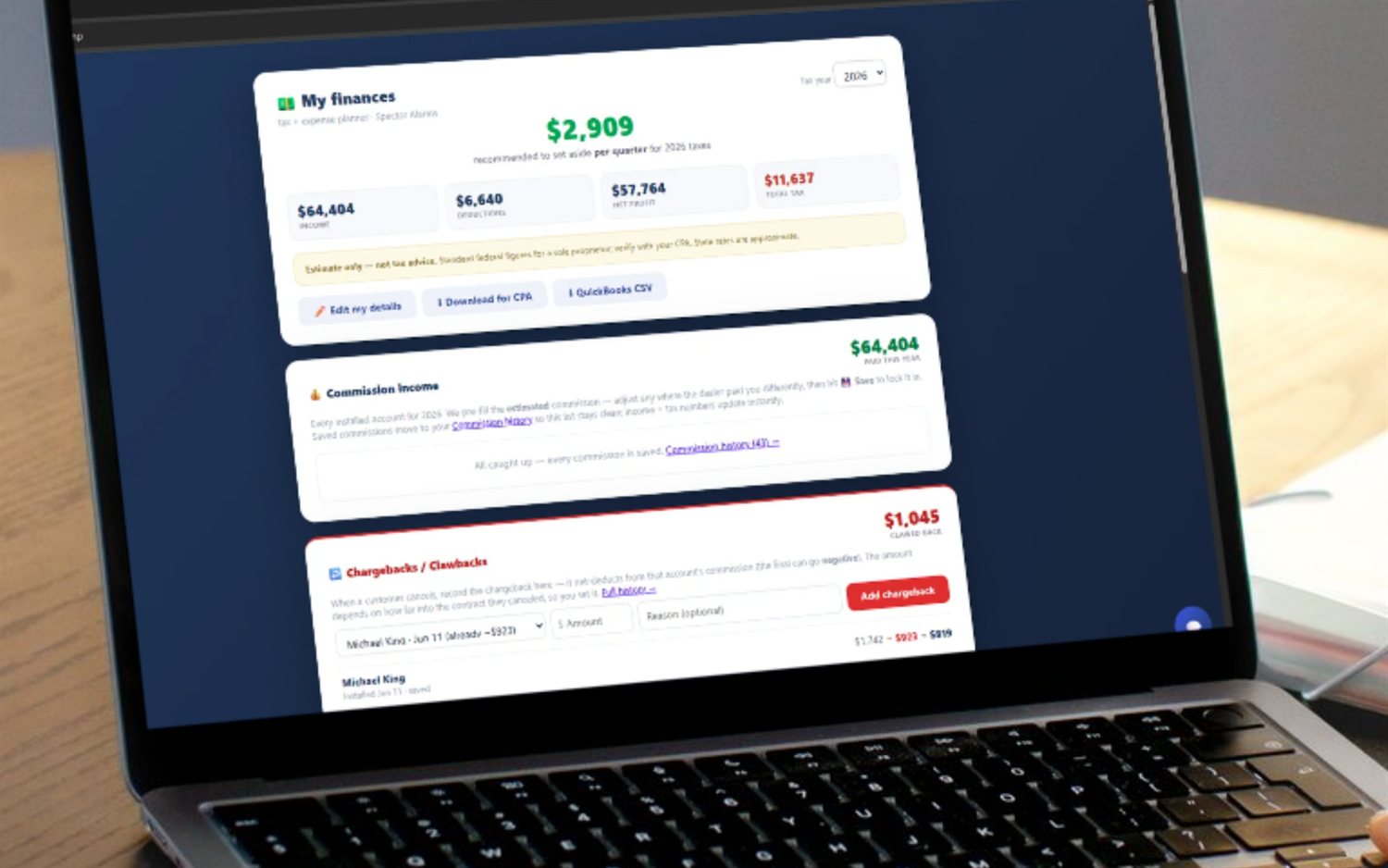
A pool canvasser who only counts signatures is flying blind. FieldStacker tracks the version that matters: commission per account on your actual plan, clawbacks netted against your total when an account cancels in the window, repair and equipment commission alongside the recurring side, and the mileage and taxes that come with being a 1099 rep.
Say you canvass a Sun Belt market on a one-month's-billing plan with a 90-day full clawback, and you sign twelve accounts in May averaging $145 a month.
Ten of twelve survive, so the recurring side lands somewhere near $1,450 — call it roughly fifteen percent below what you wrote — and the equipment sale claws part of that back for you. The last part is the point: the reps who earn well in pool service are not the ones with the most signatures, they are the ones with the fewest reversals and a repair line on their plan. Numbers here are illustrative, not a promise.
For what all of this adds up to across a season, see how much pool service sales reps make.
The rest of the pool service door-to-door library.
Almost always around the recurring account, not a one-time ticket. The four structures you will actually be offered are: one month's billing as a one-time payout (sell a $150/mo account, get roughly $150); a multiplier of the monthly rate, commonly somewhere between half a month and a month and a half; a flat bounty per signed account regardless of its price; or a residual — a small percentage of that account's billing every month for as long as it stays on service. Repairs, filter cleans, green-pool recoveries and equipment swaps are usually paid separately as a percentage of the job. Every one of these varies by company and market, so get the plan in writing.
Because a serviced account is an asset with a resale value, not just a month of revenue. Service route books change hands in this trade at a multiple of monthly billing — the commonly quoted range is around eight to twelve times the monthly rate, though what a route actually fetches depends heavily on density, contract quality and the local market. That means an account billing $150 a month may be worth well over a thousand dollars to the company that owns it, which is exactly why they will hand a canvasser a month's billing to go get one — and exactly why they will take it all back if the account cancels in ninety days.
More than in most trades, because the product is a subscription. The standard clawback is cancellation inside a retention window — usually 60, 90 or 120 days — paid back in full or pro-rated depending on the plan. You will also lose commission when the first invoice never clears, when the account turns out to be unserviceable (no gate access, an aggressive dog, unsafe electrical at the pad, a pool that needed a drain-and-clean sold as routine weekly), and when the account was underpriced badly enough that the company has to reprice it and the customer walks. Mispricing a hard pool costs you twice: once on the reprice and again on the cancel.
Typically not on signature. The common pattern is payout on the payroll following the account's first successful billing cycle, which puts real money four to six weeks behind the handshake — and some plans hold part of it until the retention window closes. Repair and equipment commission usually pays after the job is completed and collected, not when it is sold. Budget for that lag, especially in your first season, because your biggest signing month and your biggest paycheck are never the same month.
It is often where the real money is, and a lot of canvassers ignore it. Filter cleans, salt cell replacements, variable-speed pump swaps, heaters and automation are large tickets compared with a month of service, and the pay is usually a percentage of the sale or of gross profit — figures in the high single digits to the mid teens are common, though it varies widely by company. A rep who notices a failing cell or a dying single-speed pump while quoting weekly service can add more to a paycheck in one conversation than several recurring signs. Ask specifically whether your plan includes it before you sign on.
Both exist. Smaller route companies frequently bring canvassers on as 1099 contractors, especially seasonal spring crews; larger operations more often run W-2 hourly plus commission, particularly where the rep also services pools. If you are 1099, nothing is withheld — you owe self-employment tax on top of income tax, you should be setting aside a meaningful share of every commission check quarterly, and your driving is deductible at the IRS mileage rate. Whichever it is, get it in writing before your first knock, along with the clawback window and the pay timing.
Track every recurring account, net out the clawbacks, and watch the tax set-aside build. 14-day free trial, no credit card, flat month-to-month.