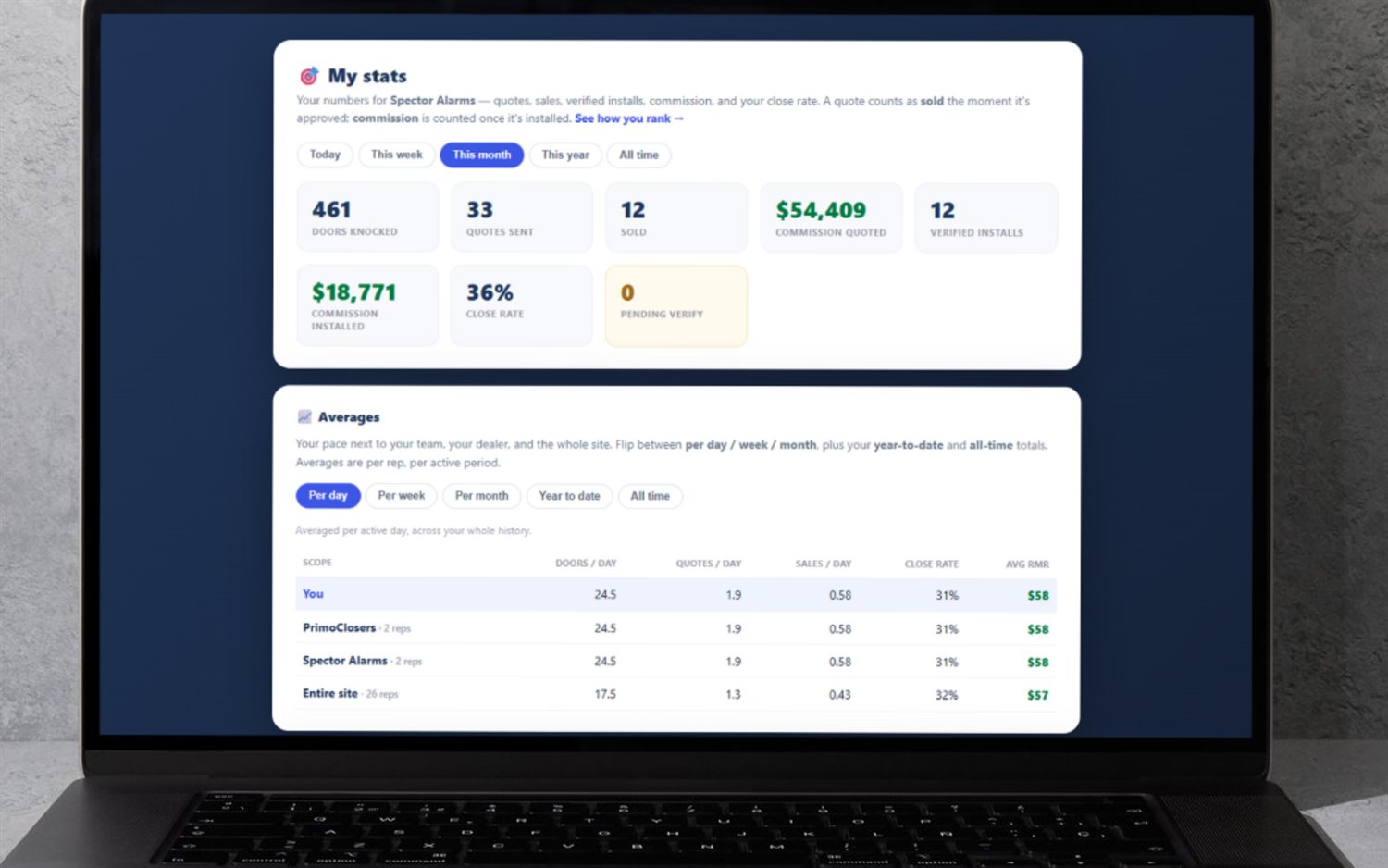
Ranges, not promises. What a first season actually looks like, what changes in season two, why identical effort pays double in Phoenix and half in Pennsylvania, and what the 1099 side takes back.
Flat month-to-month from $30/mo · 14-day free trial · no seat minimums, no annual contract
Ask a roofer what they make and the answer moves with storms. Ask a pool rep and it moves with latitude. A canvasser in Phoenix, Las Vegas, Southern California, Houston or Central Florida can knock pools every month of the year, and their "season" is really just two peaks — spring green-up and the first sustained heat — inside a twelve-month grind. A canvasser in Pennsylvania, Ohio or Long Island has a five-to-six-month window bookended by openings in April and May and closings in September and October, and after that the doors are gone until spring.
That single fact does more to your annual number than any script, any pay plan and any amount of hustle. A rep doing genuinely identical work can finish the year at wildly different totals purely on where they knocked. Any earnings claim that does not mention season length is not telling you anything.
Illustrative ranges, not averages or promises. Assumes commission-based canvassing, not a salaried inside role.
| Who | Typical monthly, in season | What is going on |
|---|---|---|
| Part-time / weekend canvasser | A few hundred dollars up to roughly the low four figures | Ten to fifteen hours a week, a handful of signs a month, learning to price. The clawbacks hurt disproportionately at this volume. |
| Full-time canvasser, first season | Often low four figures monthly, climbing through the season | The first six weeks pay almost nothing because commission trails the first cleared invoice. Underpriced pools cause reversals. The number improves sharply once the callback list exists. |
| Full-time canvasser, experienced, peak season | Commonly low-to-mid four figures monthly | Consistent volume, better pricing instincts, fewer reversals, and a go-back list that produces sales without new doors. |
| Experienced rep with repair & equipment commission | Materially higher — often the difference between an average and a good year | Salt cells, variable-speed pumps, heaters, filter cleans and green-pool recoveries. One equipment sale can outpay several recurring signs. |
| Year-round Sun Belt vs seasonal North | Twelve earning months vs roughly five or six | Same monthly performance, roughly double the annual total. This is the single biggest variable on the page. |
| Route owner / owner-operator | Different economics entirely — see below | You keep the recurring revenue but carry chemicals, fuel, insurance, equipment and licensing. Not a sales job. |
In rough order of impact.
Twelve knockable months versus five or six. Nothing else on this list comes close. If you are in a seasonal market, your real question is what you sell from November to March.
On a month's-billing plan your commission is the customer's invoice. A market where full service bills over two hundred pays roughly double a chem-only market near a hundred, for the same knock.
A flat bounty rewards volume. A month's-billing plan rewards selling premium tiers. A residual pays little now and real money in year two. Know which curve you are on. Full breakdown →
Clawbacks inside a 60-to-120-day window routinely erase a chunk of what you wrote. The gap between a careful rep and a sloppy one is mostly here, not in signatures.
Whether your plan pays on cells, pumps, heaters, filter cleans and recoveries. This is the most commonly missing line in a canvasser's plan and often the largest single upgrade available to you.
Some plans quietly pay more inside existing service areas, because a tight book is worth more. Selling around your company's current stops can pay better than selling further out. Map it →
The gap between a rookie and a veteran pool canvasser is not charisma. It is three specific, learnable things.
Pricing instinct. A first-season rep quotes a screened cage with four oaks over it the same as an open kidney pool with nothing around it, wins the sale, and loses the commission six weeks later when the company reprices and the customer walks. A veteran walks to the equipment pad, counts trees, notices the spa and the water feature, and prices it right the first time. That one skill removes most of the reversals in the earnings table above.
The go-back list. A rookie's April is all cold doors. A veteran's July is mostly callbacks — every "I do it myself" from spring, revisited the week it hits a hundred degrees. The second season pays better than the first on identical effort largely because the list already exists. Reps who do not disposition their doors never build it and start from zero every year.
The repair eye. A veteran quoting weekly service notices a salt cell past its life, a single-speed pump on borrowed time, or a filter that has not been broken down in three years, and mentions it. That is a second income stream on the same knock, and it is the most reliable way experienced pool reps out-earn the trade average.
A lot of people asking what pool sales pays are really asking whether to build their own book, so it is worth separating the two jobs honestly.
As a canvasser, you are paid once for an account the company keeps forever. That is a clean trade — no truck, no chemical cost, no liability, no license exposure, no 3am call about a flooded pump pad. As a route owner, you keep the recurring revenue and, more importantly, you own an asset: route books change hands between pool companies at a multiple of monthly billing, so a tight book is a saleable business rather than a job. Against that, you carry chemicals, fuel, a truck, insurance, equipment, and in many states a contractor license to legally do repairs at all — California's C-53 swimming pool classification and Florida's pool and spa servicing license are the two most commonly cited examples. Rules vary by state and by the dollar value of the work, so check your own before assuming cleaning-only keeps you clear.
The common path is to do both in sequence: canvass for a company first to learn pricing, neighborhoods and what a hard pool looks like, then build or buy a book once those instincts are real. Starting the other way around is how people underprice a route into the ground.
If you are a 1099 canvasser, nothing is withheld. You owe self-employment tax on top of income tax, you are generally expected to pay quarterly estimates, and the first April after a good season is where a lot of pool reps get hurt. The two habits that fix it are boring: set money aside the day each commission lands, and track your miles.
This is general information, not tax advice — the right set-aside percentage depends on your bracket, state and deductions. Talk to an accountant.
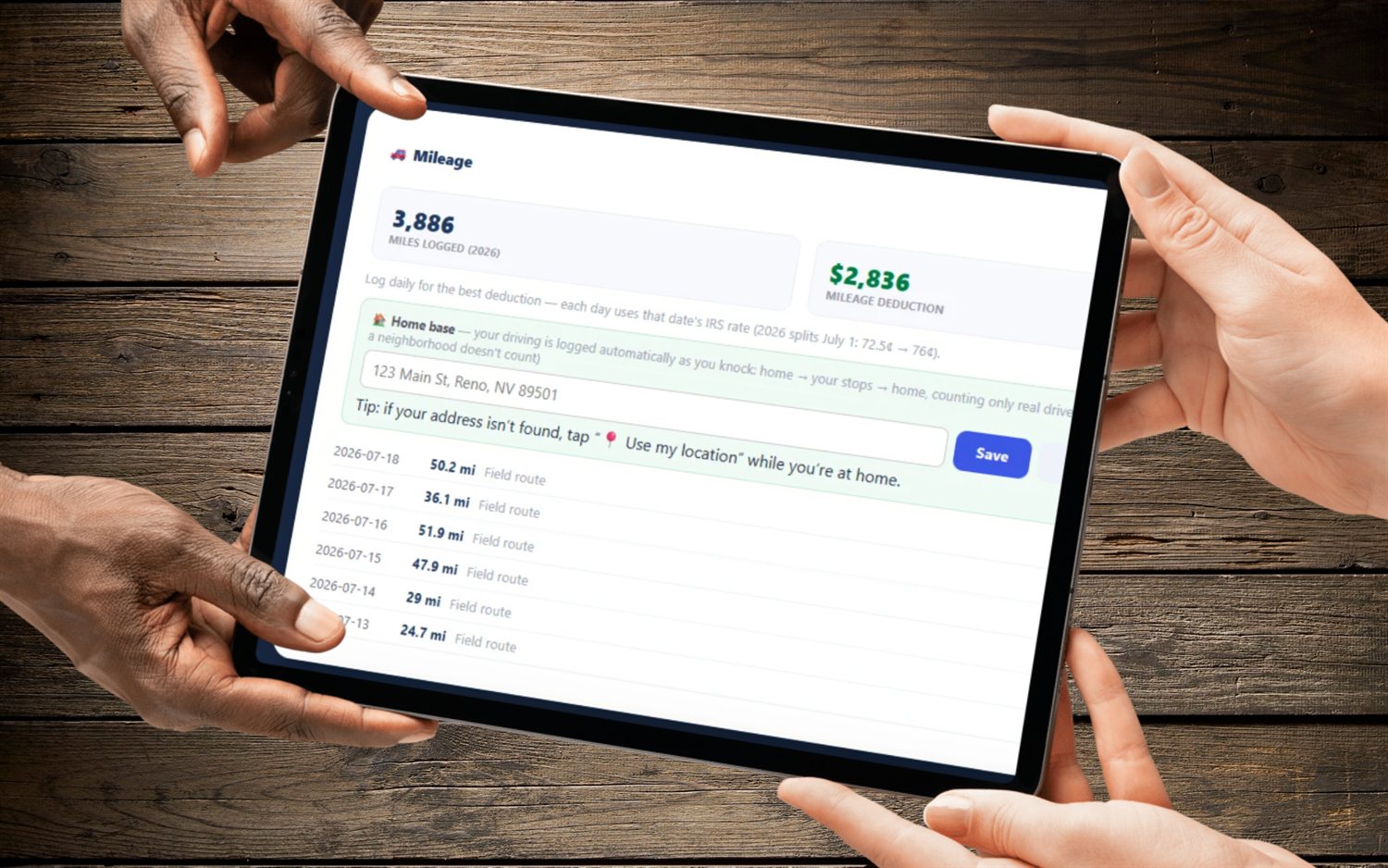
Most pool reps genuinely do not know their real income until a company statement tells them, months later and net of reversals they forgot about. FieldStacker keeps the honest version on your phone as you knock — accounts signed, commission on your actual plan, clawbacks netted out, miles logged, taxes set aside — so you can answer this page's question for yourself instead of reading a range.
The rest of the pool service door-to-door library.
It varies more than almost any door-to-door trade, because the season length varies from five months to twelve depending on where you live. As a typical picture rather than a promise: a part-time or first-season canvasser often lands somewhere around a few hundred to a couple of thousand dollars a month while learning; a full-time canvasser in peak season in a year-round Sun Belt market commonly runs in the low-to-mid four figures monthly; and an experienced rep on a plan that includes repair and equipment commission can reach a solid five-figure annual income, with strong performers in good markets going higher. Everything depends on your pay structure, account price points, retention and season length.
Five things drive nearly all of the spread. Season length — Phoenix and Orlando knock year-round while the Northeast has a hard five-to-six-month window. Account price point — a chem-only market where weekly service bills near a hundred dollars pays a rep half what a full-service market billing over two hundred does on a month's-billing plan. Pay structure — a flat bounty and a residual produce completely different curves. Retention — clawbacks routinely erase a chunk of what you wrote. And whether repairs and equipment are on your plan, which is often the difference between an average income and a good one.
Less than the recruiting pitch suggests, and the reason is timing rather than talent. Pool commission generally pays after the account's first invoice clears, so your first four to six weeks of work produce almost no income, and your first clawbacks land right when you thought you were rolling. A realistic first season is learning the pricing variables well enough to stop underquoting hard pools, building a callback list of DIY homeowners for midsummer, and finishing with a modest but real number. Reps who survive season one usually do materially better in season two on the same effort, because the go-back list already exists.
Per sale, no — a pool account is a small ticket next to a solar system or a roof. Per hour of work, it is more competitive than people expect, because the product is visible from the street, the qualifying is fast, and the sales cycle is often one conversation rather than a multi-week close. The realistic comparison is that pool service pays less per deal than solar or roofing, sits in a similar range to pest control, and rewards volume, route density and retention rather than big single tickets. The reps who out-earn the trade average are almost always the ones selling equipment and repairs alongside the recurring accounts.
They are different jobs with different risk. Canvassing for a company means no truck, no chemicals, no liability and no license exposure, but you are paid once for an asset the company keeps. Owning a route means you keep the recurring revenue and you own something with a resale value — route books trade at a multiple of monthly billing — but you also carry chemical cost, fuel, insurance, equipment, and in many states a contractor license to touch repairs. A lot of pool salespeople start as canvassers precisely to learn pricing and neighborhoods before buying or building a book of their own.
More than most first-year reps expect. As a 1099 contractor nothing is withheld, so you owe self-employment tax on top of ordinary income tax and you are generally expected to pay quarterly estimates rather than settling up once in April. The common guidance is to set aside a meaningful percentage of every commission payment the moment it lands — the right number depends on your bracket, state and deductions, so ask an accountant rather than trusting a rule of thumb from a group chat. The one thing that reliably helps is tracking your miles: canvassers put on serious mileage, and the IRS standard rate deduction is real money.
Track every account, every clawback, every mile and the tax you owe on it — on your phone, as you knock. 14-day free trial, no credit card.