Ranges, not recruiting-poster numbers. What setters earn, what a first-year closer earns, what the top of the trade looks like, the four variables that explain the whole spread — and why the gross on your 1099 is not your income.
Flat month-to-month from $30/mo · 14-day free trial · no seat minimums, no annual contract
Because it is two jobs wearing one job title. A canvasser is paid to produce appointments; an in-home closer is paid to convert them. They sit in different pay systems, work different hours, take different risk, and finish the year in different places. Any article that quotes one number for "gutter sales rep" has blended them, and the blend is meaningless.
There is a second reason the range is so wide, and it is the one nobody says out loud: in this trade the rep does not control the biggest variable. Sat appointments per week is the master input, and in most companies marketing controls it. A capable closer with four demos a week and a capable closer with ten are not going to have similar years no matter how good either of them is.
Annualized, full-season, United States. Ranges — treat the top of each band as achievable rather than expected.
| Seat | How they are paid | Typical annual range | What it actually depends on |
|---|---|---|---|
| Canvasser / setter | Hourly base plus per-set bonus, or per-set only; sometimes a small piece of what sells | Roughly the mid-thirties to mid-sixties for a full season worked full time | How narrowly a "qualified set" is defined, and how many hours of genuine prime knocking time you get in |
| First-year in-home closer | Percentage of contract on company-supplied leads, often against a recoverable draw | Roughly the mid-forties to high seventies for those who finish the year | Whether you survive the first ninety days at all — attrition in this seat is high everywhere |
| Experienced closer | Percentage of contract, or price-sheet overage plus a base commission | Roughly ninety thousand into the low six figures with steady lead flow | Close rate on sat demos, average ticket, and how little you discount |
| Top performers, high-volume brands | Overage or profit share with strong company lead flow | Can exceed two hundred thousand — outliers, not the middle | Being handed a lot of qualified demos in a long-season, heavy-canopy market |
| Self-generating rep or small operator | Higher rate on self-produced work, or business profit outright | Highly variable, from part-time supplement to well past a closer's number | Whether you can keep your own pipeline full in February as well as October |
One more caution about the top row. Recruiting ads in home improvement love to publish a top-earner figure next to the words "average rep." Ask instead for the median of reps who completed twelve months, and ask how many started in the same period. The gap between those two answers tells you more about a company than any pay range does.
Income in this trade is one chain, and it is worth being able to run it in your head. Sat demos per week multiplied by close rate multiplied by average ticket multiplied by your commission rate, then reduced by your cancel rate. That is the whole business.
An illustration with clearly made-up but plausible inputs: a closer running eight sat appointments in a good week, closing roughly one in three, on an average contract in the middle four figures, at a single-digit percentage of contract, produces something on the order of a thousand dollars-plus of gross commission that week. Then knock off the deals that cancel in the three-day window or never fund — a meaningful share in this trade — and knock off the discounts that came out of your share. The number that survives all of that is your actual pay. Run the same chain with four demos a week instead of eight and you can see immediately why lead flow dominates everything else.
Attrition is high in the closer seat, and it is front-loaded. New reps get handed the leftover appointments, have not yet learned the demo, discount too hard because they are afraid of the price, and then watch a chunk of their early wins cancel inside the rescission window. Anyone quoting you a first-year number should be asked what fraction of new hires reach month twelve. That is the number that determines whether the range applies to you.
Most of this trade happens in about ten to fourteen weeks around leaf drop, with a second, smaller push after the first serious spring rains. A rep can have an outstanding October and a genuinely thin February. Two practical consequences: budget on the year rather than the good weeks, and treat the pile of "come back when the leaves start" doors you collected in August as an actual financial asset, because it is the difference between starting the season cold and starting it with a list.
If you get a 1099-NEC instead of a W-2, the number on it is not your income.
You pay both halves of Social Security and Medicare — 15.3% on net profit — where a W-2 job would have split it with an employer. It is the first surprise every first-year rep hits.
Nobody withholds from a commission check, so the IRS expects estimated payments four times a year. Skipping them can mean penalties even if you pay in full later.
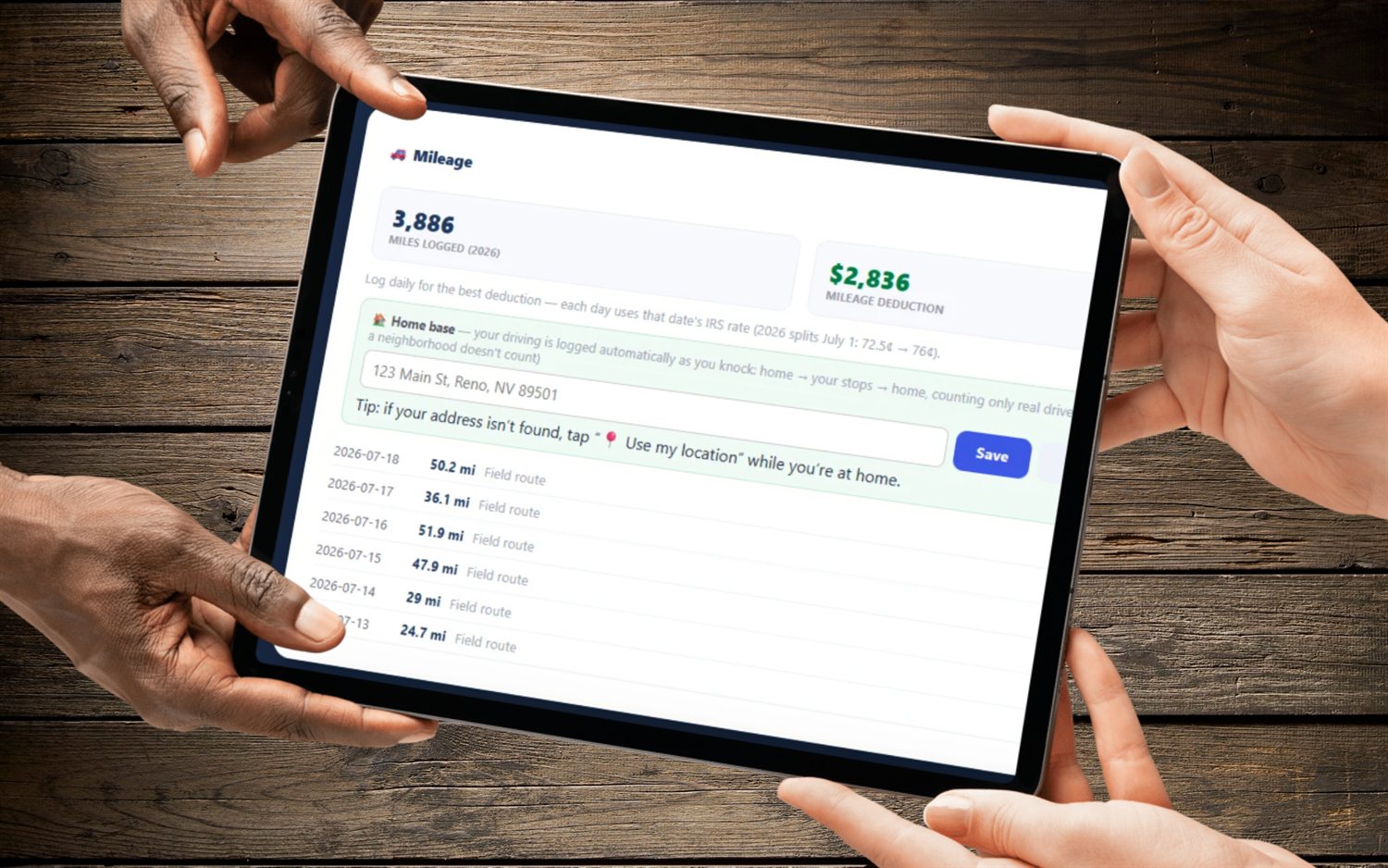
Canvassers drive constantly, and the standard mileage rate is usually the largest single write-off on the return — but only with a contemporaneous log you did not invent in April.
In a seasonal trade with a slow winter, unpaid downtime is a real cost. Budget for the gap the same way you budget for taxes.
A common rule of thumb is to park 25 to 30 percent of net commission income for taxes as it arrives, but the right number depends on your bracket, your state and your deductions. None of this is tax advice — talk to a CPA. The 1099 tax guide for D2D reps walks the whole thing in plain English.
You cannot manage a close rate you have never measured, and you cannot spot a commission error you never checked. FieldStacker keeps the rep-money side next to the doors that produced it: real per-deal commission on your own splits, chargebacks netted against the total when a job cancels or never funds, automatic mileage capture at the IRS rate, and a quarterly tax set-aside that builds while you knock.
The rest of the gutter playbook.
Per-set, percent of contract, overage and profit share, plus what a discount really costs. Gutter sales commission →
Openers and objection branches in homeowners' actual words. D2D gutter scripts →
Territory, timing and the walk-up that turns a block into appointments. How to sell gutters D2D →
The honest answer is a very wide range, because the job title covers two different roles. Canvassers and setters typically land in the mid-tens of thousands annually when they work the full season, driven by hourly base plus per-set pay. In-home closers on company-supplied leads commonly finish a first full year somewhere in the forties to high seventies, and experienced closers with steady lead flow in a good market commonly run from around ninety thousand into the low six figures. Top performers at high-volume national brands can exceed two hundred thousand, but those are outliers built on heavy company lead flow, and recruiting ads that quote them as an average should be read with suspicion. All of these are typical ranges that vary by market, season length and company.
Setter pay is usually a base plus a per-set bonus, and per-set amounts commonly run from a couple of tens of dollars up to around a hundred for an appointment that actually sits with both owners present. In peak season a productive full-time canvasser often earns the equivalent of a solid hourly job with real upside on a good week; out of season the hours frequently dry up. The two things that move a setter's number most are how narrowly the company defines a qualified set and how many hours of genuine prime knocking time you get in — not how many doors you touch.
Yes, and people do, but it is worth being precise about who. Six figures in this trade almost always means an in-home closer who is getting a consistent flow of sat appointments, holding a solid close rate, selling large tickets without heavy discounting, and keeping their cancel rate low. Lead flow is the single biggest variable and it is largely controlled by the company, which is why the same rep can earn very differently at two employers. Self-generating reps who canvass around their own installs and work a seasonal callback list can reach it from the other direction, by earning a higher rate on work they produced themselves.
A typical leaf-protection job lands in the four figures, and a straight percentage plan on a company-supplied lead commonly turns that into a few hundred dollars of commission per sale. Price-sheet and overage plans behave differently — they can pay considerably more on a large job sold at full price and very little on one that was discounted to close, because the discount comes out of the rep's share first. Gutter replacement without protection is generally a smaller ticket and therefore a smaller commission. The structure matters more than the headline percentage; the commission breakdown page walks through each plan shape.
Very. The business concentrates around leaf drop in the autumn and again after the first heavy rains in spring, with a long slow stretch in between in most climates. That means annual income is a poor guide to what any given month looks like: reps in this trade often make a disproportionate share of their year in about ten to fourteen weeks. Two consequences follow — budget across the whole year rather than the good months, and treat your seasonal callback list as an asset, because it is what makes next October busy.
It can be, provided you go in understanding that a 1099 commission is not a salary. Nothing is withheld, you owe the full self-employment tax on your net profit rather than half of it, you are expected to pay estimated taxes quarterly, and there is no paid time off in a trade that already has a slow season. The offsetting advantage is real: business mileage is deductible and a canvasser drives constantly, which usually makes it the largest single write-off on the return. Set aside a percentage of every commission as it arrives and talk to a CPA — none of this is tax advice.
Track every door, every deal, every chargeback and every mile in one app. Start a 14-day free trial — no credit card, month-to-month.