The lead-card approach that gets you to the kitchen table, the cold senior door, the second and third knock — and every objection a final expense agent hears: "I don't remember sending that in," "I've got the AARP one," "my kids will handle it," "are you with Medicare?"
Flat month-to-month from $30/mo · 14-day free trial · no seat minimums, no annual contract
Three things make this door unlike any other in door-to-door sales, and every one of them changes the script.
First, you are usually not cold. The person behind the door filled out a reply card asking about a funeral expense benefit and dropped it in a mailbox. You are not interrupting a stranger, you are following up on something they started — and the card in your hand is the proof. That is an enormous advantage and most new agents throw it away by launching into a pitch instead of showing the card.
Second, the person answering is a senior. Often in their late sixties to eighties. Often on a fixed income. Often approached by a great many people who wanted something from them, some of whom were criminals. Everything you do in the first ten seconds is a credibility test: your name, your license, your posture, whether you step back from the screen door, whether you take your sunglasses off, whether you speak up clearly without being loud or condescending.
Third, the subject is their own death. Not a roof, not a water softener. You will stand at doors where the spouse died fourteen months ago and the paperwork nightmare is still fresh, and at doors where the person has never once said the word out loud. The scripts below are deliberately plain-spoken about it, because the agents who do best in this trade are the ones who can talk about it calmly and without a euphemism in every sentence.
The universal five-beat door approach still applies — interrupt, reason, question, bridge, ask — but the shape is different because your ask is a chair, not a sale.
Six real ones. Say them in your own words — the shape matters far more than the wording.
Try: "Hi, are you Dorothy? Marcus — I am the one who came out about this." (hold the card where she can read it) "You mailed this back about three weeks ago about the funeral expense benefit. Takes about fifteen minutes at your table. Is now alright, or is there a better time this week?"
Why it lands: her own handwriting is the credential. And the alternative-time question makes "no" mean "later" instead of "never."
Try: "Before anything else — my name is Marcus, here is my license, I am an independent agent and I am not with Medicare or the government. I represent about eight insurance companies. Sound alright if I come in for a few minutes?"
Why it lands: it answers the question every senior is silently asking and pre-empts the objection that kills the most doors in this trade.
Try: "Hey Dorothy — Marcus again. I stopped by Tuesday morning and left my card in the door, you were out. Caught you this time. Two minutes at your table and I will be out of your hair."
Why it lands: persistence on a card you already bought reads as diligence, not pestering. A large amount of final expense business is written on the second or third attempt.
Try: "Are you Dorothy? Betty Sanders down on Ridge told me to come see you — I set her up on her funeral coverage back in the spring and she mentioned you two go to the same church. Has she said anything about it?"
Why it lands: in a senior community a name is worth more than any mailer. Ask every client for two names before you leave the table.
Try: "Hi, I am Marcus, I am a licensed agent working this side of the county today. I help folks on Social Security get the funeral costs covered so the kids do not have to. Do you already have something in place, or is that still on the list?"
Why it lands: it names who you serve, what the problem is and gives an easy binary answer. Use it on the doors around a lead you already drove out to.
Try: "I am out doing the annual reviews on the funeral coverage in this area. A lot of these older policies were written years ago and folks have no idea what they actually pay out now. Do you know off the top of your head what yours is for?"
Why it lands: only use it if you genuinely will review what they have and tell them honestly if it is fine. Say "review" and then only sell, and you become the guy the next agent has to apologise for.
The single most common mistake new final expense agents make is trying to close at the doorway. It cannot be done, and attempting it costs you the sit. You cannot quote a premium without knowing age, tobacco use and the medication list, and a number without qualification is either wrong or gets measured against zero and loses.
Three things are working in that paragraph. You removed the pressure they were bracing for, you told them exactly what is going to happen, and you gave them explicit permission to say no — which, counter-intuitively, is what makes it safe for them to say yes to the next fifteen minutes.
Once you are inside: sit at the kitchen table if they offer it, not the sofa. You need a hard surface for the application and you need to be beside them rather than across a coffee table. Ask where they would like you to sit rather than choosing. And if there are photographs on the wall, look at them and ask — this is not a technique, it is how you find out who the beneficiary is going to be.
Every one of these is something a senior has actually said to a final expense agent. Agree, ask, then let the answer do the work.
What it means: usually honest confusion, sometimes a soft brush-off, almost never hostility.
Try: "Happens all the time — you get a mountain of mail. That is your handwriting though, see there? You checked the box on the funeral expense benefit. I am not here to sign you up for anything, I just go over what folks your age qualify for."
Principle: show, do not argue. The physical card ends the debate in two seconds and lets them save face.
Try: "Good, I am glad — most folks do not. Three quick things and I will leave you alone if you are covered. How much is it for? Where did you get it? And does it end at a certain age? … Would you mind grabbing it so we can look together?"
Principle: never argue with existing coverage. Ask three questions instead. A senior who walks off to find the policy has already invited you in.
Try: "A lot of people out here have that. Do you know if yours is the kind that ends at a certain age, and does the price go up every five years? Some of them do and folks find out at the worst possible time. Go grab the letter, let us actually read it — if it is doing what you think it is, I will tell you so."
Principle: be scrupulously accurate. Read their actual policy rather than characterising a product you have not seen. Being the agent who told them their coverage was fine wins more business over a year than any takeaway.
Try: "That is more than most people do. Is it paid in full, or are you still making payments on it? And is it locked to that one funeral home — because if you move to be near your daughter, or if that place gets sold, folks are sometimes surprised what transfers and what does not."
Principle: a preneed arrangement is real coverage and you should say so. The honest gaps are payment status, portability and whether it covers anything outside the funeral itself.
Try: "No ma'am. I am an independent licensed agent, this has nothing to do with Medicare or Social Security, and I do not work for the government. I represent several insurance companies and I work for myself. Here is my license."
Principle: flat, instant, no softening. This is a legal line as much as an ethical one, and the speed of your answer is itself the proof.
Try: "Medicare is great and it will take care of you while you are here. It just stops the day you do — it does not pay a funeral home a nickel. Social Security pays out a one-time death payment of two hundred and fifty-five dollars, and that is the whole thing. That gap is what this is about."
Principle: the confusion is genuine and extremely common. The $255 Social Security lump-sum death payment is a real, checkable figure and it does more work than any statistic you could invent.
Try: "They probably would — most kids would. Have you talked with them about what that actually looks like? A funeral with a burial runs into the thousands and the funeral home wants it before the service, not after the estate settles. Would you rather they wrote that cheque, or that it was already sitting there waiting for them?"
Principle: do not insult the children. Move the question from willingness to timing and liquidity, which is the part nobody has thought through.
Try: "I hear that at almost every house and it is usually true. That is exactly why I ask what you can comfortably do a month instead of telling you what to buy. Some folks here are at thirty a month, some are at ninety. What would not hurt you? … Alright, let us see what that gets and you decide if it is worth it."
Principle: in this trade you sell a monthly budget and back into the face amount, not the other way round. Asking what they can afford is not weakness, it is the actual process.
Try: "You absolutely should — she is probably the one who would be handling all of it. Is she around, or can we get her on speaker right now? I would rather answer her questions myself than have you try to repeat all this tonight."
Principle: get the daughter on the phone at the table. The adult child is very often the strongest advocate for the purchase once she understands she is the one who would otherwise be writing the cheque.
Try: "You would be surprised. There are companies that ask five health questions and companies that ask none at all — those pay your money back plus interest for the first couple of years instead of the full amount, and after that it is the whole thing. Let me ask you the questions and we will find out where you actually land."
Principle: be precise and honest about level, graded and guaranteed issue. Promising immediate full coverage to someone who will land on a graded plan is how policies get rescinded and licences get reviewed.
Try: "Honestly, a brochure will not tell you anything useful because the price is different for every person — it depends on your age and your health. Let me leave you my card so you have me, and give me ten minutes at the table instead. Is now bad, or genuinely bad?"
Principle: a paper leave-behind captures nothing. Send a digital business card with a QR code so at minimum you leave with a contact and they leave with a way to reach you.
Try: Nothing. Stop selling. "I am sorry. How long were you married?" … Then listen for as long as she wants to talk.
Principle: this is not an objection and it is not an opening. If it turns into a conversation about what the funeral cost and how it got paid, that is her decision to make, not your pivot to execute. Agents who handle this door badly are the reason the trade has the reputation it has.
Two follow-up patterns are worth scripting because they are worth real money in this trade.
The first is the not-home go-back. A card you paid twenty-five or forty dollars for is not spent after one knock. Leave a handwritten note with your name and a time you will return — "Dorothy, sorry I missed you, I will swing back Thursday around ten. Marcus" — and then actually be there Thursday around ten. The willingness to come back three times is most of what separates agents who make a living here from agents who quit at month three complaining about lead quality.
The second is the check-timing callback. "Come back after my check comes in" is the most common soft no in final expense, and it is usually sincere. Social Security deposits land on a schedule tied to the recipient's birth date, so "after the check" means a specific week for that specific person. Ask which week theirs lands, write it on the pin, and set the callback for it.
Both of these depend entirely on the door remembering what happened. Nobody reconstructs "she said the third Wednesday" accurately six weeks later from a stack of cards in a truck.
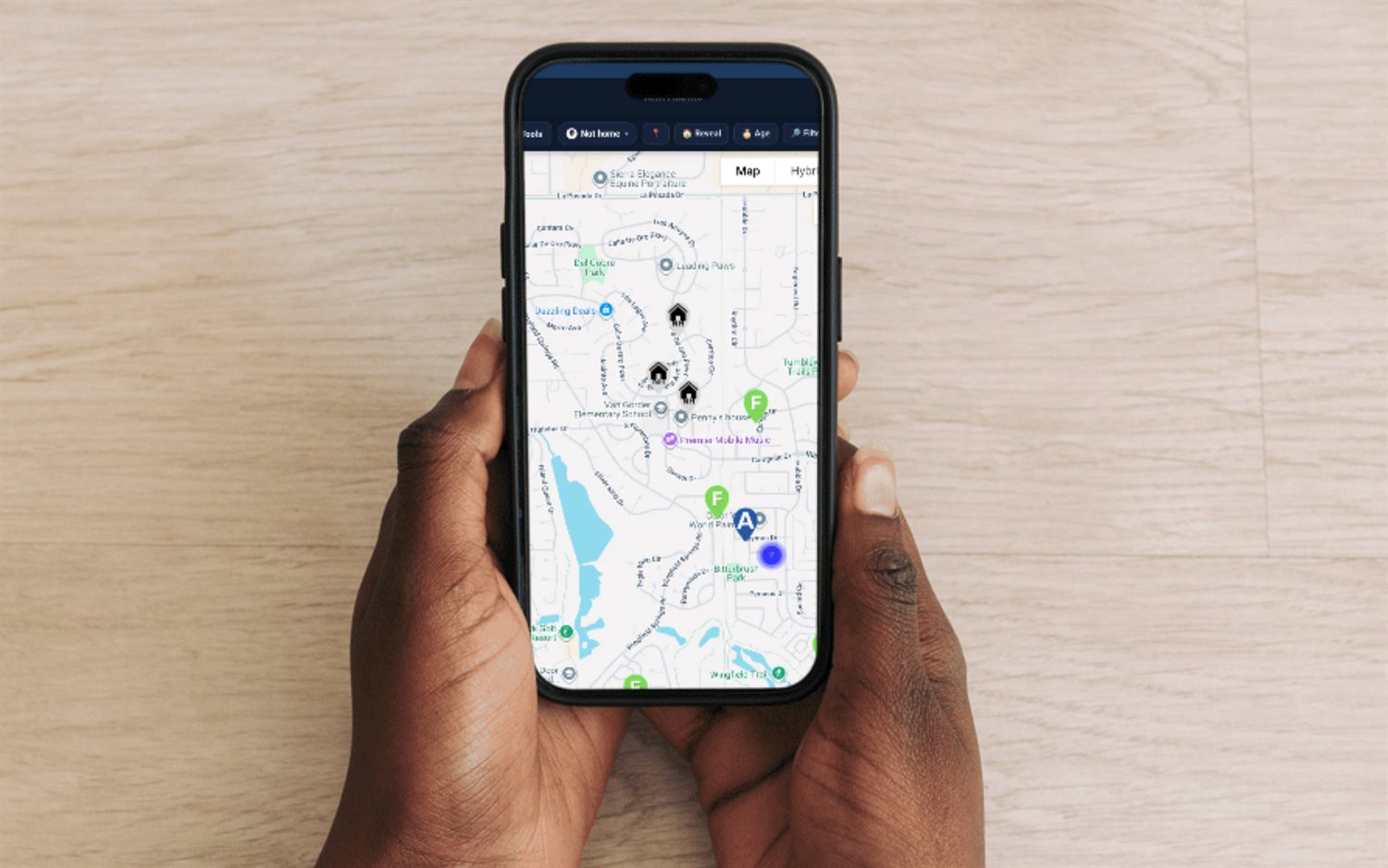
Final expense go-backs carry details — which attempt this is, what the existing policy was for, which week her deposit lands, whether the daughter needs to be on the phone. That is the entire advantage of a paid lead, and it evaporates the moment it lives only in your head. FieldStacker keeps it on the pin.
Hold the card up where they can see it before you say anything else, use their first name, and give one sentence of reason. Something like: "Hi, are you Dorothy? I am Marcus, I am the one who came out about this" — card visible — "you mailed this in about three weeks back asking about the funeral expense benefit. I just need about fifteen minutes at your table to go over what you qualify for." The card is doing the work. It is physical proof you are not a random stranger, it is in their own handwriting, and it converts a cold door into a follow-up on something they started. The goal of the doorway is not a sale and not a quote — it is a chair at the kitchen table.
Expect it on a large share of your cards and do not treat it as a lie or a rejection. Normalize it, then show them. "That happens all the time, you get a lot of mail. That is your handwriting right there though, see? You checked the box about the funeral expense benefit. Nothing to worry about — I am not here to sign you up for anything today, I just go over what the programs look like at your age and you tell me if it is worth your time." Two things just happened: you gave them a graceful way not to be embarrassed, and you lowered the ask from a decision to a conversation.
Never argue with it and never dismiss it. Congratulate them and then ask three specific questions: how much is it for, where did they get it, and does it end at a certain age. Most of the time one of the answers opens the whole conversation — a 5,000 dollar policy against a funeral that now runs well into five figures, a group policy through a job they retired from that terminated when they left, or an age-banded product where the premium steps up every five years. Ask them to go get the paperwork. A senior who walks to the bedroom to find the policy has just invited you further into the house, and you will usually be reading it together at the table two minutes later.
You answer no, immediately, plainly, before you say anything else. "No ma'am — I am an independent licensed agent, I am not with the government or Medicare and neither is this. I represent several insurance companies and I work for myself." There is no clever version of this. Implying or allowing a government affiliation is one of the most serious things an agent can do at a senior's door, it is a regulatory problem in every state, and it is the exact thing the people who prey on seniors do. Being fast and flat about it also happens to be the single strongest credibility move available to you.
You need a different opening and the same middle. With a card you lead with the card and you already have implied permission. Cold, you have to earn the same permission in one sentence and with visible credibility: name, that you are a licensed agent, what this is about, and a low ask. "Hi, I am Marcus, I am a licensed agent — I work with folks on Social Security here in the county on the funeral expense side. Not selling anything at the door, I just wanted to see if you have got something in place already." The card version converts far better, which is why the trade is built on mail, but a cold senior door on a street you are already working is not wasted time.
Never imply you are from the government, Social Security, Medicare or the funeral home. Never say someone has been approved before an underwriter has actually approved them. Never quote a monthly premium at the doorway before you know their age, tobacco use and medications, because the number without the qualification is either wrong or is instantly compared to zero. Never use fear about a family being left with a bill as a weapon on someone who is clearly frightened already. And never keep pushing a person who has told you plainly to leave — beyond the ethics, a complaint from a senior is the fastest way to lose a carrier appointment.
Import your cards, log every attempt, and let the go-backs come due on their own. 14-day free trial, no credit card.