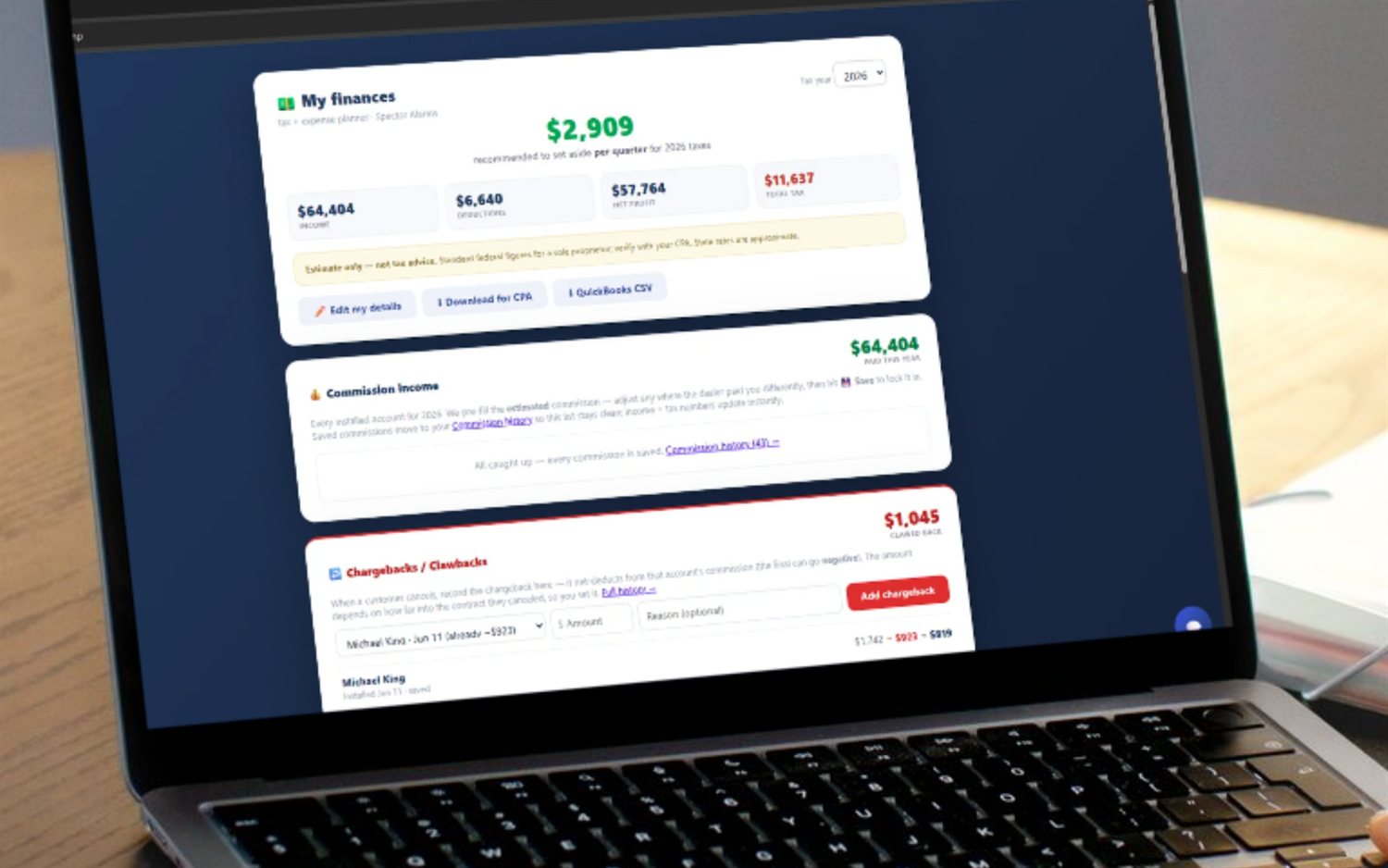
Wide ranges, an explanation of why they are wide, and the arithmetic that produces them — so you can work out your own number instead of trusting somebody else's average. Plus the part most pages skip: gross commission is not take-home.
Flat month-to-month from $30/mo · 14-day free trial · no seat minimums, no annual contract
Search this question and you get a tidy national salary figure. It is a blend of at least four completely different jobs: a seasonal 1099 canvasser working a spring push, a W-2 outside salesperson at a national branch with a base and a car allowance, a design/build salesperson closing six-figure projects, and a sales manager earning overrides. Averaging those produces a number that describes nobody.
There is a second problem nobody mentions: survivorship. Door-to-door sales in this trade has heavy early attrition, and the reps who make very little do not stay long enough to be counted. Any average you read is computed mostly from people who were good enough to still be there in July. If you are deciding whether to take a canvassing job, the relevant number is not what the average rep makes — it is what the range looks like including the people who washed out in April.
Canvassing income in this trade is five multipliers stacked on top of each other. Fill these in with your own company's real figures and you will have a better forecast than any salary aggregator can give you.
| Input | Weak | Middle | Strong | What actually moves it |
|---|---|---|---|---|
| Doors knocked per selling day | ~50 | ~75 | ~100+ | Route density and planning. Driving between scattered streets is the biggest silent thief of doors. |
| Share where someone answers | ~20% | ~28% | ~35% | Time of day and day of week. Evenings and Saturday mornings in spring are not a preference, they are the job. |
| Close rate on conversations | ~5% | ~8% | ~12%+ | Whether you diagnosed something real in the yard, and whether you asked who treats it as well as who cuts it. |
| Average commission per sale | low | mid | high | Program value, lot size, add-on attach rate, and whether your plan pays a bounty or a percentage. |
| Selling days in the season | ~60 | ~120 | ~200 | Climate and whether you sell winter lines. A Gulf-coast market and a northern market are different jobs. |
Multiply the weak column and the strong column and the result is uncomfortable: roughly 0.5 sales a day against roughly 4. Three differences that each look like a coaching note — knock a few more doors, knock at better hours, diagnose before you pitch — compound into an eight-to-tenfold gap in sales volume. That, and not talent, is why two reps on the identical comp plan at the identical company finish a season with wildly different checks.
It also tells you where to intervene. A rep stuck at the bottom almost never fixes it by improving their pitch. They fix it by fixing route density and knocking hours first, because those multipliers sit in front of the pitch.
Broad on purpose. These are commonly observed bands in the US market, not quotes, offers or forecasts.
| Who this is | How they are paid | Typical annual range (varies widely) | What moves them up |
|---|---|---|---|
| Seasonal / part-season canvasser | Usually 1099, flat bounty per account, sometimes a small hourly plus bounty | A few thousand for a short spring push up to low five figures for a heavy one | Working both the spring and fall windows instead of only spring |
| First full year, commission-heavy D2D | 1099 bounty or percentage of program value; occasionally a small base | Commonly the thirties to mid-fifties, with a real tail in both directions | Add-on attach rate, and surviving to the second season with the same territory |
| Experienced program / route seller | Bounty or percentage plus a renewal or retention component | Commonly the fifties to around ninety | Retention — a book that renews pays twice, and chargebacks stop eating the top line |
| W-2 branch or outside salesperson | Base plus commission, often with vehicle and benefits | A modest base plus commission; total commonly lands in a similar band to the above, with far less downside | Quota attainment and accelerators above plan |
| Design/build & hardscape salesperson | Percentage of contract price or of job gross profit, often staged | Commonly the seventies into six figures for a strong producer; top performers with large annual volume go well beyond | Annual sold volume and margin discipline — discounting to close is a direct pay cut on a GP plan |
| Sales manager / branch lead | Base plus override on the team, sometimes plus personal production | Commonly six figures at a producing branch; heavily dependent on team size and market | Team retention. Rebuilding a canvassing crew every spring destroys the override |
One caveat worth repeating: on a pure-commission 1099 plan the bottom of each band is not a floor — there is no floor. A rep who knocks fifty doors a day at the wrong hours in a scattered territory can finish a season having earned less than minimum wage for the time invested, and that outcome is common enough that you should plan around it rather than assume it away.
Nine variables explain most of the difference between a rep making thirty and a rep making ninety.
A warm-season market with a nine or ten month service calendar simply has more selling days than a northern market with a hard freeze. Same effort, different denominator.
Programs priced by square footage mean a neighborhood of quarter-acre lots pays materially more per sale than a neighborhood of townhomes — for exactly the same conversation.
A flat bounty rewards volume. A percentage of program value rewards selling bigger lawns and fuller programs. A gross-profit plan rewards not discounting. Each produces a different top earner.
The most underrated variable in the trade. Chargebacks come straight off the top, and where a retention bonus exists, the honest sale pays twice. Overselling is a pay cut on delay.
Aeration, overseeding, mosquito, grub, cleanups. Small tickets, fast payment, almost no chargeback risk. Reps who attach consistently out-earn reps who only chase programs.
Company-provided leads usually pay a lower rate than self-generated. Reps who canvass their own doors often earn a materially better percentage on the same sale.
A tight territory means more doors per hour and a book your company can actually service profitably. Scattered accounts cost you doors now and get cancelled later.
Year three in the same neighborhoods beats year one badly: you have referrals, visible work in yards, a callback list with dates on it, and people who recognize you.
Programs are frequent and small; projects are rare and large. Reps who can do both — sell a patio to a treatment customer — smooth the curve and lift the total.
Annual figures hide the shape of the year. Lawn care income has two peaks and a deep valley, and the payout timing pushes each peak a month or two to the right of the work.
If you are 1099 — and most door-to-door lawn care reps are — the number on your commission statement has three bites out of it before it is yours.
The offset that matters most in this trade is mileage. Lawn reps drive constantly between neighborhoods, and business miles deducted at the current IRS standard rate — which changes, so check the rate for the year you are filing — are frequently the largest single deduction on the return. The catch is that the deduction is only as good as the log behind it: the IRS wants a contemporaneous record of date, miles and business purpose, not a number you reconstructed in April from memory and a calendar.
Chargebacks matter here too. When a program cancels and the commission is clawed back, that reduces the income you are taxed on — so it has to be tracked, not just absorbed. A rep who reports gross commission and forgets the reversals overpays.
The reps who know their real income are the ones who tracked it as it happened. Everyone else is reconciling a season from a shoebox in February.
The rest of the lawn care and landscaping series.
The honest answer is a wide band, not a number. A commission-heavy door-to-door rep in their first full year commonly lands somewhere in the thirties to mid-fifties; an experienced rep who owns a productive territory and sells add-ons well commonly sits in the fifties to around ninety; a strong design/build or hardscape salesperson carrying a large book of project work can go well into six figures, and a small number do considerably better than that. Every one of those ranges is typical rather than promised, and they move substantially with market, season length, comp structure and whether leads are company-generated. Treat any single "average lawn care sales salary" figure with suspicion — most published averages blend seasonal canvassers, W-2 branch salespeople and project salespeople into one meaningless composite.
Enormously variable, because three modest differences compound. Doors knocked per day, the share of doors where someone actually answers, and the share of those conversations that close each vary roughly two-fold between a weak rep and a strong one — and multiplied together that is a spread of ten to twenty times in sales volume, not twenty percent. A part-season canvasser working a spring push may make a few thousand dollars; a full-season rep working the spring and fall windows hard commonly earns a solid five-figure income from canvassing alone. The reps at the bottom of that range usually do not finish the season, which is exactly why the reported averages look better than the reality for a new rep.
On average yes, with more variance and a slower ramp. Design/build and hardscape sales carry four- to six-figure tickets, so a single closed project can pay more than a month of program sales — but the cycle is long, the close rate is lower, and much of the compensation is tied to the job actually performing at its estimated margin. Recurring lawn treatment and maintenance sales are smaller, faster and more predictable, and they build a book that pays again at renewal. Reps who do well in project sales generally have technical credibility — they can talk drainage, base depth and plant material without bluffing — which takes seasons to build, not weeks.
Yes, and it is neither common nor mysterious. The people who get there are almost always in one of three positions: a design/build or commercial salesperson closing a large annual volume of project work on a percentage of contract or gross profit; a senior program salesperson in a dense, long-season market with a strong add-on attach rate and high retention; or a sales manager earning overrides on a producing team. What they share is not talent at the door — it is a territory they have worked for years, a book that renews, and a comp plan with either large tickets or a retention component. A first-year canvasser reaching six figures is the exception, not the plan.
Because the product is. The heaviest selling weeks of the year cluster around green-up and the pre-emergent window in spring, with a second real window in autumn for aeration, overseeding, cleanups and next-season sign-ups. Summer is steady but slower for new programs, and midwinter is nearly dead for turf work in cold markets. That produces an income curve with two peaks and a deep valley, and it is worse than it looks because commission frequently pays after first service and first collection — so a great March often shows up in an April and May check. Reps handle it by budgeting on the season rather than the month, selling winter lines like holiday lighting and snow contracts, and setting aside from the peaks instead of spending them.
A common rule of thumb is 25-30% of net commission income, but the right number depends on your bracket, your state and your deductions, so confirm it with a tax professional. What is not optional: as a 1099 rep you owe the full 15.3% self-employment tax on net profit on top of income tax, and the IRS expects quarterly estimated payments. The counterweight is mileage — lawn reps drive between neighborhoods constantly, and business miles at the current IRS standard rate are usually the largest single deduction on the return, provided you kept a contemporaneous log. Gross commission is not take-home, and reps who treat it as take-home are the ones who get hurt in April.
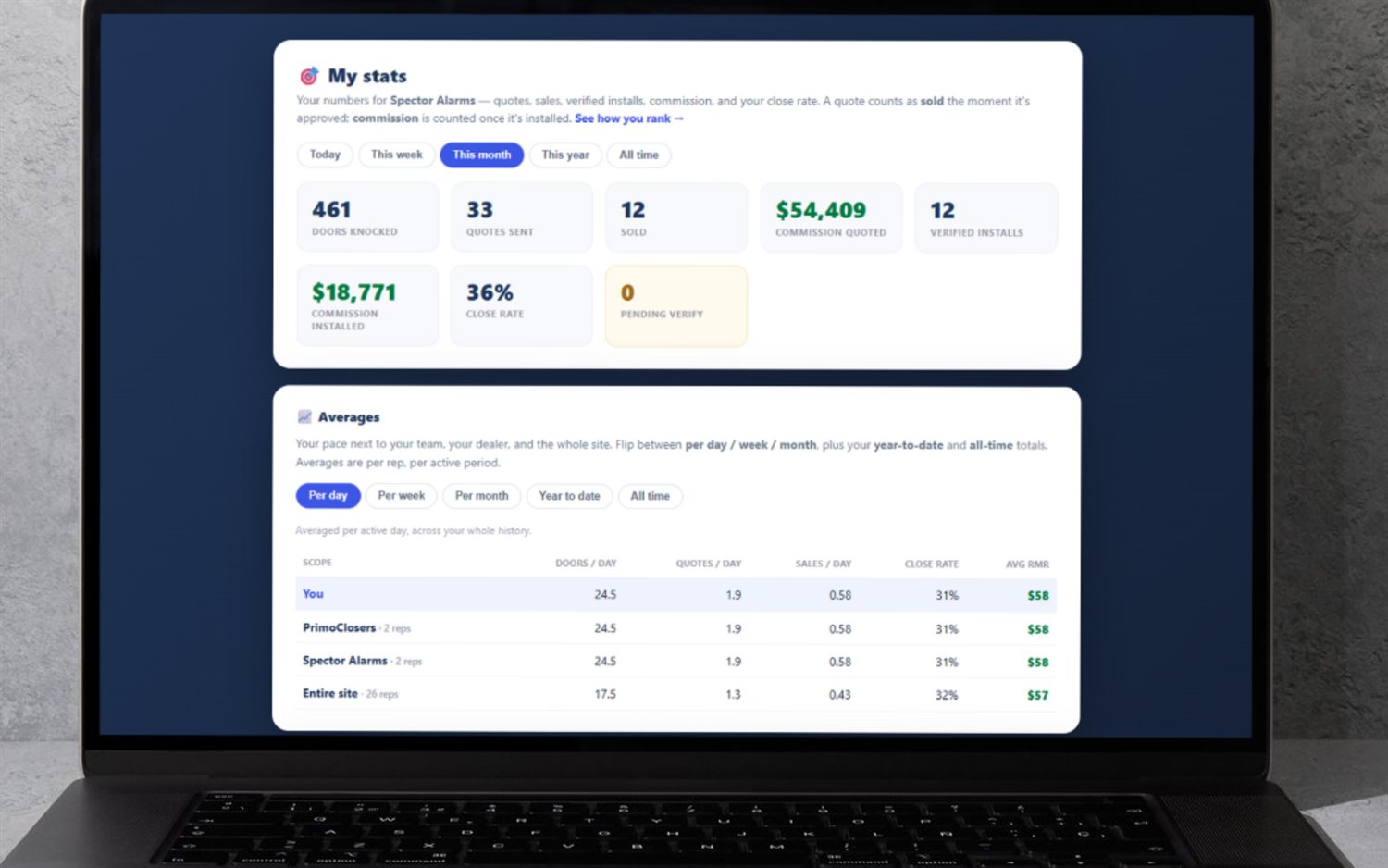
Track every program, project and add-on with your real rate, net out the chargebacks, capture the miles, and set the taxes aside as you go. 14-day free trial, no credit card.