Field guide · lawn care & landscaping

How to sell lawn care door to door

Where to knock and why, the two windows that carry the year, the permits and licensing nobody warns you about, how to read a yard in twenty seconds, and the follow-up system that turns "call me in the spring" into March revenue.

Flat month-to-month from $30/mo · 14-day free trial · no seat minimums, no annual contract

The short version: pick blocks you already service, work the two windows the agronomy dictates rather than the ones on your calendar, get the permit before the complaint, diagnose from the sidewalk before you knock, close on a start date, and set expectations honestly enough that the account survives to application three. Everything else is detail.

First, know which of three things you are selling

Canvassers who struggle usually have not decided. Recurring treatment — fertilization and weed control on a multi-step calendar — is a subscription sale governed by timing and retention. Maintenance — the weekly or biweekly cut — is a route-density business where one account barely matters and twelve on a street matter enormously. Design/build — patios, walls, drainage, plantings, irrigation, sod — is project selling with a site visit, a proposal and a weeks-long cycle. They share a sidewalk and nothing else. Decide before you walk, because the territory you should pick, the door you should knock and the thing you should say all change.

Territory: density is the whole game

This is where lawn care diverges hardest from every other door-to-door trade. In solar or roofing, a sale twenty minutes out of the way pays exactly the same as one next door. In yours it does not: a maintenance account off the route drags a truck, a trailer and a crew out of position every week for as long as you keep it, and a treatment account on an island costs a technician a stop that was never planned. Selling widely-scattered accounts is how a canvasser hits their numbers and their company loses money on the book they built.

So rank your territory on four factors, in this order:

  • Proximity to what you already service. Blocks with your trucks on them absorb new accounts at almost no marginal cost, and the mower running two doors down does half of your selling for you.
  • Visible evidence. Drive it once and look. Weed pressure, thin turf under mature trees, scalped slopes, fresh sod on new construction — these are qualified doors you can see.
  • Ownership. Owner-occupied converts; renters cannot buy. Heavy rental blocks and apartment complexes waste a day. A landlord with several houses nearby, on the other hand, is a multi-property account worth chasing.
  • Lot size. Where programs price by square footage, larger turf is straightforwardly more commission for the same conversation. Townhome rows are volume, not value.

Read the flags before you knock a single door

Walk a neighborhood and count the competitor service flags. New reps see them as bad news; they are the opposite. A street with flags on every third lawn is a street that has already proven it will pay somebody for this service — the hard part, creating the category, is done. A street with zero flags is either untouched opportunity or a neighborhood that does not buy, and one drive-by will usually tell you which. Flags also tell you who holds the account and roughly when they were last out, which is the entire setup for the renewal-timing question that turns a "we already have someone" into a February callback.

The neighborhood age sweet spot

Brand new subdivisions have fresh sod, builder-grade soil and owners who have not chosen anybody yet — excellent for a first program and for irrigation work. Neighborhoods roughly ten to thirty years old are frequently the best overall: mature enough to have thatch, shade, compaction and real weed pressure, new enough that people still care what the front looks like. Very old neighborhoods split hard — some are meticulously maintained by people who have used the same company for twenty years, others have owners who stopped caring a decade ago. Deed-restricted and HOA neighborhoods can be a gift, because the standard is enforced and non-compliance has a cost, but check whether the HOA has a preferred vendor or restricts solicitation before you spend a day there.

Timing: the season is set by agronomy, not by you

This is the part transplanted reps from other trades get wrong. In roofing you knock when the storm hits. In lawn care the deadline is biological and it does not negotiate.

The two windows that carry the year

Plus the shoulder seasons that keep a canvasser earning in between.

1

Late winter → green-up

The pre-emergent window. Once soil temperature climbs and crabgrass germinates, the first application is late and every conversation for the rest of the year is a defense. This is the single most valuable stretch of knocking in the trade, and it is short.

2

Spring

Homeowners look at the lawn for the first time in months, compare it to the neighbor already on a program, and are actively deciding. Highest contact rates of the year on evenings and Saturday mornings, because people are outside.

3

Summer

Fewer new programs, but visible damage sells itself: grub, drought stress, chinch or fire ants in the south, disease pressure after a wet spell. Mosquito and perimeter are the easiest attachments of the year.

4

Autumn

The second real window. Aeration and overseeding give cool-season turf its one good seeding chance; cleanups and winterizer close alongside. Early sign-ups for next season close better now than in January.

5

Late autumn → winter

Holiday lighting sells before anyone is thinking about it, and snow contracts sign in late summer and autumn. Both exist largely so a green-industry sales team still has income when the mowers are parked.

Warm-season markets run this calendar differently — bermuda, zoysia and St. Augustine green up later, take a different fertility approach and bring their own problem list — so build yours from your own agronomy, not from a generic one. What does not change is the structure: hard deadlines create urgency you do not have to manufacture. "The window closes when the soil hits temperature" is the rare piece of sales pressure that is simply true, and homeowners can feel that you are not making it up.

Time of day and day of week

Weekday evenings and Saturday mornings do the heavy lifting, and in spring both are better than usual because people are already outside in the yard. Midday weekdays are near-dead in owner-occupied suburbs. There is also a window unique to this trade: knock the block your crew is working, while they are working it. Nothing else in door-to-door gives you a live demonstration two houses away, and the difference in contact quality is not subtle.

The legal part nobody mentions until it goes wrong

Lawn care canvassing sits on top of two separate regulatory stacks, and reps who ignore either one create problems for the whole crew.

  • Solicitation permits. Many cities and towns require a peddler or solicitor permit, sometimes with a background check and a badge you must display. Requirements differ from one municipality to the next inside the same metro. Get it in each city you work.
  • Do-not-knock registries and posted signs. Some jurisdictions maintain a registry you are legally required to honor. A posted "no soliciting" sign should end the visit immediately, and the address should be tagged so nobody on your team knocks it again — you work these same neighborhoods for years, and a repeat knock after a posted sign is how a company loses a whole subdivision.
  • Permitted hours. Ordinances commonly restrict canvassing hours, which matters because your best contact window is the evening.
  • Pesticide regulation. Application is licensed at the state level. Depending on the state, people who sell or recommend treatments may need their own registration or license, not just the technician applying. Some states require pre-notification to neighbors on a registry, and posting after application is common.
  • What you can claim. Do not describe products as "safe," do not call something organic that is not, do not invent a re-entry interval, and do not promise a result the label does not support. This is a compliance issue, not a style preference.

None of the above is legal advice. Verify with your state department of agriculture and with the clerk in each municipality you canvass — the answers genuinely differ across a single county line.

The walk-up: twenty seconds that decide the knock

Before you ring, take inventory of the yard: the driveway strip where crabgrass and spurge appear first, broadleaf weeds you can count from the street, nutsedge shooting above the cut line, thin turf under trees, moss on the north side, scalping on a slope, drought stress next to an irrigated neighbor, fresh sod, or a competitor flag. Pick one specific finding and lead with it. A specific observation proves you know something; a generic greeting proves you are selling. The full library of openers and objection responses lives on the lawn care scripts page — this guide is about everything around them.

One question belongs at every door regardless of what you saw: who cuts it, and who treats it? Those are two different companies at a very large share of homes, and reps who hear "I already have a lawn guy" and walk away are abandoning half the market on the porch.

The close is a start date, not a yes

You are not closing a purchase, you are scheduling a service. That reframing does most of the work: "we are on this street Thursdays — do you want the first application this Thursday or next?" is easier to say and easier to answer than "so do you want to sign up?" Three things reliably move a lawn care close:

  • Anchor small and true. Quote the first application or the first month, not the season total. A real small number beats a vague big one.
  • Let the measurement be the yes. Where price depends on square footage, "let me get you the actual number instead of a guess" is a tiny ask that puts you in the yard and ends with a real quote in their hand.
  • Use the block. Neighbor proof in this trade is visible from where you are standing. "Go look at the corner lot, then tell me no" is social proof they can walk to.

The most profitable thirty seconds: setting expectations before you leave

Early cancellation is what claws your commission back, and most early cancellations are manufactured at the door by a rep who oversold. Spend thirty seconds preventing it:

  • A pre-emergent prevents germination — it does not remove the weeds already standing there.
  • A thin or damaged lawn does not thicken in one visit. Recovery is a season, and seeding has a window.
  • State the schedule: how many visits, roughly how far apart, what happens between them.
  • State the price and the billing plainly — including auto-renew if there is one, and exactly how to cancel.

This is not a soft sell, it is self-interest. A customer whose expectations were set correctly stays through application three and pays you. A customer who was sold a miracle cancels in six weeks, takes the commission back with them, and tells the neighbor you knocked last week. See how chargebacks actually work if you want the arithmetic on that.

Follow-up: where the real money in this trade hides

Half of your "no" in lawn care is a calendar problem, not an objection — and a calendar problem with a date attached is an asset. Four follow-up motions produce most of a good rep's second-season income:

  • The not-home go-back. A large share of doors are simply empty. Leave a card, note what you saw in the yard on it, and come back at a different hour — not the same hour on a different day.
  • The dated callback. "Come back in the spring" is worth money if you record the month. "You told me in September to catch you before green-up, so here I am" is the highest-converting knock in the trade.
  • The renewal-window knock. Every competitor-held door you tagged with a renewal month becomes a warm lead at exactly the right time next year.
  • The win-back. Customers who cancelled a competitor — or cancelled you — are qualified, informed and often reachable a season later.

All four are record-keeping problems, not selling problems. The rep who keeps this in their head loses it by Thursday; the rep who tags it walks into next spring with a list.

Measure the four numbers that matter

Doors per day, contact rate, close rate on conversations, and add-on attach rate. A fifth — retention of what you sold — determines whether you keep the money. Whichever of those is weakest is your entire coaching plan, and it is almost never the pitch. Reps stuck at the bottom usually fix it with route density and knocking hours, both of which sit in front of anything you say at the door.
Run the system, not your memory

Everything above is a record-keeping problem

Territory, timing, the finding in the yard, the renewal month, the February callback, the four numbers. None of it works out of a notebook across a season. FieldStacker is the canvassing layer for it, and it hands the sold account off to Jobber, Service Autopilot, Real Green or whatever runs your service board — scheduling, routing and invoicing stay there.

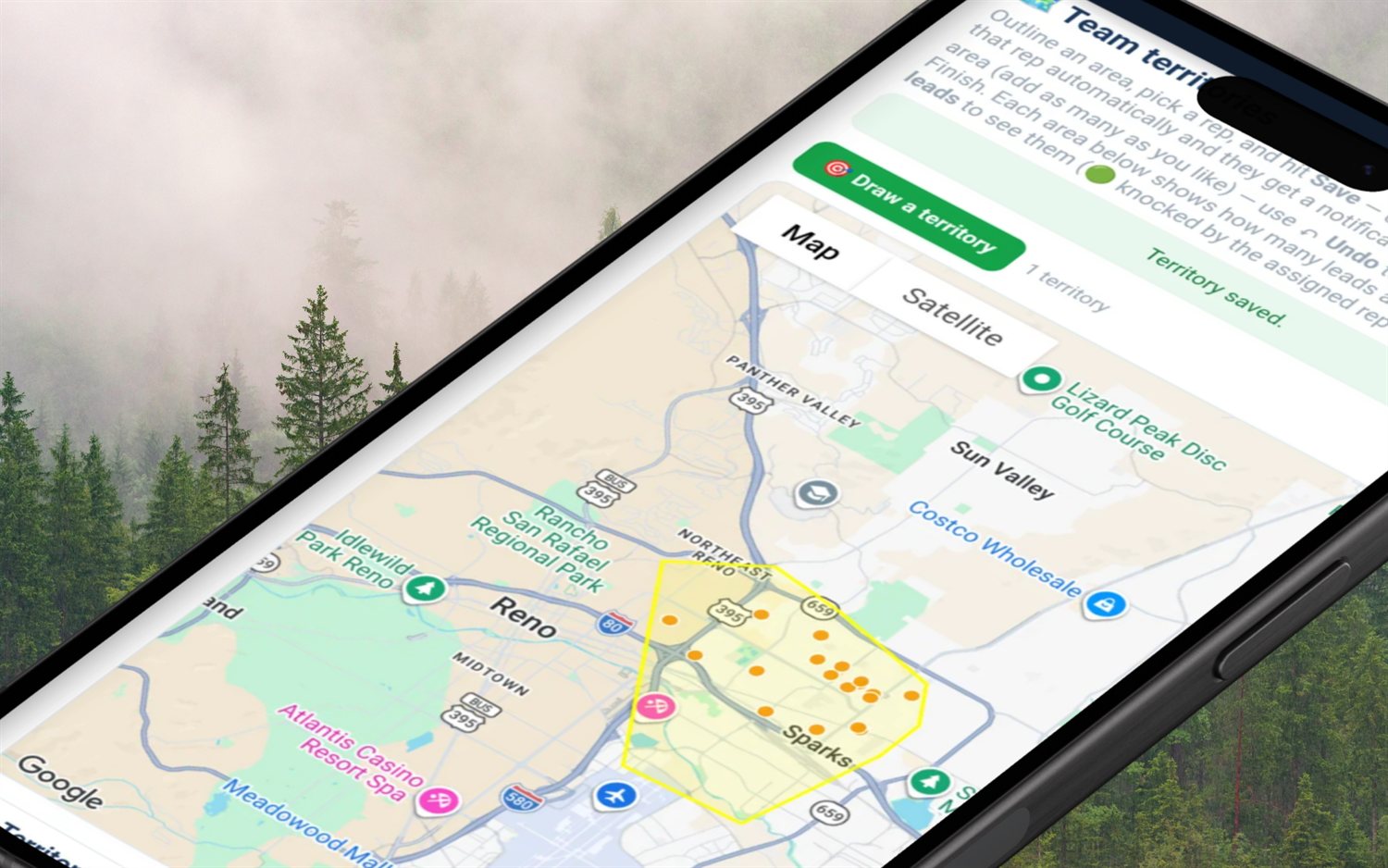
  • Draw territories around the routes you already service, and assign them
  • Pull just-sold homes onto the map — no incumbent, neglected lawn, service-shopping owner
  • Custom dispositions for competitor-held, DIY, rental, quoted and no-soliciting
  • Callbacks that come due in the month you promised, so the go-back actually happens
  • GPS-verified team knocks so a spring crew never double-knocks a block
  • Commission, chargebacks, mileage and the 1099 set-aside in the same app — and it all works offline

FieldStacker for lawn care →   See the knock map →

FieldStacker territory drawn tightly around an existing lawn care service route and assigned to a canvasser

Keep reading

The rest of the lawn care and landscaping series, plus the general D2D fundamentals.

🗣️

The scripts

Openers built on what you see, and every objection with the words back. Read them →

💰

Commission structures

Bounty, percent of contract, percent of GP, chargebacks, renewal bonuses. Read it →

📊

What reps make

Honest ranges, the math, and the 1099 reality. See the numbers →

Field questions, answered straight

Is door-to-door still effective for selling lawn care?

It is arguably more effective here than in any other residential trade, for one structural reason: the qualifying evidence is visible from a public sidewalk. You can see the crabgrass, the thin shade patch, the fresh sod on a new build and the competitor's service flag before anyone opens a door — no data purchase, no storm map, no utility bill required. Add the fact that your crew is often physically working two doors away, and canvassing gives you proximity proof no phone call or paid ad can match. The trade's largest branded operations still knock, which tells you what the economics look like.

What is the best time of year to canvass lawn care?

Two windows carry most of the year. The first and biggest is late winter through spring green-up, because the pre-emergent application has to go down before crabgrass germinates — after that the first application is late and you spend the summer defending a result you cannot deliver. The second is autumn: aeration and overseeding give cool-season lawns their one good seeding chance, cleanups and winterizer sell alongside it, and early sign-ups for next season close well. Summer is steady rather than strong for new programs but excellent for damage-driven doors and mosquito. Warm-season markets shift the whole calendar later and swap the problem list.

Do I need a permit or a license to sell lawn care door to door?

Frequently, and it varies by jurisdiction, so check before you knock rather than after. Many municipalities require a solicitation or peddler permit, some maintain a do-not-knock registry you are obligated to honor, and hours of permitted canvassing are often restricted by ordinance. Separately, pesticide application is regulated at the state level: applicators must be licensed or certified, some states require a registration or license for people who sell or recommend treatments, some require pre-notification to registered neighbors, and posting requirements apply after application. None of this is legal advice — verify with your state's department of agriculture and the city clerk in each municipality you work.

How many doors do you have to knock to sell a lawn care program?

Work the arithmetic rather than a rule of thumb. Roughly a quarter to a third of doors produce a live conversation depending on the hour and the day, and a modest single-digit to low-double-digit share of those conversations close in season. Combine them and a typical rep needs somewhere in the range of thirty to a hundred-plus doors per sale, which swings enormously with the season window, the neighborhood and whether you diagnosed something real in the yard before you knocked. The useful move is to measure your own three numbers — doors per day, contact rate, close rate — because whichever one is weakest tells you what to fix.

What neighborhoods are best for lawn care canvassing?

Rank on four things: density, evidence, ownership and lot size. Density means blocks you already service, because the truck is proof and the route absorbs the account without a new trip. Evidence means visible turf problems and visible competitor flags — flags are not a warning, they are proof the neighborhood buys this service. Ownership means owner-occupied rather than heavily rented, since renters cannot buy. Lot size matters because programs priced by square footage pay more on larger turf. Neighborhoods roughly ten to thirty years old are often the sweet spot: mature enough to have shade, thatch and weed pressure, new enough that owners still care about the front yard.

How do I stop my sales from cancelling after the first application?

Stop overselling at the door — it is the single highest-leverage thing a lawn care canvasser can do for their own income, because early cancellation is what claws the commission back. Say plainly what the first application will and will not do: a pre-emergent prevents germination, it does not remove weeds that are already up; a thin lawn does not thicken in one visit; seeding needs the right window; a dense, weed-free lawn is a season of work, not a treatment. Confirm the price, the schedule and how to cancel before you leave. A customer whose expectations were set correctly stays; a customer who was sold a miracle cancels in six weeks and takes your commission with them.

Draw your first territory before green-up

Put the blocks you already service on a map, load the just-sold homes inside them, and knock the window while it is open. 14-day free trial, no credit card, cancel when the season ends.