Percent of contract or percent of gross profit. Setter fees and overage splits. What triggers the check, what gets reversed, and why a signed painting contract on Saturday isn't a sale until Wednesday.
Flat month-to-month from $30/mo · 14-day free trial · no seat minimums, no annual contract
An alarm rep sells a monitoring agreement and creates recurring monthly revenue, so the comp plan can pay against a multiple of that RMR. A pest rep sells a recurring service and gets renewals. A painting rep sells a one-time job with a real cost of goods attached to it — gallons, sundries, masking, lift rental, and a crew's hours — and then that cost of goods moves after the sale, because nobody knows how much bare wood is under a coating until somebody scrapes it.
That single fact shapes every painting comp plan you will ever be handed. It is why gross-profit plans exist. It is why the pay trigger is usually completion or collection rather than signature. It is why discounts you give at the table get treated as if you took the money out of your own check — because on a gross-profit plan you literally did. And it is why the honest reps in this trade get obsessive about spec'ing prep correctly, since underselling the prep is the fastest way to work three weeks and get paid for two.
Typical ranges only. Every one of these varies by company, market, ticket size and who produces the lead.
| Structure | Typical range | Who it favors | What to watch |
|---|---|---|---|
| Percent of contract price | Roughly 6–12% commission-only; often 3–6% if you get a base and company-set appointments | Reps who self-generate, sell big tickets and can hold price | Whether the percentage applies before or after any discount you granted, and whether it applies to the collected amount or the signed amount |
| Percent of gross profit | Roughly 20–40% of the profit left after materials and labor | Reps who scope prep accurately and protect margin | How "gross profit" is defined. Overhead allocations, lift rental, drive time and warranty reserve can all quietly land on your side of the line |
| Base + commission (estimator role) | A modest salary plus a reduced percentage — commonly a few points of contract or a smaller GP share | Reps who want a floor during the off-season and take company leads | Whether the base is a draw against commission. A recoverable draw is a loan, not a salary |
| Setter / canvasser pay | Hourly, or roughly $25–$75 per qualified appointment sat, or low single-digit % of jobs sold from your sets | New reps building the muscle before they close | The definition of "qualified" and "sat," and who gets credit when two canvassers touched the same door |
| Price floor + overage split | Bonus layered on top — commonly a 25–50% share of anything sold above the company's floor price | Strong closers at companies that build the estimate for you | Whether selling below the floor cuts your base commission, and by how much. Some plans cut it aggressively |
One more structure worth naming because it is everywhere in this trade: the summer student programs. Outfits that run college reps through a painting season generally do not pay commission at all — the student runs a territory as a small business and keeps a share of the profit after paint, labor and overhead. It is a legitimate way to learn a P&L fast, and it is not comparable to a commission job. Do not read a commission range off this page and expect it to describe that model.
The gap between "I sold $42,000 this month" and "I was paid on $42,000 this month" is where painting reps get blindsided. Three cadences cover most companies:
Whatever the cadence, the three-day cancellation window sits in front of all of it. Door-to-door sales are generally covered by a federal cooling-off rule and by state analogues, so a contract signed on the porch Saturday afternoon is not real money until midweek. Good companies say this out loud in the comp plan. Good reps say it out loud to the homeowner, because volunteering it makes signing feel safer.
Two things follow from that list. First, prep is not the crew's problem, it is your commission. Second, you need your own ledger. If the only record of what you sold, what got repriced and what got reversed lives in the office's system, you are auditing your own pay from memory.
That last one is not a technicality. Being 1099 means no withholding, self-employment tax on your net, and quarterly estimated payments — which is a whole subject of its own. We wrote it up in 1099 taxes for door-to-door sales reps, and the income side is on how much painting sales reps make. None of this is tax or legal advice — take your actual comp plan to a CPA.
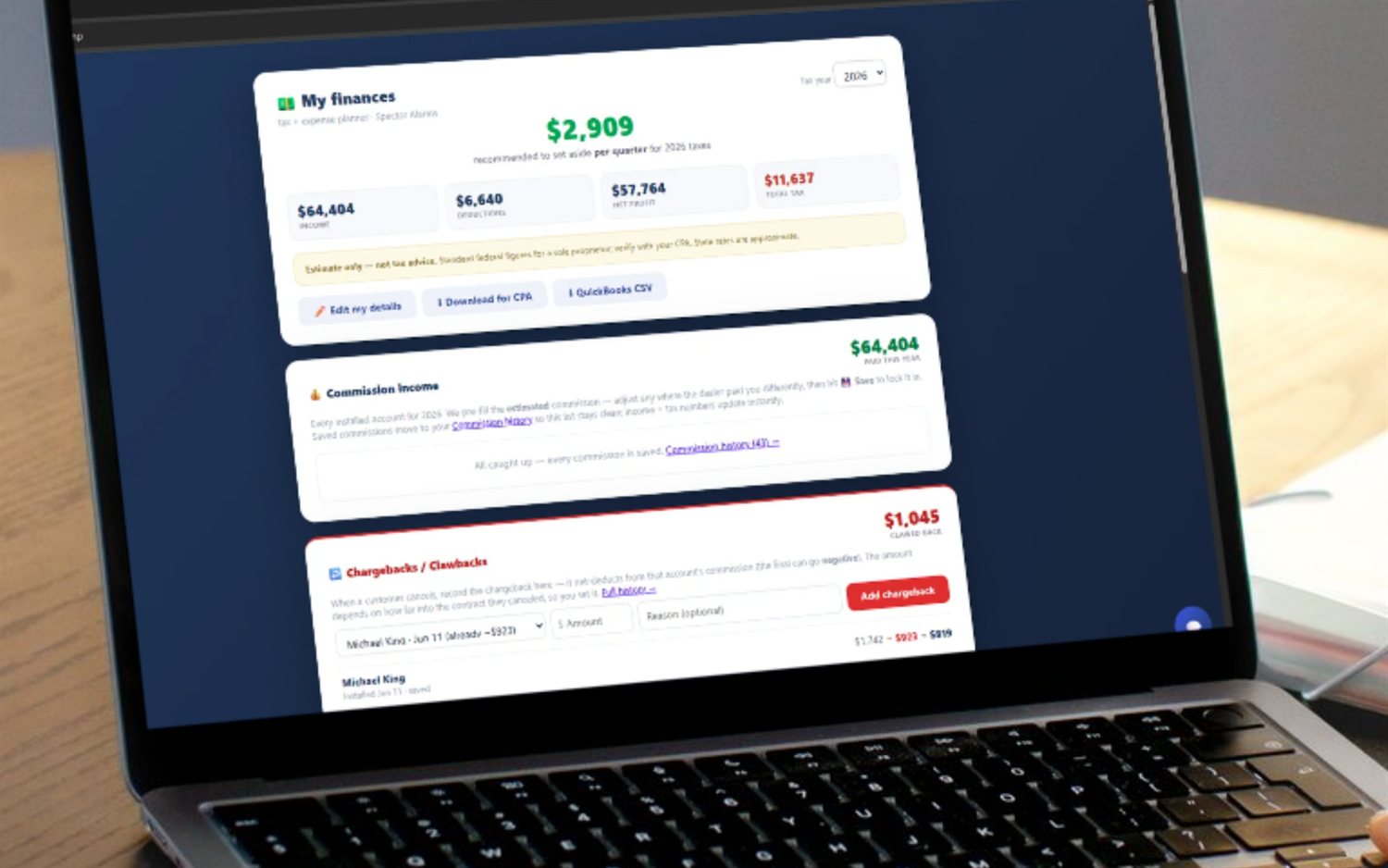
FieldStacker tracks the rep's money, not the company's. Log each painting job with your own split, then watch the messy parts net out instead of guessing at the end of the month:
Pricing the repaint stays in your estimating tool. This tells you what you were actually paid for it.
Three levers that move a painting rep's check faster than a percentage negotiation.
Trim, fascia, soffit, shutters, the front door, the deck, the fence, the garage floor. Change orders and added scope are usually commissionable — and they are already standing in front of you.
Canvass the radius around your active job site. Higher close rate on the same number of doors is worth more than two points of commission. See the knock map.
Discounts come straight off your base. Learn the branches instead — the painting scripts cover the price objections that reps usually pay their way out of.
No RMR means the counter resets every spring. Work the pre-season and the shoulder — the field guide lays out the calendar, and a second vertical from all industries covers the winter.
The two structures you will actually be offered are a percentage of the contract price or a share of the job's gross profit. Percentage-of-contract plans commonly land somewhere around 6 to 12 percent for a commission-only rep who generates some of their own work, and lower — often 3 to 6 percent — when the company hands you booked appointments and pays a base on top. Gross-profit plans typically pay a rep something in the range of 20 to 40 percent of the profit left after materials and labor. These are typical ranges, not rules, and they move with market, ticket size and who is producing the leads. Read the actual plan before you argue about the number.
Both exist and they reward completely different behavior. Paid on contract price, your incentive is volume and ticket size, and the company carries the risk when a job runs long. Paid on gross profit, you effectively become a partner in how the job was estimated — sell it too cheap or spec too little prep and your own check shrinks when the crew burns extra hours. Gross-profit plans usually pay a higher headline percentage precisely because the number they apply it to is much smaller. Neither is a scam; just know which one you are on, because it should change how you scope prep.
Almost never at signature. The most common arrangements are a split — part when the deposit clears and the three-day cancellation window has passed, the balance at completion — or a single payment on final collection. Collection-based plans are the norm at companies that have been burned by unpaid final balances, and they are the reason a rep's "sold" number and "paid" number can be thousands apart in the same month. Ask for the pay cadence in writing: what triggers the first payment, what triggers the rest, and how long after the trigger the check runs.
More than new reps expect. Door-to-door sales generally carry a three-day right to cancel, so a Saturday signature is not a sale until Wednesday. Beyond that: a customer who cancels before the start date, a job repriced when the crew opens up rot the measure missed, scope the homeowner drops at the last minute, a discount you granted at the table coming off the commissionable base, a final balance that never gets collected, and at some companies a share of the cost of a warranty callback traced to a bad spec. Change orders usually cut the other way and pay you more.
Essentially no, and that is the honest structural difference between this trade and alarms or pest control. There is no monitoring RMR and no recurring service agreement carrying you through the winter — a few companies sell maintenance or touch-up plans, but they are small money. A painting rep eats what they kill and the counter resets every season. That is exactly why the reps who last treat their old customer list as an asset: an exterior repaint typically comes due again in five to ten years, so the houses you sold six seasons ago are this spring's warmest doors.
Separately from the closer, and usually one of three ways: an hourly rate, a flat fee per qualified appointment that actually gets sat — commonly somewhere in the $25 to $75 range depending on market and lead quality — or a small slice of the contract, often in the low single digits, on jobs that close from their sets. Plenty of crews run hourly plus a per-set bonus so the canvasser is not starving on a rainy week. The fights are always about attribution, which is why GPS-verified knocks and a dispositioned map matter as much to the setter as to the manager.
Track every painting job, every chargeback and every mile in one place. 14-day free trial, no credit card, flat month-to-month.