Pay · exterior painting

How much do exterior painting sales reps actually make?

Ranges, not a headline number. The ticket-times-close-rate math underneath the spread, why two equally good reps finish a season $50,000 apart, and what a 1099 gross number really nets after self-employment tax.

Flat month-to-month from $30/mo · 14-day free trial · no seat minimums, no annual contract

The short version: typical full-season ranges run roughly $30k–$60k for a first-year closing rep, $60k–$100k for an experienced rep or estimator, and higher for genuine top producers at high-ticket companies. Canvassers and setters sit below that. The spread is driven by lead flow, ticket size, close rate and how many months your climate lets you sell — not mostly by talent. Every figure on this page is a typical range that varies by market and company. Nobody can quote your income from a web page.

Start with the math, not the salary survey

Painting rep income is three numbers multiplied together, and if you know yours you can predict your season better than any job posting can:

average ticket  ×  commission rate  ×  jobs closed per month  ×  selling months

A standard single-family exterior repaint commonly lands somewhere from the low four figures up to about $10,000, depending on square footage, stories, substrate and how much prep it needs. Cedar, stucco with heavy patching, historic homes, three-story elevations and houses with real rot run well past that. Apply a typical percentage-of-contract rate around 8 to 10 percent and a normal job pays somewhere around $300 to $1,000 in commission, with the big ones paying multiples of that.

Now the volume. A rep running a full week in season might sit somewhere between eight and fifteen measures and close a quarter to about 40 percent of them, which is roughly three to five jobs a week. That is a plausible $1,200 to $3,500 gross in a good in-season week. The mistake new reps make is annualizing that number by twelve. Multiply it by your actual selling months instead — and in most of the country that is not twelve.

Typical ranges by role

What each seat typically earns in a full season

Typical U.S. ranges that vary widely by market, company, comp structure and climate. Not a guarantee, not an offer, not a survey.

RoleTypical full-season rangeHow they're usually paidWhat moves them up
Canvasser / setter Roughly $25k–$45k full-time in season; a summer-only run is often far less Hourly, or per qualified appointment sat, or hourly plus a per-set bonus Set quality. A canvasser whose appointments actually close gets fed the best territory and gets promoted to closing
First-year closing rep Roughly $30k–$60k Commission-only, or a small base plus a reduced percentage Filling a pipeline before the season peaks, and surviving the first eight weeks of cancels while the go-back list builds
Experienced rep / estimator Roughly $60k–$100k Percent of contract or a share of gross profit, sometimes with a base Average ticket and attach rate — trim, fascia, decks, fences, garage floors — plus a past-customer list coming due
Top producer / selling manager $120k+ happens, but it is a small group and it is not the median Higher percentage, overage splits on the price floor, sometimes an override on a crew High-ticket market, strong self-generated lead flow, a long selling season, and low cancellation and collection losses

A note on the summer student painting programs, since they show up in every search for this topic: those reps generally are not on commission at all — they run a territory as a small business and keep a share of the profit. Some clear real money in a summer, plenty clear very little, and the outcome depends on whether they could recruit and hold a crew. Do not read the ranges above as describing that model.

The six things that actually create the spread

  1. Where the leads come from. The single biggest factor, and it is mostly not about you. A rep handed six company-set measures a week will out-earn a better closer knocking cold — until the cold knocker owns a territory and a repaint list, at which point it flips.
  2. Average ticket. Selling two-story cedar and stucco in an established neighborhood is a different job from selling small vinyl-and-brick ranches. Same effort, double the check.
  3. Close rate. Painting bids do not usually die on price, they drift on color and comparison shopping. Reps who deliver a number on site and set a decision date close far more of what they measure than reps who email a PDF two days later.
  4. Selling months. Exterior coatings generally want surface temperatures above about 50°F and a dry wall, which puts the northern season somewhere in the seven-to-nine-month range. A Phoenix or Florida rep sells nearly year-round and dodges heat and rain instead of frost. That difference alone can be tens of thousands of dollars.
  5. Comp structure. Percent of contract versus percent of gross profit changes both your ceiling and your risk. See the full breakdown on painting sales commission.
  6. What survives. The three-day cancellation window, pre-start cancels, repriced jobs and uncollected final balances all sit between "sold" and "paid." A rep with a 15 percent fallout rate earns 15 percent less than their sold board says.

The seasonality trap

This is where painting income differs most from alarms, pest control or fiber. Painting income is earned fresh every season: a repaint carries no RMR, no renewals and no residual to carry you through February, so the counter goes back to zero every spring. Reps who last in this trade do three things about it: they book the spring calendar during the late-winter pre-season window, they build a second offer for the shoulder months (interior work, cabinets, staining), and they treat the old customer list as an appreciating asset, because an exterior repaint typically comes due again in five to ten years.

That last one is the most underrated income lever in painting sales. If you sold forty houses six seasons ago and you still have the addresses, you are sitting on forty warm doors with a reason to knock that no cold canvasser can match. Most reps lose that list when they change companies or phones. Do not.

What a $80,000 gross year feels like as a 1099 rep

Gross is not take-home, and in this trade the difference is bigger than most new reps expect. Rough shape of it, illustratively:

  • Nothing is withheld. Every dollar arrives whole and every dollar of tax is your job.
  • Self-employment tax runs 15.3 percent on net earnings — Social Security and Medicare, both halves, because you are both.
  • Federal income tax sits on top of that, plus state income tax in most states.
  • Legitimate business deductions come off first: business mileage at the IRS standard rate is usually the biggest one for a rep driving to six measures a day, plus phone, software, sample boards, marketing and a home office if you qualify.
  • Common guidance is to set aside roughly 25 to 30 percent of net as you go, and to pay quarterly estimates in April, June, September and the following January rather than facing one bill.
  • No employer health plan, no paid time off, and no unemployment to cover the off-season — a seasonal 1099 rep is running a business with a four-month gap in it.

Which is exactly why the mileage log matters. A rep who drives to measures all season and never tracks it is handing back one of the largest deductions available to them. The full write-up is in 1099 taxes for door-to-door sales reps. As always: general information, not tax advice — a CPA who knows contractors is worth what they cost.

Know your real number

Track the season like a business, not a vibe

Most painting reps find out what they made when the season ends. FieldStacker keeps the rep's side of the ledger while it happens — the part canvassing platforms leave to a spreadsheet:

  • Per-job commission on your own percentage or gross-profit split
  • Chargebacks netted out when a job cancels, gets repriced or never collects
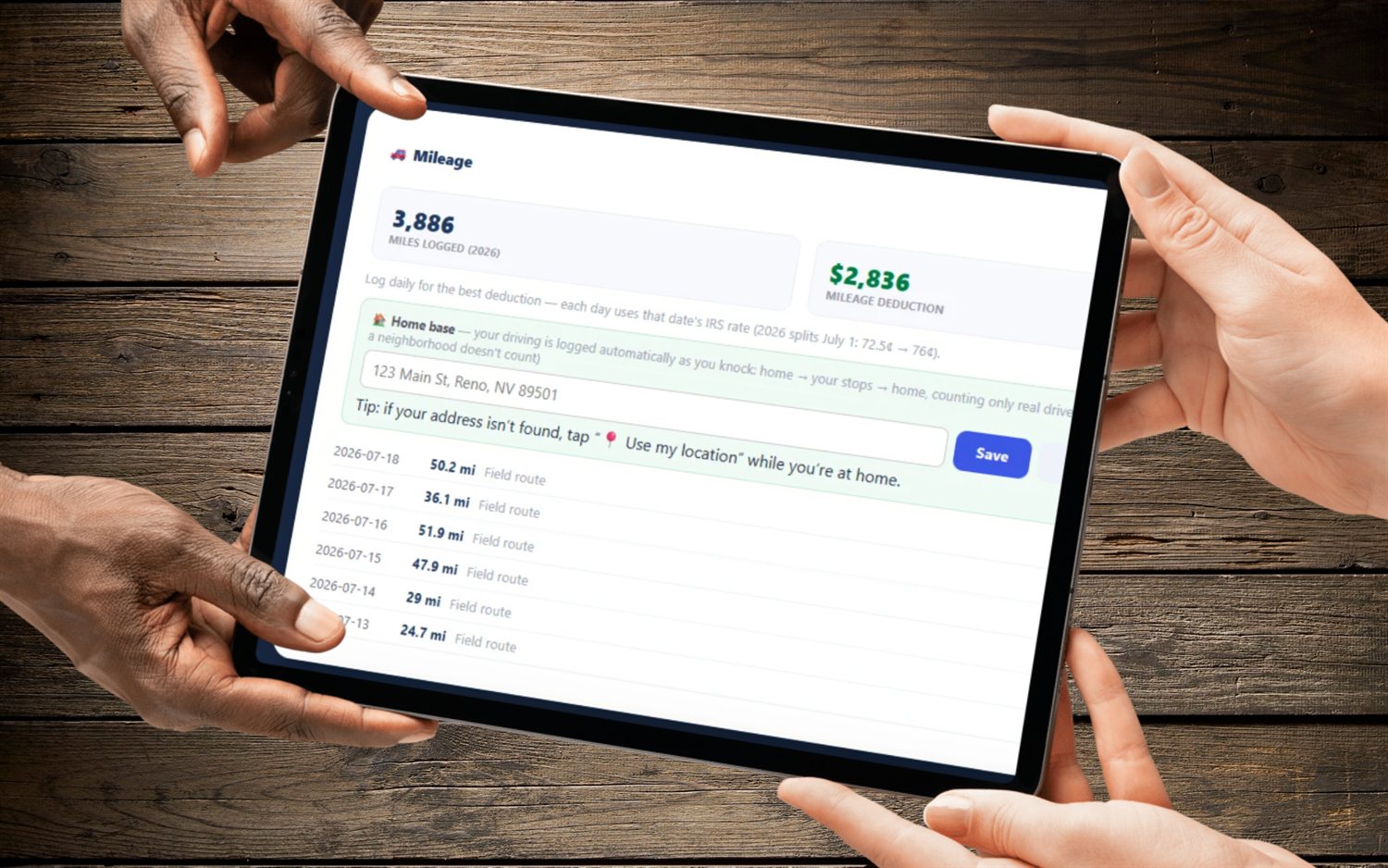
  • Automatic mileage at the IRS standard rate for every measure run
  • A quarterly 1099 tax set-aside that builds while the season is good
  • Knock, measure and close stats so you know your real dollars per door
The painting D2D CRM →   The knock map →

FieldStacker automatic mileage capture at the IRS standard rate — the largest deduction for a painting rep driving to measures all season

Raise your number, not just your hours

Three levers that move a painting rep's season more than working later.

🎯

Knock where you have proof

Canvass the radius around your active job site. Same doors, far better close rate — and close rate multiplies through every other number on this page.

🗣️

Stop losing bids to the color stall

Most lost painting deals were never a price problem. The painting scripts cover the stalls that quietly eat a season.

📐

Work the whole season

Pre-season booking, in-season radius canvassing, off-season list building. The field guide lays out the calendar.

Painting rep pay questions

How much do exterior painting sales reps make?

The honest answer is a wide band, because pay in this trade is a product of ticket size, close rate, season length and comp structure rather than a salary band. Typically, a first-year closing rep who works a full season lands somewhere in the $30,000 to $60,000 range; an experienced rep or estimator with two to five seasons and steady lead flow commonly runs $60,000 to $100,000; and top producers at high-ticket companies in strong markets can clear well past that, though that group is smaller than recruiting ads imply. Canvassers and setters who do not close sit below all of it. These are typical ranges that vary a lot by market — treat any single number you see as marketing until you have seen the comp plan.

Is exterior painting sales good money for a first-year rep?

It can be, with two caveats that recruiters skip. The first is seasonality: outside the Sun Belt you are realistically selling exteriors seven to nine months a year, so an impressive weekly number in July has to carry January. The second is that most first-year income is decided by lead flow, not by talent — a rep handed company-set measures will out-earn a better closer knocking cold, at least until the cold knocker builds a territory and a past-customer list. If you are commission-only, budget for a slow first eight weeks while your pipeline fills and the three-day cancellation window eats a few of your early wins.

What does a typical exterior painting job pay a rep in commission?

Work it from the ticket. A standard single-family exterior repaint commonly lands somewhere in the low-to-mid four figures through about $10,000 depending on size, stories, substrate and how much prep it needs, with cedar, historic, three-story and heavy-rot houses running well above that. On a percentage-of-contract plan around 8 to 10 percent, that is roughly $300 to $1,000 of commission on a typical job, and materially more on a big one. On a gross-profit plan the headline percentage is higher but it applies to a much smaller number, so the per-job result often lands in a similar place.

Why is the income range for painting reps so wide?

Six things drive almost the entire spread: where the leads come from, your close rate, your average ticket, how many selling months your climate gives you, whether you are paid on contract price or gross profit, and how much of what you sell survives cancellation and collection. A rep with company-provided appointments in a market where the average repaint is $9,000 is playing a different game than a rep cold-knocking a neighborhood of small ranch houses. Two reps with identical skill can finish a season $50,000 apart on lead flow alone.

Do painting sales reps get a base salary?

Some do. Estimator roles at established residential companies frequently pay a modest base plus a reduced commission percentage, which trades upside for a floor during the shoulder season. Canvassing and setting roles are often hourly or hourly plus a per-appointment bonus. Pure commission-only is common at storm-adjacent and high-volume shops and among reps who self-generate. Ask one specific question if a base is offered: is it a salary or a recoverable draw? A recoverable draw is a loan against future commission, and in a seasonal trade that debt can follow you into the winter.

What is the 1099 tax reality for a painting sales rep?

If you are paid as a 1099 contractor, nothing is withheld. You owe self-employment tax — 15.3 percent covering Social Security and Medicare — on your net earnings, plus federal and any state income tax on top, and the IRS expects estimated payments four times a year rather than one bill in April. Most reps in this trade are advised to set aside somewhere around 25 to 30 percent of net as they go, which is brutal in a seasonal job where the money arrives in a lump. The upside is real deductions: business mileage at the IRS standard rate, your phone, your software, sample boards and marketing. This is general information, not tax advice — get a CPA.

Stop guessing what the season made you

Commission, chargebacks, mileage and a quarterly tax set-aside in one app. 14-day free trial, no credit card, flat month-to-month.