Wide ranges, a brutal first ninety days, and a headline number that is almost never the take-home. Here is the spread, what moves you across it, and the tax math nobody covers in the interview.
Flat month-to-month from $30/mo · 14-day free trial · no seat minimums, no annual contract
Three genuinely different jobs share this title. The first is a cable vendor rep, hired through a firm that staffs a multiple-system operator’s door channel, usually W-2, usually with an hourly or salary base plus per-unit commission. The second is a satellite retailer rep, typically a 1099 contractor on a higher per-unit rate with no floor under a bad week. The third is a dealer or team owner, who earns on the production of a crew and, at many retailers, on an ongoing monthly residual from the accounts placed — which is a different business entirely, not a promotion.
Quoting one income number across those three is how recruiters produce misleading averages. So does one more thing: the washouts. Turnover in door-to-door TV sales is high, and a large share of new hires leave inside ninety days having earned very little. Any average that includes them is dragged down; any average that quietly excludes them is inflated. Both numbers get published.
These describe how pay in this trade is commonly discussed. Treat them as the shape of the distribution, not a forecast.
| Where you are | Commonly reported annualized | What is actually going on |
|---|---|---|
| First 90 days | Very little — often under $2,000/month | Learning curve plus the pay lag. Commission pays after install and lands a period or two later, so month one reflects almost nothing. |
| Survived year one | Roughly $35,000–$65,000 | Consistent hours, a functioning close, and the first taste of chargebacks eating a good month. |
| Steady full-time rep | Roughly $45,000–$80,000 | The realistic middle of this trade. Decent attach, decent territory, some seasonal swing. |
| Consistently strong | Roughly $90,000–$140,000 | High units per household, high install-completion rate, low cancel rate, and a working follow-up pipeline. |
| Top of the board | Beyond that, for a small number | Elite territory, heavy internet and mobile attach, and usually 50+ hours a week in season. Real, and rare. |
| Dealer / team owner | Highly variable | Override on a crew plus, at many retailers, monthly residual on placed accounts. Also carries the overhead and the chargeback liability. |
In rough order of impact. Note how little of this is about your pitch.
The biggest lever by far. Video-only at two units per five households is a different income from internet plus video plus a mobile line at nearly three per sale. Same doors, same close rate, double the check.
You are paid on completed installs, not sold ones. Overselling in the driveway, missed line-of-sight problems and appointments that no-show quietly delete income that already felt earned.
Sales that cancel inside the window come straight back out. A rep at a 5% cancel rate and a rep at 20% with identical production are not in the same income bracket.
A rural route with no cable competition or a mover-heavy suburb beats a saturated urban footprint that three companies have already canvassed twice this year. Territory is frequently worth more than skill.
Per-unit rates, ladder structure, spiffs, reserve holdbacks and window length differ enormously between dealers. Changing dealers can move income more than a year of improvement.
This income is lumpy. Football season and mover season carry the year; the late-winter stretch is thin. Reps who only work when it is easy earn like reps who only work when it is easy.
Here is the part that turns a good-sounding number into a real one. This is an illustration with round figures, not your situation and not tax advice — but the shape is what surprises first-year contractors.
Run that honestly and a $7,000 gross month is often closer to $4,000 of genuinely spendable income. That is not a scare story — it is the normal arithmetic of contracting, and it is exactly why the set-aside habit matters more than the pitch. A W-2 cable rep’s walk-down is gentler: withholding happens automatically, the employer covers half of Social Security and Medicare, and the commuting mileage generally is not deductible to them.
Full detail on the tax side is in the 1099 taxes guide for door-to-door reps. If you have never filed as a contractor, read it before your first quarterly deadline.
Nobody warns new reps that this pay is seasonal and lagged at the same time. Football season and summer mover season carry the year; the stretch after the holidays is thin in most markets. Layer a two-to-four-week payout lag and a 90-plus-day chargeback window on top, and the money hitting your account in any given week is a blurry echo of work you did a month or two ago. Reps who budget against a strong October and get surprised by February are not bad at sales — they are budgeting against a number that was never a monthly salary.
You cannot fix a chargeback pattern you never noticed, and you cannot deduct miles you never logged. Reps who keep their own ledger find things a dealer statement will never show them: which promo always cancels in month three, which install crew produces no-shows, which street never pays a second bill.
The rest of the satellite and cable TV playbook.
Units, ladders, spiffs, residual, reserves and every chargeback trigger. TV sales commission →
Stacking another trade on top is the most common way reps smooth the off-season. All industries →
The honest answer is a wide range with a long tail. Reps and dealers commonly describe something like this: a large share of new hires wash out inside 90 days having earned very little, a steady full-time rep who survives the first year often lands somewhere in the $45,000 to $80,000 range, consistently strong reps at a good dealer report roughly $90,000 to $140,000, and a small number of top performers with a great territory and heavy bundle attach go beyond that. Those are reported ranges that vary enormously by market, employer, product mix and hours worked — not a projection of what you will earn.
Less than the recruiter's number, almost always, and the first two months in particular are close to nothing regardless of talent. Commission is paid after the install completes and usually lands a pay period or two later, so your first check reflects a fraction of your first month, and anything sitting in the pipeline pays out after you have already covered rent from savings. Reps who make it through that lag and the learning curve frequently describe a first full year in the $35,000 to $65,000 range. The variance is brutal because it is driven by whether you were still knocking in month four.
They usually earn differently rather than more. Cable door channels are often staffed through vendor firms that pay a W-2 base plus per-unit commission, which raises the floor, lowers the ceiling and covers half your payroll taxes. Satellite retailers more often run straight 1099 with a higher per-unit rate, no floor and full self-employment tax on you. In dense serviceable footprints the cable rep usually gets more doors per hour; on rural routes the satellite rep faces less competition and drives far more miles. Compare take-home after taxes and mileage, not the headline rate.
Per unit, not per sale, and the distinction is most of the answer. Video, internet, voice and a bundled mobile line each count as their own revenue-generating unit, so one household can pay once or four times. Reps report per-unit figures roughly in the $40 to $150 band depending on product, dealer and market, frequently with a volume ladder and spiffs on top. A rep averaging two and a half units per household earns dramatically more than one selling video-only at the same close rate. Your dealer's rate card is the only authoritative number.
A common rule of thumb is 25 to 30 percent of net commission income, though the right figure depends on your bracket, your state and your deductions. As a 1099 contractor you owe the full 15.3 percent self-employment tax on net profit on top of income tax, because no employer is paying half of it for you. The offsetting good news in this trade is mileage: TV reps drive constantly, and the IRS standard mileage rate frequently produces the single largest deduction on the return — but only if you kept a contemporaneous log all year. This is a primer, not tax advice; talk to a CPA.
It is a real income for people who are good at it, and it is a shrinking video market being propped up by attach. Traditional pay-TV subscriptions have declined for years, which is exactly why nearly every rate card now rewards internet and mobile lines as heavily as video. The reps who are doing well today generally sell connectivity with television attached rather than television alone, work rural or mover-heavy territory where competition is thinner, and treat contract-expiry follow-up as their actual pipeline. Reps selling video-only into a saturated urban footprint are having a much harder time.
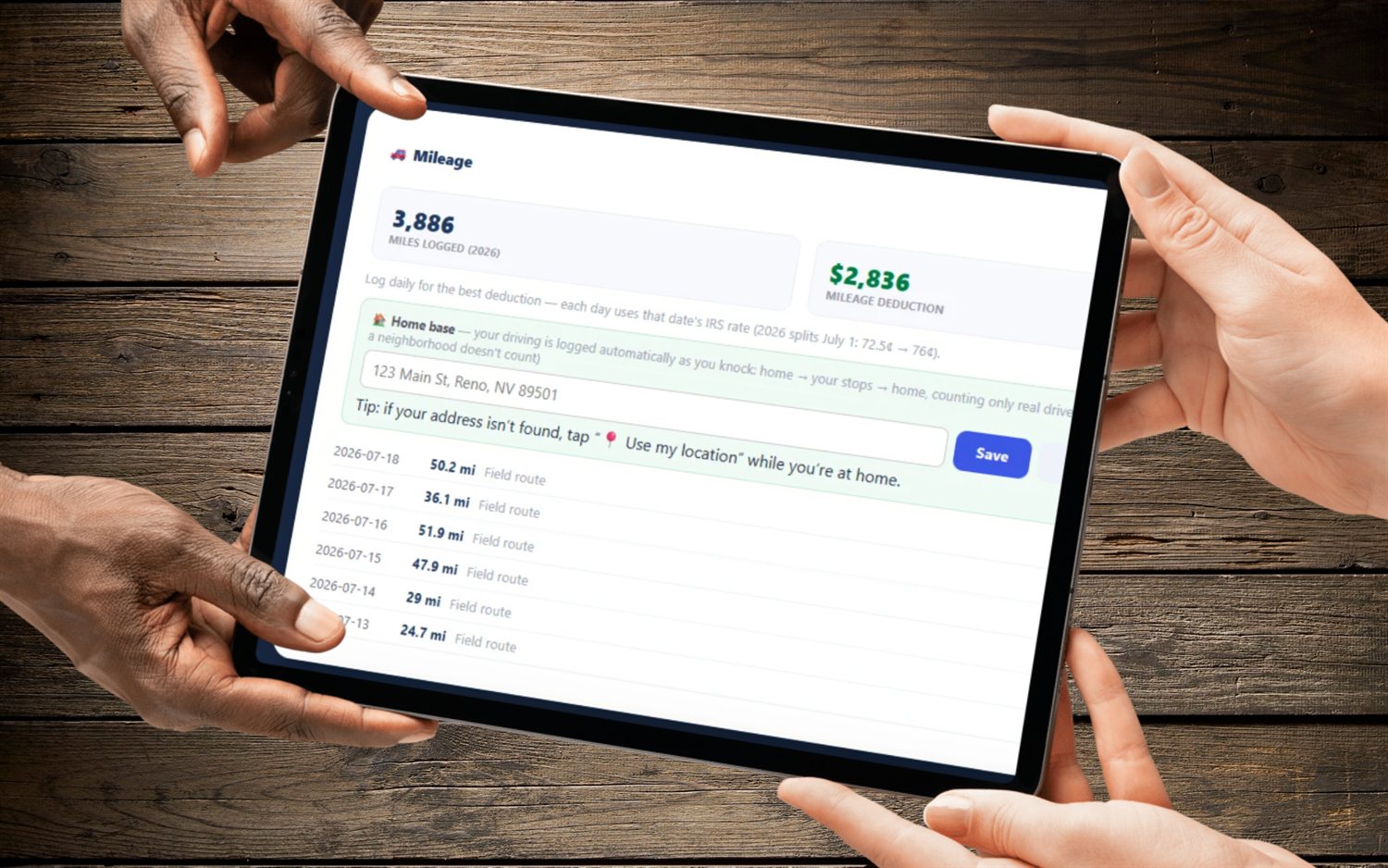
Commission, bundle spiffs, chargebacks, mileage and a quarterly tax set-aside — tracked next to the knocks that produced them. 14-day free trial, no credit card, flat month-to-month.