Rep money · lawn care & landscaping

Lawn care and landscaping sales commission, structure by structure

Bounty per account, percent of contract, percent of gross profit, renewal bonus — this trade uses all four, sometimes in the same comp plan. Here is what each one actually means for your check, when it pays, and what takes it back.

Flat month-to-month from $30/mo · 14-day free trial · no seat minimums, no annual contract

Figures on this page are ranges and shapes, not quotes. Lawn care pay varies enormously by market, company size, program value and whether you are selling company-generated or self-generated leads. Use this to know what questions to ask and what the structures are called — then get your plan in writing, including the chargeback terms, before you knock a single door.

One trade, three different pay worlds

Most confusion about lawn care commission comes from treating the industry as one thing. It is not. A rep selling six-step treatment programs, a rep filling a mowing route and a rep selling a $28,000 paver patio are in the same truck company and on completely different math.

Recurring treatment and maintenance is a subscription sale. The individual ticket is small, the volume is high, and the company's real interest is not the sale — it is whether the account is still there in year two. That is why nearly every comp plan in this lane has a retention hook in it, either as a chargeback for early cancellation or as a bonus for accounts that renew.

Seasonal add-ons — aeration and overseeding, mosquito and perimeter, grub prevention, leaf cleanup, holiday lighting, snow — are one-time or single-season sales with quick, clean payouts and short or nonexistent chargeback windows. They are the easiest money in the trade and the most commonly under-sold, because reps chase the big program and forget the customer standing in front of them will buy an aeration in ten seconds.

Design/build, hardscape and irrigation is project sales. Large tickets, long cycles, real estimating risk, and a comp structure that increasingly ties your pay to the margin the job actually produces rather than the number on the contract. This is where the difference between percent-of-revenue and percent-of-gross-profit stops being academic.

What each structure looks like

The pay structures by service line

Shapes you will actually be offered. Ranges are broad on purpose — the point is the structure, not a number to hold anyone to.

Service lineHow it is usually paidTypical shape (varies widely)When it paysWhat claws it back
Lawn treatment program
fertilization & weed control, 5–7 steps
Flat bounty per program sold, or a percentage of annual program value, or a multiple of the first application price Bounty models are commonly a two-figure amount per account scaling with program size; percentage models are commonly a modest single-digit-to-low-teens share of the annual value After the first application is performed, often also after first payment clears Cancellation before app 2 or 3, prepay refund, non-payment, customer never lets the tech on the property
Mowing / maintenance route Flat bounty per account, or a percentage of the first month, or the value of one to two cuts The smallest ticket in the trade per account — this line pays on volume and route density, not on any single sale After the first cut, sometimes after 30 days of service Account cancels inside the first weeks, seasonal customer who quits after two cuts, mis-quoted lot that the crew cannot service profitably
Mosquito & perimeter Bounty per season signed or a share of the season contract value Comparable to or slightly below a treatment program bounty; frequently sold as an attachment rather than standalone After the first service Early season cancellation, refund of an unused season balance
Aeration, overseeding & one-time upsells Small flat amount per job, or a percentage of the job price Modest per unit — the value is in attaching several per day to accounts you already have Fast: usually the pay period after the service is done and billed Little to nothing; short or no chargeback window because the work is completed and collected quickly
Holiday lighting Percentage of install revenue, sometimes with a separate rate on repeat/renewal installs Single digits to low double digits of the install price is a common shape; renewal-year rates are usually lower At install or at final payment; some plans split deposit and completion Cancellation before install, weather-related non-installs, unpaid balance after takedown
Snow & ice contracts Percentage of seasonal contract value, or a flat per-contract amount; per-push accounts often pay a smaller rate Highly market-dependent; seasonal contracts pay better and earlier than per-push, which pays only if it snows At contract signing or at first service, depending on the plan Contract cancelled before the season, a per-push account in a winter with no snow
Design/build & hardscape Percentage of contract price, or a percentage of the job's gross profit Contract-price plans commonly sit in the low single digits up to roughly ten percent, with the top of that reserved for self-generated leads; gross-profit plans use a much larger percentage against a much smaller base Often staged: part at signed deposit, part at start, balance at completion or final collection Cancelled contract, discounts you authorized, job that misses its estimated margin, callbacks, redos and warranty work that eat the GP
Irrigation install & service Percentage of install contract; service and backflow/winterization work often carries a small per-job amount Structured like a small design/build job; recurring seasonal service is a low-value, high-frequency attachment At completion or final payment Cancellation, scope reduction, warranty rework

Two patterns are worth noticing in that table. First, the fastest, cleanest money in this trade is the add-on: aeration, mosquito, a cleanup. Small per unit, but it collects quickly and almost never claws back. Second, every large-ticket line has a margin risk attached to your pay, either explicitly through a gross-profit plan or implicitly through the discount you gave to close it.

Percent of contract vs. percent of gross profit

This is the most consequential line in any landscaping comp plan, and the one reps most often skim. A percentage of the contract price pays you on revenue: sell a $30,000 patio at 5% and you earn $1,500 whether the job made money or lost it. A percentage of gross profit pays you on what is left after materials, labor and equipment: the percentage is much bigger, but so is the risk that a bad estimate or a discount you authorized shrinks it.

Companies that have been burned by reps discounting to close move to gross-profit plans, and it is not a trick — it is the only structure that makes the salesperson care about the estimate. But it changes what you must control:

  • Who owns the estimate? If someone else prices the job and you are paid on its margin, you are being paid on another person's accuracy.
  • What is in "cost"? Materials and direct labor, obviously. Equipment hours, fuel, dump fees, overhead allocation — those are negotiable definitions and they move your check.
  • Who eats the discount? On a revenue plan a discount trims your percentage slightly. On a margin plan a discount comes almost entirely out of the gross profit, which means it comes almost entirely out of you.
  • What happens on a callback? If warranty and rework hours post back against job cost, a job that closes fine in June can shrink your commission in September.

Chargebacks: what actually takes the money back

Recurring service means your commission is conditional for longer than you think. The specific triggers in this trade:

  • Early program cancellation. The classic. A treatment customer who cancels before the second or third application typically triggers a full or partial clawback — and the most common reason they cancel is that the rep promised a result the first application was never going to produce.
  • Prepay refunds. A season prepay generates commission up front and reverses it if the customer is refunded a balance.
  • Non-payment. Frequently not a deadbeat customer but a misunderstanding — auto-renew they did not expect, a price that went up after a promotional first application, an add-on they did not know was billable.
  • The account nobody can service. A locked gate, a dog in the yard every visit, a lot mis-measured at the door so the crew loses money every stop. On a maintenance route this gets cancelled by your own company, and it still charges back.
  • Margin misses on project work. On a gross-profit plan, the job that ran three extra days is a pay cut delivered a month late.
  • Moves and resales. A customer who sells the house mid-program cancels through no fault of yours and can still charge back, depending on your plan's language.

The uncomfortable through-line: most chargebacks in lawn care are made at the door, not in the office. Overpromising the first application, glossing over auto-renew, guessing a square footage low to hit a price — each one is a sale that pays today and reverses in ninety days. Selling honestly is not just ethics here; it is the highest-leverage thing you can do to protect your own income.

Renewal season: the closest thing to residual

True recurring commission is uncommon in lawn care, but the renewal mechanism is real and worth understanding. Because treatment programs and maintenance agreements roll into a new season, many companies pay a renewal bonus, a retention bonus based on the share of your accounts still active at season start, or a reduced second-year commission. That structure quietly rewards a completely different behavior than a bounty does: it pays you for selling the right customer the right program, not for selling anyone anything.

If you are choosing between two offers and one has a retention component, model it over two seasons rather than one. A slightly lower bounty with a renewal bonus frequently beats a higher bounty with a hard chargeback window, especially for a rep who sells honestly and works the same neighborhoods year after year.

Ask these before you take the job

  • Is this W-2 or 1099? If 1099, is there any mileage reimbursement, or is the deduction mine to track?
  • What exactly triggers a chargeback, and for how long after the sale?
  • Is commission paid on the sale, on the first service performed, or on cash collected?
  • Is there a draw? Is it recoverable against future commission, and what happens to a negative balance if I leave?
  • Am I paid on contract price or on gross profit — and if GP, what is in "cost"?
  • Can I discount, and does the discount come out of my commission?
  • Are leads company-generated or self-generated, and is the rate different for each?
  • Is there a renewal or retention bonus, and how is it calculated?
  • Are add-ons — aeration, mosquito, cleanups — commissionable, and at what rate?
  • Who owns the account if I leave, and do renewals continue to pay me?

Get the answers in writing. A verbal comp plan is not a comp plan, and in a seasonal trade with high turnover you may be explaining it to a manager who was not there when it was promised.

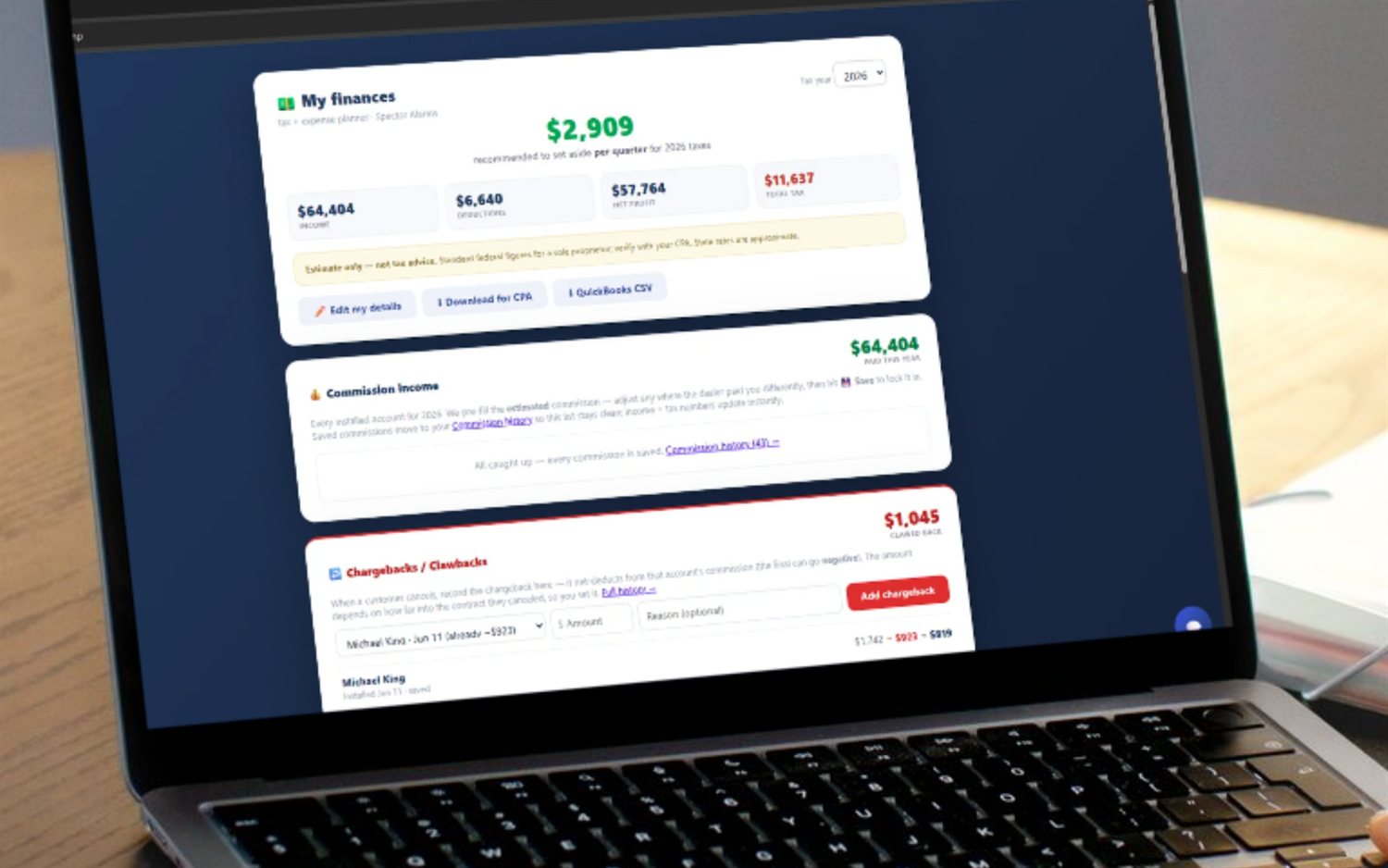
FieldStacker 1099 financials showing per-deal lawn care commission with chargebacks netted out and a quarterly tax set-aside
Track it, do not trust it

Know what you are owed before the statement arrives

Nearly every dispute in this trade is the same dispute: the rep's number and the company's number disagree, months after the sale, and only one side kept records. FieldStacker keeps yours.

  • Log every sale with your own rate — bounty, percent of contract, or percent of gross profit
  • Chargebacks and clawbacks net against your running total, so you always see the real figure
  • Automatic mileage at the IRS rate — the single biggest deduction most 1099 lawn reps have
  • A quarterly tax set-aside that sweeps a percentage off each deal before you spend it
  • Add-on sales tracked alongside programs, so the aeration money stops disappearing

FieldStacker for lawn care →   1099 taxes for reps →

Keep reading

The rest of the lawn care and landscaping series.

📊

What reps actually make

Honest ranges, the math behind them, and why the money is lumpy. See the numbers →

🗣️

The scripts

Openers and every real objection with the words back. Read them →

🚪

The field guide

Territory, season, permits, the close, the follow-up. How to sell it →

Commission questions, answered straight

How are lawn care and landscaping sales reps usually paid?

Four structures cover almost everything you will be offered. A flat bounty per account sold, most common on recurring treatment programs and mowing routes. A percentage of the annual or first-year value of the program. A percentage of the job's contract price, standard on design/build and hardscape. Or a percentage of the job's gross profit, which better-run landscape companies increasingly prefer because it stops reps from discounting their way to volume. Many plans blend them — a bounty on recurring work plus a percentage on projects — and seasonal add-ons like aeration, mosquito or holiday lighting usually carry their own smaller flat amount. The specific numbers vary enormously by market, company size and program value, so get your plan in writing before your first door.

What is a typical commission percentage on a landscaping job?

On design/build and hardscape work paid as a percentage of the contract price, plans commonly land somewhere in the low single digits to around ten percent, with the higher end reserved for reps who generate their own leads rather than working company-provided ones. On plans paid from gross profit instead, the percentage looks much larger — a share of GP rather than of revenue — because the base it applies to is far smaller. Neither number means anything on its own: a percentage of contract price with no margin floor and a percentage of gross profit on a well-estimated job can pay out similarly. Always ask which base the percentage applies to, and always ask whether discounts you give come out of your side.

Do lawn care reps get residual or recurring commission?

Rarely as true ongoing residual, and you should be skeptical of anyone who implies otherwise. Recurring service does produce something close: many companies pay a renewal-season bonus, a retention bonus tied to how many of your accounts are still active at the start of the next year, or a smaller second-year commission on programs you originally sold. That is genuinely valuable — it means the quality of the sale keeps paying — but it is not the monthly recurring revenue split an alarm or SaaS rep gets. Treat any promise of "residual income" in this trade as a claim to verify in the written comp plan.

What causes a chargeback in lawn care sales?

The most common trigger is early cancellation: a treatment program that stops before the second or third application, or a maintenance account that quits inside the first month or two. Prepay refunds claw back the commission that the prepay generated. Non-payment does the same, and in this trade a surprising share of it is not a deadbeat but a homeowner who never understood what they signed up for. On project work, a job that comes in under its estimated margin can reduce a gross-profit-based commission, and callbacks, redos and warranty work on hardscape can eat the margin the commission was calculated from. Every one of those traces back to how the sale was made, which is why overselling at the door is expensive twice.

When does lawn care sales commission actually pay out?

Almost never on the day you sign it. The most common triggers are after the first service is performed, after the first payment is collected, or both — which in a treatment program can be weeks after the sale if you sold ahead of the season. Project work is often paid at deposit, at start, and at completion in stages, or entirely on final payment. Many companies also hold a portion through the cancellation window, and 1099 canvassers frequently get a draw against future commission rather than a straight payout. The practical effect is that a great February and March can pay out mostly in April and May, which is exactly the gap that catches first-year reps.

Are lawn care sales reps W-2 employees or 1099 contractors?

Both exist and the difference matters more than the headline commission. Larger branded operations and franchise networks frequently hire outside sales as W-2 with a base plus commission, which means taxes are withheld, mileage may be reimbursed and there may be benefits. Independent canvassers, seasonal door crews and many subcontracted sales teams are 1099, which means no withholding, the full 15.3% self-employment tax on net profit, quarterly estimated payments, and mileage as a deduction you have to substantiate yourself. A 1099 offer at the same nominal rate is worth meaningfully less than the W-2 version unless the rate accounts for it.

Stop reconciling your pay from memory

Log every program, project and add-on with your real rate, watch chargebacks net out, and keep your miles and tax set-aside in the same app you knock with. 14-day free trial, no credit card.