Which streets, which weeks, what to look at before you knock, what to carry, how the demo closes, and the follow-up that keeps deals from dying in the three-day window. The whole trade, in order.
Flat month-to-month from $30/mo · 14-day free trial · no seat minimums, no annual contract
There is no opener good enough to save a treeless street. Before you knock anything, look at the neighborhood the way a leaf does. You want mature canopy — oak, maple, sweetgum, pine — hanging over or near the roofline. You want houses old enough to have tired gutters, which in most markets means built roughly fifteen to thirty years ago, on original aluminum with spike-and-ferrule or early hanger systems. And you want height: two stories, a steep pitch, a walkout back that drops another level, anything that makes the ladder conversation uncomfortable.
Conversely, the streets to skip: new construction with saplings, single-story ranches with a clean gable and no trees, dense HOA communities where exterior changes need approval, and anywhere the rentals outnumber the owner-occupied homes. You will still get a few sales there, but you will earn each one twice.
Two territory situations worth knowing. A block where one of the big national brands has just run a marketing push is warm, not burned — those homeowners have been educated and many of them balked at the price, which makes them a good audience for a different system. And the single best territory you will ever have is the two houses either side and three across the street from a job you are installing today.
Most of the year's money lives in about ten to fourteen weeks. The rest of the year is for building the list.
Nobody is thinking about leaves yet, so the sets are harder. That is fine: this is when you canvass wide, collect the "come back when the leaves start" doors, and set the callbacks for October. Start the season with a queue, not a cold map.
Once debris is visibly in the gutters and homeowners are eyeing their own ladder, everything converts better. This is when you work the heaviest canopy, run the longest evenings, and reheat every callback you banked in August.
In cold markets, ice damming, sagging spans and gutters pulled off the fascia by ice load are visible from the street and create genuine urgency. In warm markets this is your slow stretch — a good time for referrals and neighbor knocks around recent installs.
The second window. First heavy rains show every overflow point, winter damage is now obvious, and maple seeds, oak tassels and pollen refill everything you cleaned. Knock the day after a storm; ask where it sheeted over.
Never walk straight to the door. Take the driveway and the visible side of the house first and find one true, specific thing you can say out loud: the tiger striping down the gutter face, a sprout growing out of an end cap, a span pulling off the fascia, the trench the downspout has washed in the mulch, the stained siding under the worst run. That single observation is the difference between "a guy selling something" and "someone who looked at my house," and no call center or mailer can replicate it. The gutter script page has the openers and every objection branch in the words homeowners actually use.
And a safety note that is also a selling point: assume you are not getting on a ladder unless your company has told you in writing that you may. Ladder falls are the most common serious injury in this line of work — which is, of course, exactly the reason the product exists.
In most gutter operations the canvasser sets and a closer runs the in-home demo. So the porch has exactly two jobs: qualify and schedule. Qualify means homeowner, how long in the house, how they handle the gutters now, and — asked early rather than at the end — whether there is a spouse or partner who should be there. Schedule means two specific choices, not an open calendar: "Are evenings better, or Saturday mornings?"
Protect the closer's night. A one-legger appointment in a same-day-decision company is the most expensive kind of nothing: it burns an evening, it produces a "we will think about it," and it pays neither of you. Flag it, move it, set it properly.
The in-home appointment in this trade has a shape that has survived because it works. Measure the whole house so the number is real. Show them what is actually in their gutters — photos from the ladder, or a handful of the sludge itself, which is more persuasive than any statistic. Run the water-and-debris test on a sample section so they watch the water go through and the leaves shed off. Then price it per linear foot off the company price sheet, and present the monthly payment alongside the total, because leaf protection is a financed purchase far more often than it is a cash one.
Two pieces of honesty at the close pay for themselves. First, if there is a genuine same-day incentive, present it as what it is — a real reason to decide today — and do not invent one, because homeowners in this category have usually sat through a presentation before and can smell it. Second, explain the three-day right to cancel yourself rather than letting them find it in the paperwork later. It sounds like it invites cancels. In practice it lowers them, because the pressure they were bracing against never materialized.
Track these and you will know exactly which part of your game is broken instead of guessing: contact rate (doors answered per door knocked — fix this with timing), sets per shift, sit rate (sets that actually happen — fix this with both-owner qualifying and reconfirms), close rate on sat demos, and cancel rate. A rep with a great close rate and a terrible sit rate has a scheduling problem, not a selling problem, and no amount of extra knocking will fix it.
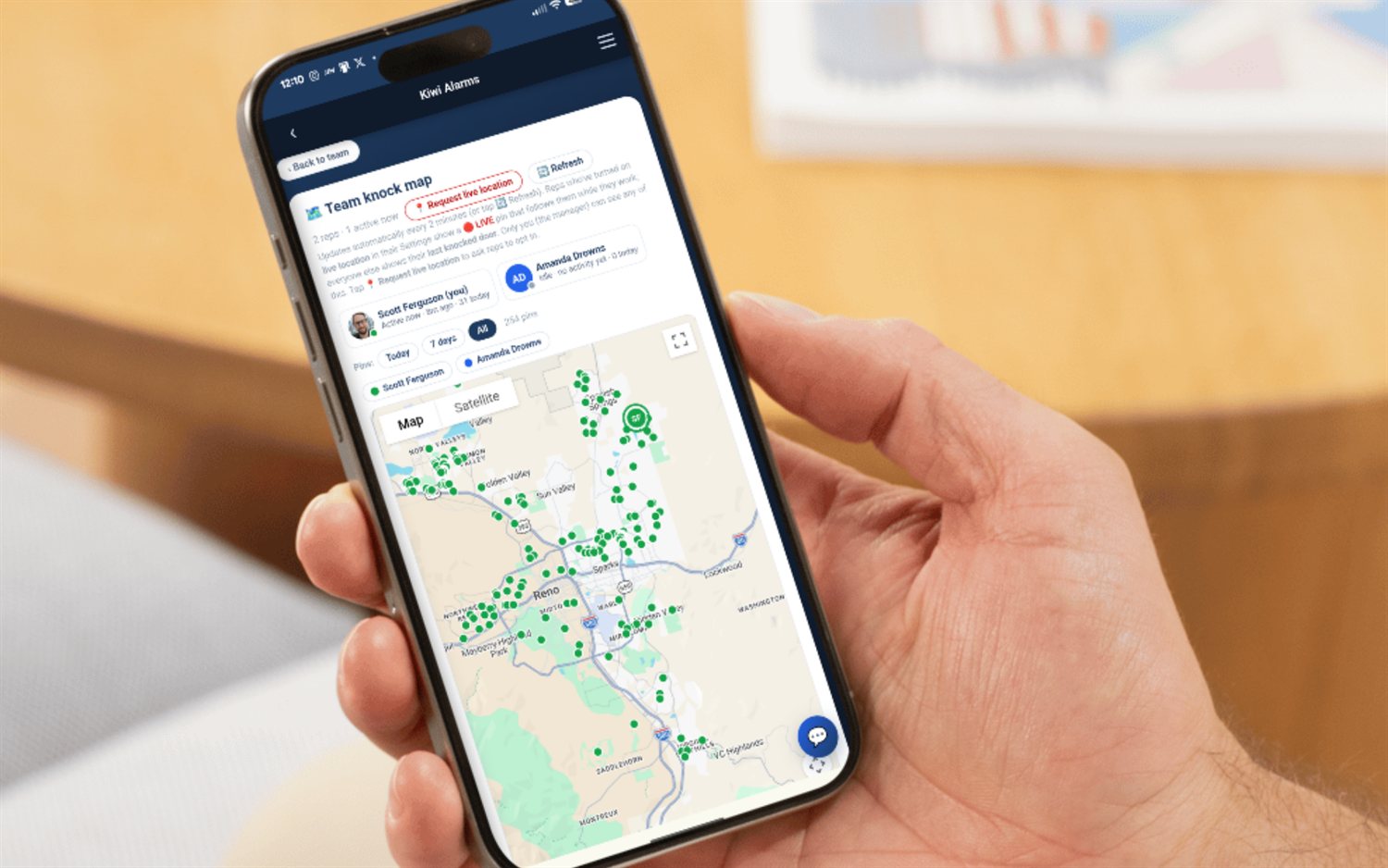
Everything on this page is an organizational problem before it is a sales problem. FieldStacker holds the whole season: draw territories around the canopy blocks and assign them, import last season's addresses from a CSV or another CRM and let them geocode themselves onto the map, build the route before you get out of the truck, disposition every door with your own custom stages, and let the "come back in October" callbacks come due on their own.
The rest of the gutter playbook.
Openers and every objection branch as homeowners really say them. D2D gutter scripts →
Per-set, percent of contract, overage, dealer fees and chargebacks. Gutter sales commission →
Roofing and siding crews add leaf protection to the same ticket. Roofing → All industries → Pricing →
Look for three things stacked on one street: mature tree canopy, houses old enough that the original gutters are tired, and elevation that makes a ladder unpleasant. Oak, maple, sweetgum and pine are the money species. Subdivisions built roughly fifteen to thirty years ago are the sweet spot because the trees have grown in and the aluminum has not been touched since it went up. Two-story homes and steep pitches sell far better than single-story ranches, because on a ranch the homeowner can genuinely handle it themselves. The blocks to skip are new builds with saplings and anything with a homeowners association that controls exterior work.
The autumn leaf drop is the season, and the window is short — roughly ten to fourteen weeks in most climates, peaking in the weeks when the debris is visibly in the gutters and the homeowner is looking at their own ladder. The second window is spring, after the winter has produced sagging spans and ice damage in northern markets and after maple seeds, oak tassels and pollen have filled everything back up. Late summer is the smartest time to build the list rather than to sell it: knock in August, collect the "come back when the leaves start" doors, and start October with a callback queue instead of a cold street.
Keep it light and make it visual. A short sample section of the guard system you sell so it is a real object rather than a brochure, a photo of a genuinely disgusting clogged gutter from a job you did nearby, your phone for pictures of the house you are standing at, door hangers or a digital business card with a QR code for the not-homes, and something to write on. What you do not need is a full brochure package — the canvasser's job is a look and an appointment, not a presentation. Save the demo materials for the closer.
Almost certainly not, and you should assume the answer is no until your company tells you otherwise in writing. Ladder work at an uninspected house is a liability and insurance question, not a sales question, and most gutter companies restrict it to trained installers or to the in-home appointment. Get your evidence from the ground instead: photograph the streaking, the sag, the sprout and the erosion under the downspout, or use a phone mounted on an extension pole if your company issues one. Falls are the most common serious injury in this trade, which is also, not coincidentally, the reason your product sells.
For a new canvasser it commonly takes somewhere on the order of sixty to a hundred-plus doors to produce one qualified set, and experienced reps working good blocks in season do considerably better than that. But raw door count is the wrong thing to optimize. The ratios that move income are contact rate — whether anyone is home, which is a function of what hours you knock — and set-to-sit rate, which is a function of whether you qualified for both decision makers. Doubling your knocks on a treeless street at two in the afternoon will not help; knocking the right street at six will.
Sell honestly and reconfirm. Federal rules give homeowners three business days to cancel most sales made at their home, and some states allow longer, so a rushed same-day close on a spouse who was not really convinced is a cancel with a delay on it. Three habits do most of the work: insist on both decision makers at the appointment, explain the cancellation right yourself instead of letting them discover it in the paperwork, and call before install day to reconfirm. Reps who reconfirm quietly out-earn reps who sell harder, because a cancelled job pays nothing and a chargeback pays less than nothing.
Route the block, disposition every door, and let October's callbacks come due on their own. Start a 14-day free trial — no credit card, month-to-month.